
August 2026 will be remembered as the month of two near-total eclipses. The partial solar eclipse on Wednesday 12 August was the deepest most UK observers are likely to see in their lifetimes, reaching 90% or more across much of the country. Unless you are prepared to travel in pursuit of eclipses, nothing comparable will be visible from the UK until 2081 and then 2090. The second event, on 28 August, was a lunar eclipse, with the Moon passing 97% into Earth’s umbral shadow. However, it occurred at the inconvenient hour of 5am, and cloud or fog prevented observations across our region.
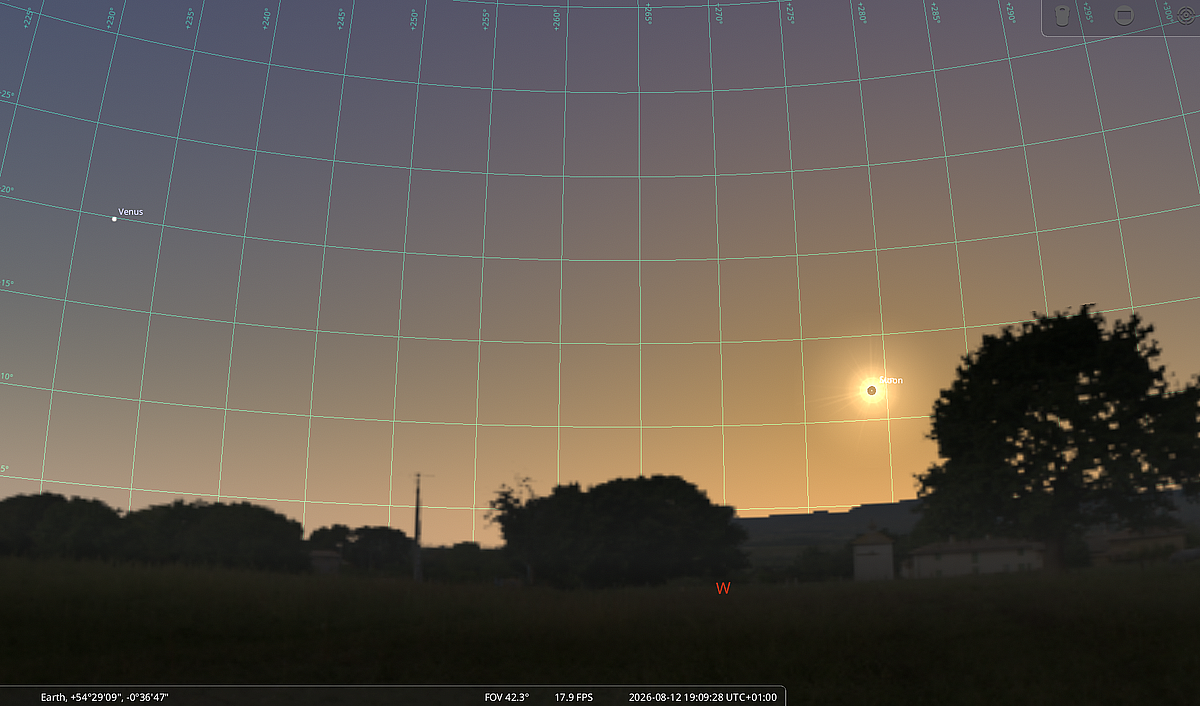
The partial solar eclipse around 18:35hrs. Image - John Lamb.
It was the solar eclipse that attracted the most public attention, helped by heatwave conditions across much of the country. Predominantly blue skies and the favourable evening timing allowed people to choose their viewing locations in advance. WDAS ultimately selected the DSS facility at Danby Lodge, as hosting events at both Whitby and Danby Lodge would have been unrealistic with the personnel available. We also saw an opportunity to link the eclipse event with August’s other celestial highlight: observing the Perseid meteor shower.
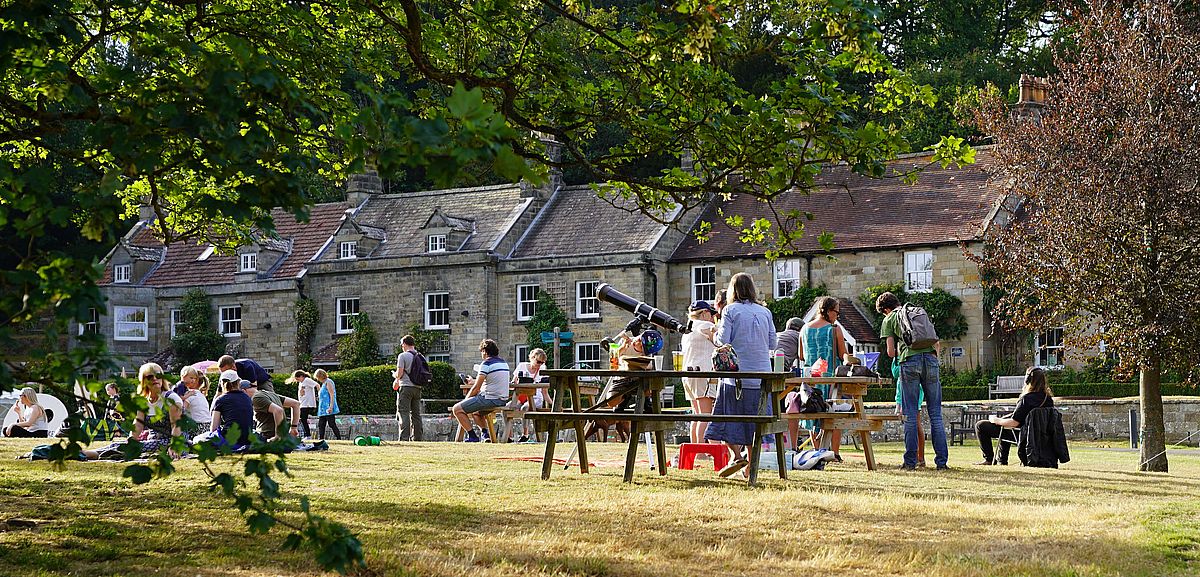
The Location - Danby Lodge Moors Centre. A busy scene. Image - Keith D. (Click for full image)
The Danby Lodge event had been well publicised through Whitby Regatta, the Danby Show, ITV regional news, Radio 5 Live and other radio stations, as well as the NYMP. WDAS members Mark, Paul and Richard had been instrumental in this effort.

Paul Wood setting up his Questar scope.
Image - Keith D

The view through Paul's Questar of the eclipse. Image - Paul Wood.
Solar eclipses always require careful, safe viewing, especially at public events. With this in mind, WDAS took advantage of Go Stargazing’s very reasonable offer of eclipse glasses for societies and bought 50 pairs. Demand exceeded expectations, and all were sold during Regatta weekend. Fortunately, Mark found a forgotten supply of Baader solar film on top of a bedroom wardrobe, which led to several busy days making eclipse viewers after the Regatta.
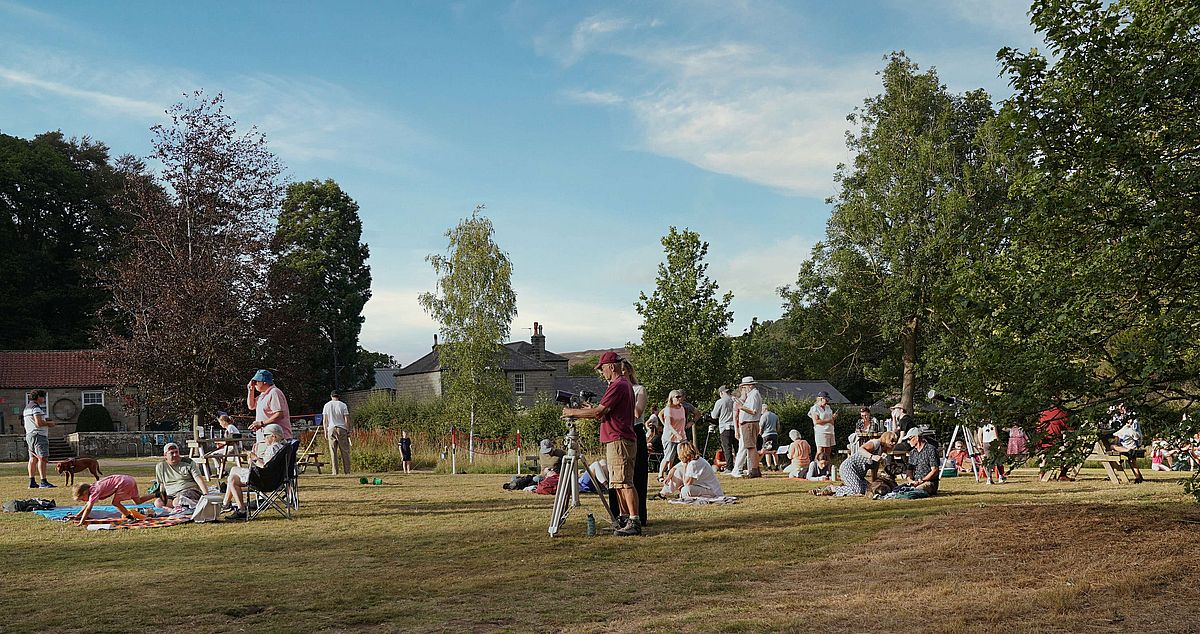
The gathering crowd. Image - Keith D. (Click for full image)
For once, confidence in the weather forecast was high, with sunshine predicted across the region during the eclipse period, apart from the chance of occasional cloud. We were even more optimistic because the eclipse did not coincide with Whitby Regatta!
Paul Wood had been staffing the DSS as usual on the morning of the 12th. By early afternoon he was joined by Mark, Brian, John L, Keith and Richard R, leaving plenty of time to set up the equipment. Mark and Keith had reconnoitred the site the previous evening and already knew the best viewing spots around the Danby Lodge site.

John L and Brian sharing a joke in the DSS facility. Image - Keith D

The dedicated H-alpha scope and instrument imaging location.
Image - Mark D. (Click for full image)

The view through a 90mm ETX around maximum. Image - John Lamb.
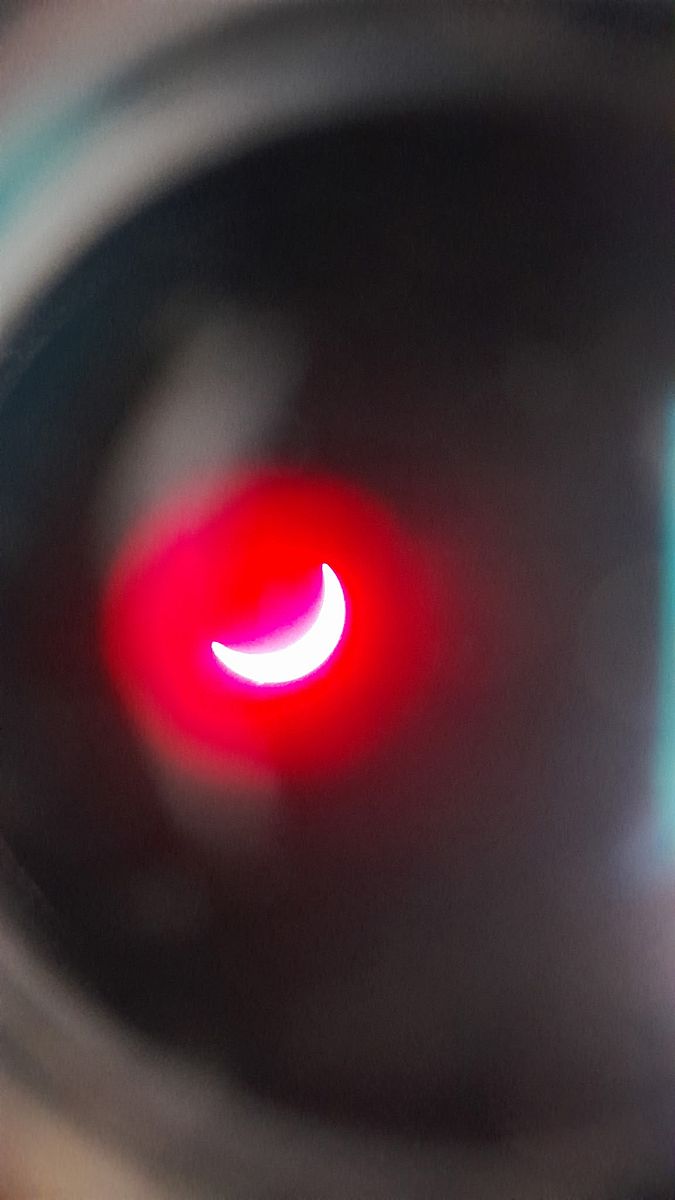
A view of the eclipsed Sun through the eyepiece of John Lamb's solar scope.
Image - John L.
Early trial observations of the Sun, using a small refractor fitted with a neutral-density safety filter and attached imager, allowed us to send the image to the monitor in the presentation room. Given the equipment limitations, the image was surprisingly good. By late afternoon, however, it became clear that the observatory wall would restrict the view of the Sun during the eclipse, so the plan was abandoned in favour of showing the live BBC feed instead.

A crowded scene! Richard in a flat cap adjusting a reflector scope.
Image - Mark D. (Click for full image)
Meanwhile, a small production line began turning out more eclipse viewers, thanks in part to a young helper—whose name we unfortunately did not get—who threw herself into the task throughout the afternoon. The resulting stockpile was soon depleted as people snapped up the viewers.

People enjoying the ambience, eclipse viewers in hand, or watching the projection on the screen manned by Brian in white hat. Image - Mark D. (Click for full image)
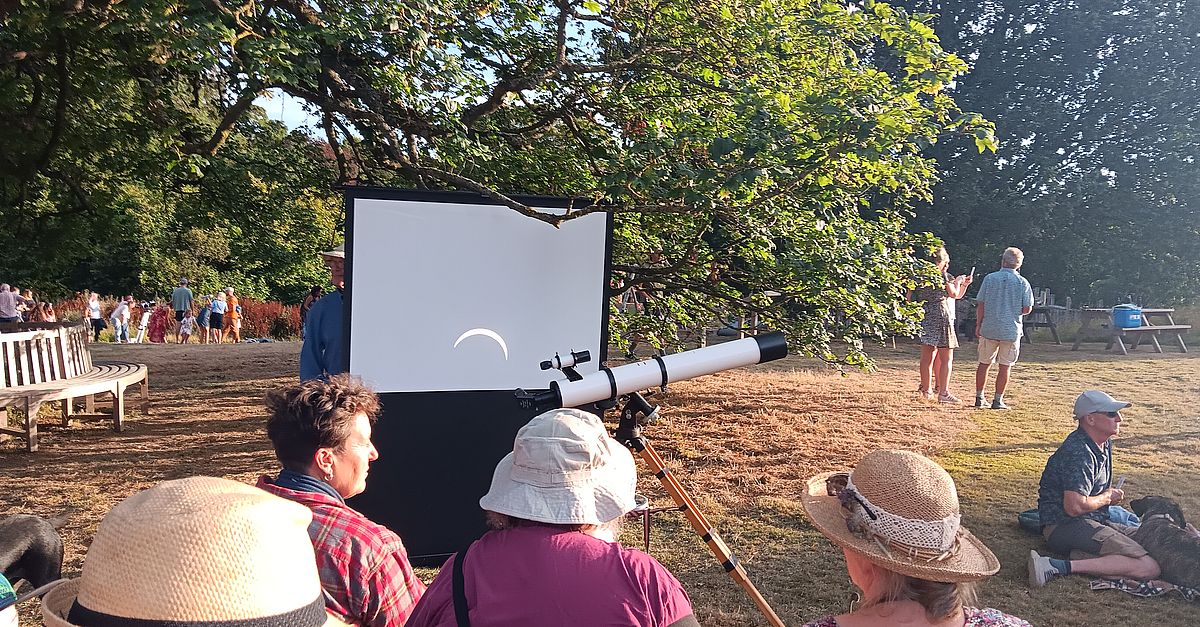
Projecting an image of the eclipse onto a pull-up screen. Image - Mark D. (Click for full image)
By 5:30pm the site was extremely busy and preparations intensified. The official start time was 6pm, and we had planned to gather everyone together, but attendance was far higher than even Mark had expected. Things soon became hectic as telescopes were moved, aligned and checked, and filters inspected. Eventually the situation was brought under control, and the first views of the Moon encroaching on the solar disc were seen shortly before 6:15pm.

The scene to the south of the DSS facility. Filtered scopes aligned.
Image - Mark D. (Click for full image)
In all, a dozen instruments were deployed, excluding the main observatory telescope for operational reasons. These included two dedicated H-alpha solar telescopes, a Questar, five refractors, an ETX and three reflectors, all fitted with neutral-density solar film or filter cells. We also used projection, making good use of the pull-up screen loaded at the last minute. This proved very effective, allowing many people to gather round and watch the unfolding eclipse.

The scene on the DSS hard standing area. Image - Keith D. (Click for full image)
The colander technique worked surprisingly well, projecting multiple solar crescents onto a card—fortunately, Richard had brought one, as Mark had forgotten his. People continued arriving throughout the event, making numbers difficult to judge, but attendance was perhaps between 200 and 250. When not observing through the telescopes, watching the live feed or viewing projected images, many sat on the ground using our viewers and enjoying the spectacle and atmosphere. WDAS members moved between the instruments that were not individually staffed, realigning them, checking filter safety and taking occasional images of the eclipse. Mark didn’t find time to take any himself!
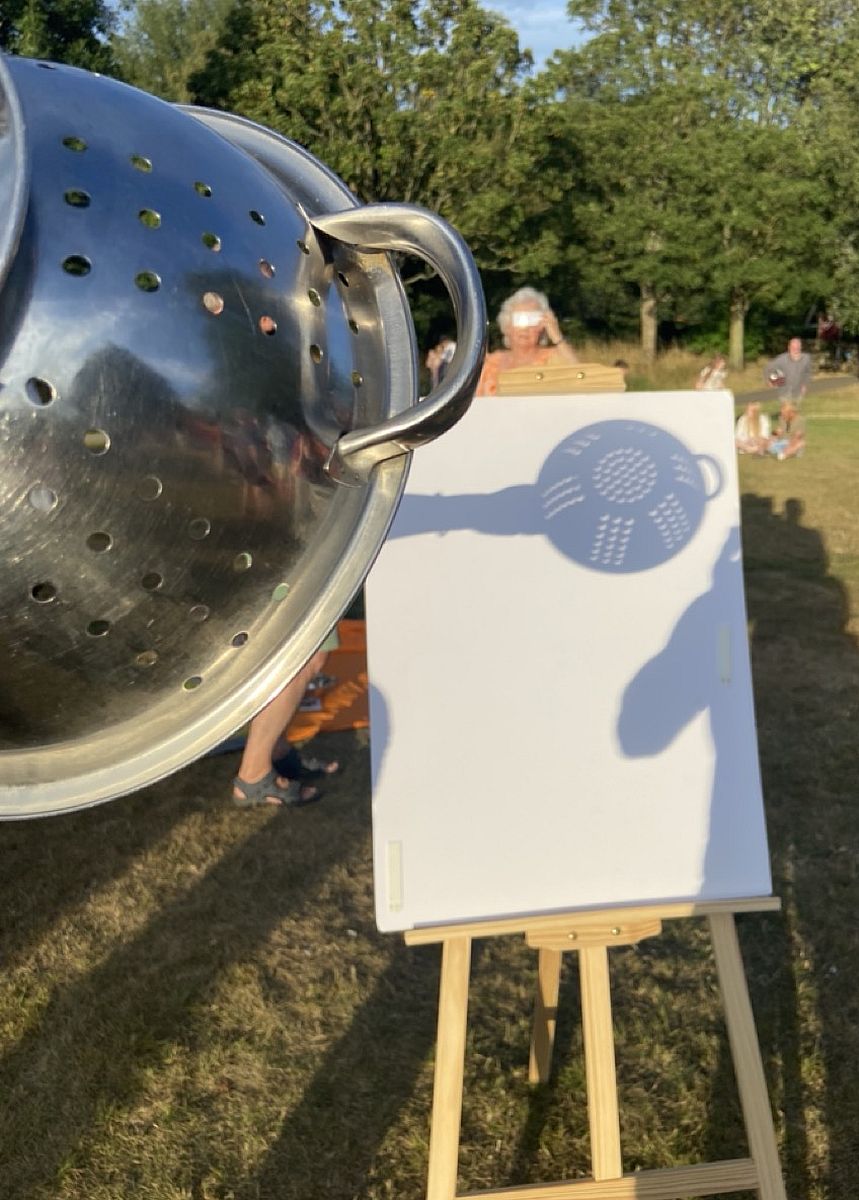
The colander projection trick. Image - Richard R. (Click for full image)
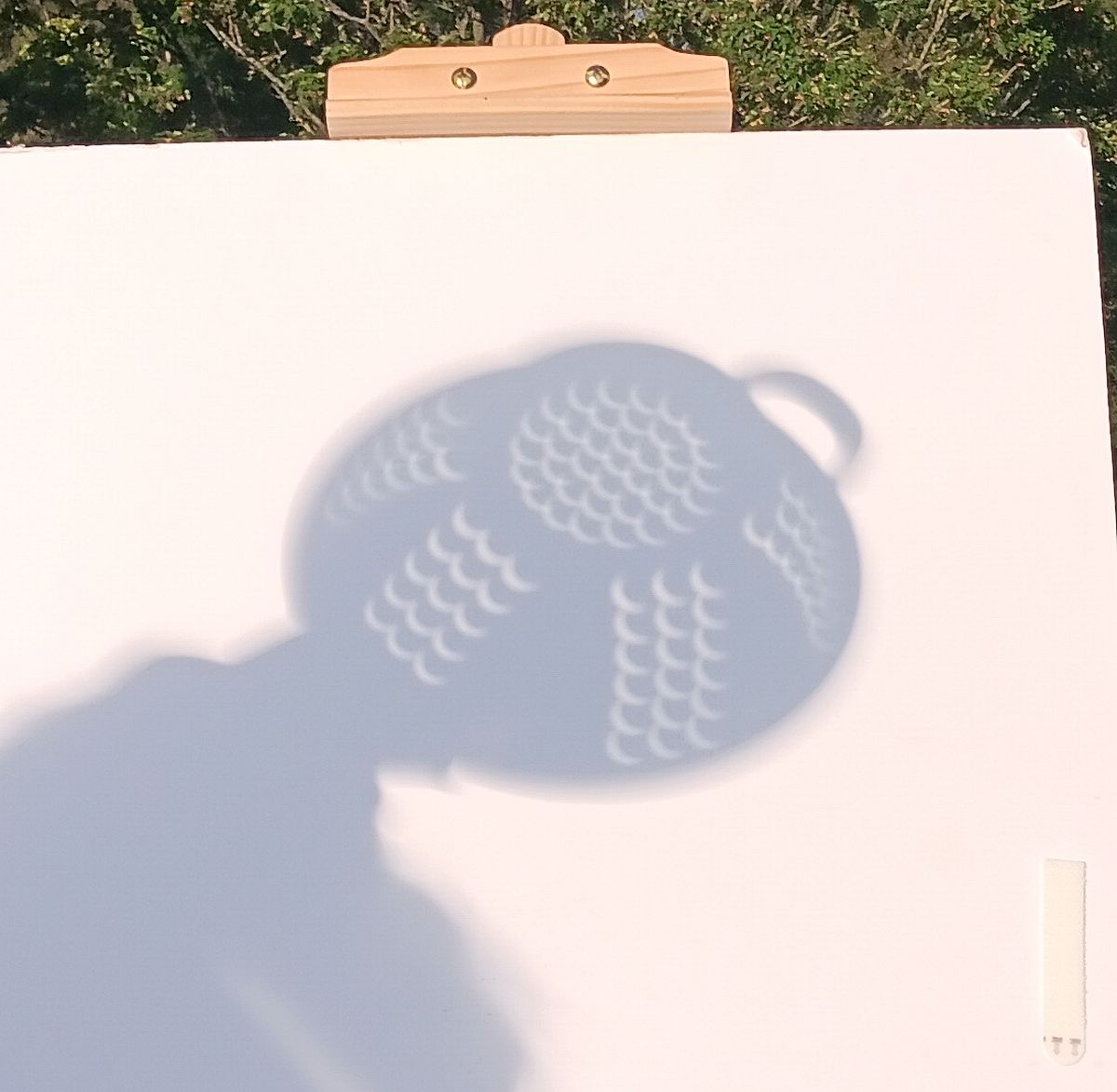
Tiny crescent images of the Sun. Image - Mark D
A bank of cloud briefly threatened to disrupt the observing, but it soon broke up, allowing the eclipsed Sun to be viewed even without hand-held viewers. By 7pm the light level and temperature had both fallen, while a live feed of totality from Spain captivated those watching in the presentation room. At Danby, maximum eclipse occurred shortly after 7:07pm, with only a sliver of Sun remaining—a spectacular demonstration of orbital mechanics, enjoyed by millions across the eclipse path.

The partial eclipse at maximum. Image - Richard R.
There were plenty of questions, not only about the eclipse but also about the DSS facility and Danby Lodge more generally, as a good number of visitors appeared to be there for the first time. It was fortunate that the café stayed open for light refreshments—a generous gesture that made a very favourable impression.

The scene towards the end of eclipse at the DSS facility. Image - Keith D. (Click for full image)
After maximum eclipse, people continued watching as the Sun sank towards the western horizon. Inside the facility and from the paved area outside, visitors also followed the BBC feed of the eclipse from various locations, including Spain and Greenwich. Gradually, people began to drift away, returning eclipse viewers and adding donations to the NYMP bucket we had arranged earlier.

After the event - people reluctant to depart. Image - John L. (Click for full image)
With the Sun now hidden behind trees except from the southern side of the facility, members began dismantling the telescopes no longer needed and took a welcome breather after a hectic evening. By 8pm, our eclipse event was over—what an evening!

The eclipsed Sun partially obscured by leaves. Image - Richard Randle.
As dusk fell, thoughts turned to the Perseids. With several WDAS members heading home, vehicles were reloaded. Those staying had hoped to use the observatory’s main telescope, but its collimation was found to be badly out, so other instruments were used instead.
For those who remained, Mark gave a sky tour and spoke about the Perseids. A handful of meteors were spotted, but by 11pm our time at the DSS was done. It had been a long, warm day and, frankly, we were flagging. A small group stayed on, hoping to see more shooting stars. Our own wishes had certainly come true: it had been a wonderful experience, shared by many, and hopefully plenty will return.
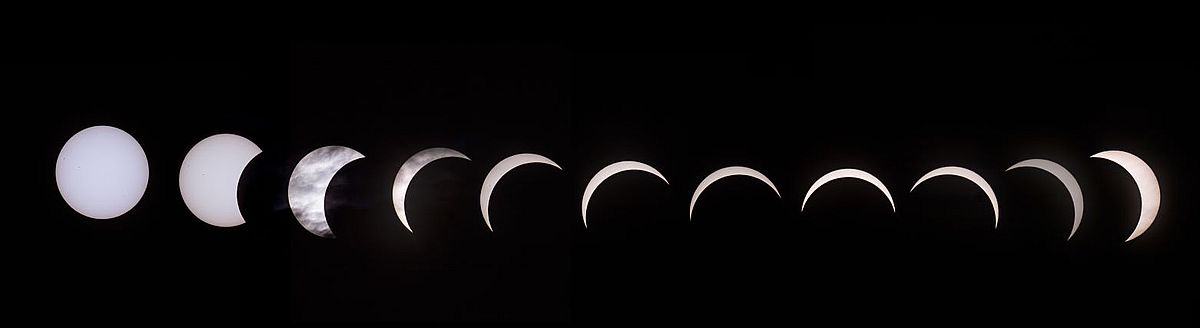
A fantastic composite series of the partial eclipse. Image - Alan Bentley. (Click for full image)
Many thanks to the Lodge and café staff, and to the Lodge caretaker, and to the small number of WDAS members who persevered throughout the afternoon and evening.
We are looking forward to the exploits of those WDAS members who ventured further afield to experience totality!
- Log in to post comments
