
In this month's Sky Notes:
Planetary Skylights:
Saturn continues to make inroads into the evening sky. Neptune comes to opposition. Mars and Jupiter are improving early morning objects. Uranus is located below the Pleiades overnight.
 Saturn is the first naked-eye planet to rise, appearing low in the east shortly after 21:30hrs at the start of September and by dusk, around 19:30hrs, by month’s end. It has now edged north of the celestial equator and, from mid-UK latitudes, culminates about 37 degrees above the southern horizon around 01:30hrs BST. Set against the faint stars of Pisces, below the Square of Pegasus, Saturn is easy to spot at magnitude +0.5. Through a telescope it can be an impressive sight, though observers should note that the ring system is inclined by less than 8 degrees, enough in steady seeing, to reveal the Cassini Division. Titan, Saturn’s largest moon, should appear as a small point of light near the planet’s disc, completing an orbit roughly every 16 days. Larger instruments under dark, steady skies may show several additional moons. The Moon lies close to Saturn overnight on Sept 26th/27th.

Sept 26th @ 21:00hrs BST - Saturn and a full Moon. (Click for larger image)
 Neptune reaches opposition on Sept 26th and will be well placed for observation from late evening through the night. It lies in Pisces, about 10 degrees ahead of Saturn, but at magnitude +7.8 it requires optical aid to see. Binoculars should reveal Neptune, though a telescope is needed to show its tiny blue-grey disc, just 2.5 arcseconds across. A 100mm (4-inch) aperture is usually sufficient, while instruments over 150mm (6 inches) will show it more clearly. The nearest named stars are 10 Cet and 44 Psc, both roughly 2.5 degrees east of Neptune.
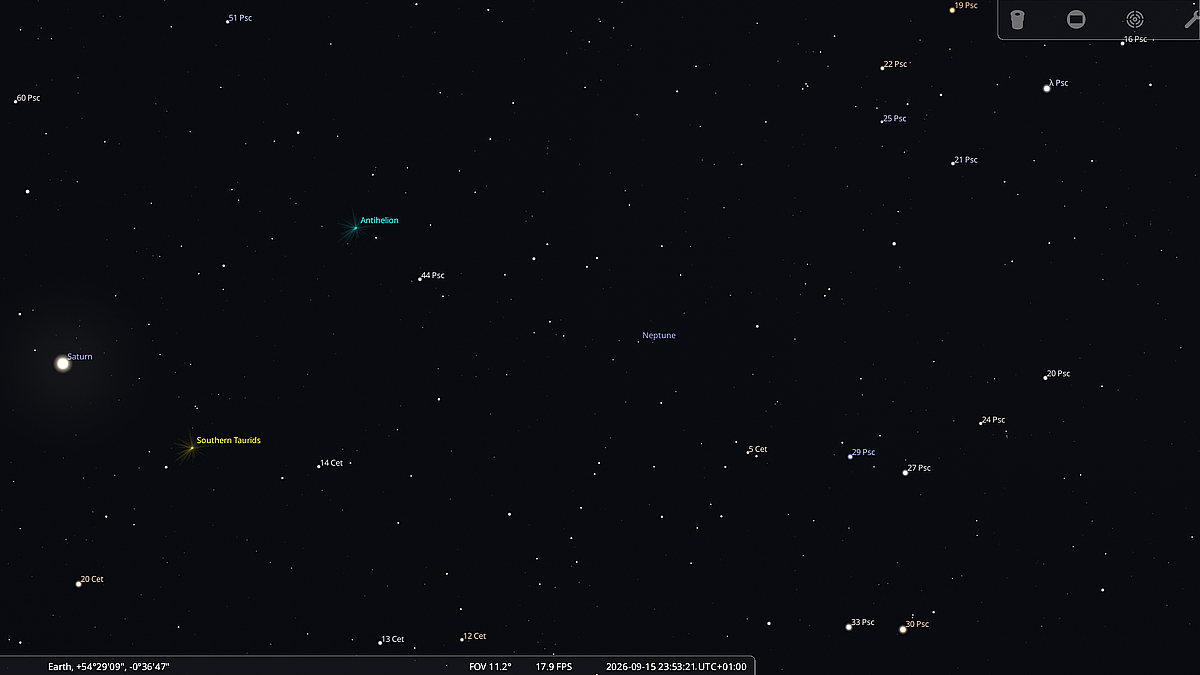
General location of Neptune, mid-month. (Click for full image)
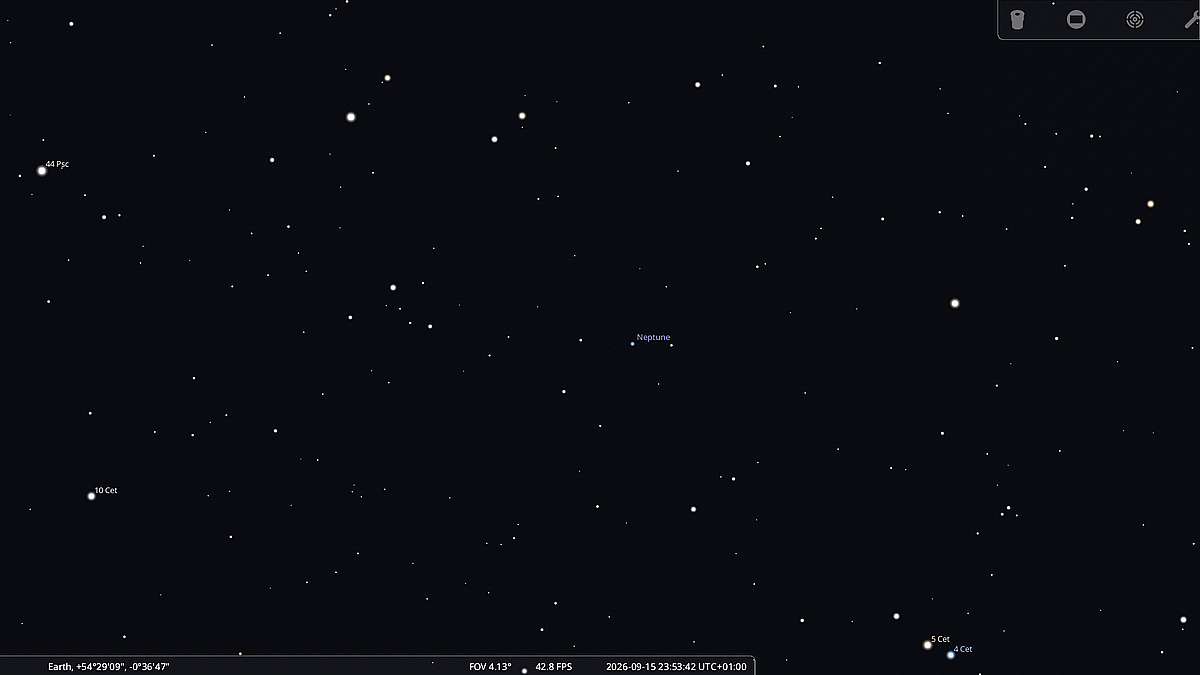
Detailed location of Neptune, mid-month, early morning hours. (Click for full image)
 Uranus also reaches the late-evening sky by mid-month, becoming visible after 23:00hrs BST and best placed after midnight. At magnitude +5.7, it is readily found in binoculars as a tiny speck between the Hyades and Pleiades star clusters in Taurus. A telescope will help confirm its position: an 80mm (3-inch) aperture should show its small, 3.7-arcsecond grey-green disc, while instruments over 125mm (5 inches) will reveal it more clearly.

General location chart for Uranus - mid-September, 23:30hrs BST. (Click for larger image)

Detailed chart for Uranus in September. (Click for larger image)
 Mars remains an early-morning object throughout September, not rising until around 01:00hrs even by month’s end. It will become easier to observe, however, as skies stay dark until after 06:00hrs and Mars climbs to about 45 degrees altitude in the south-east. At the start of the month the red planet lies in the heart of Gemini, crossing into neighbouring Cancer by month’s end, while brightening from magnitude +1.38 to +1.03.
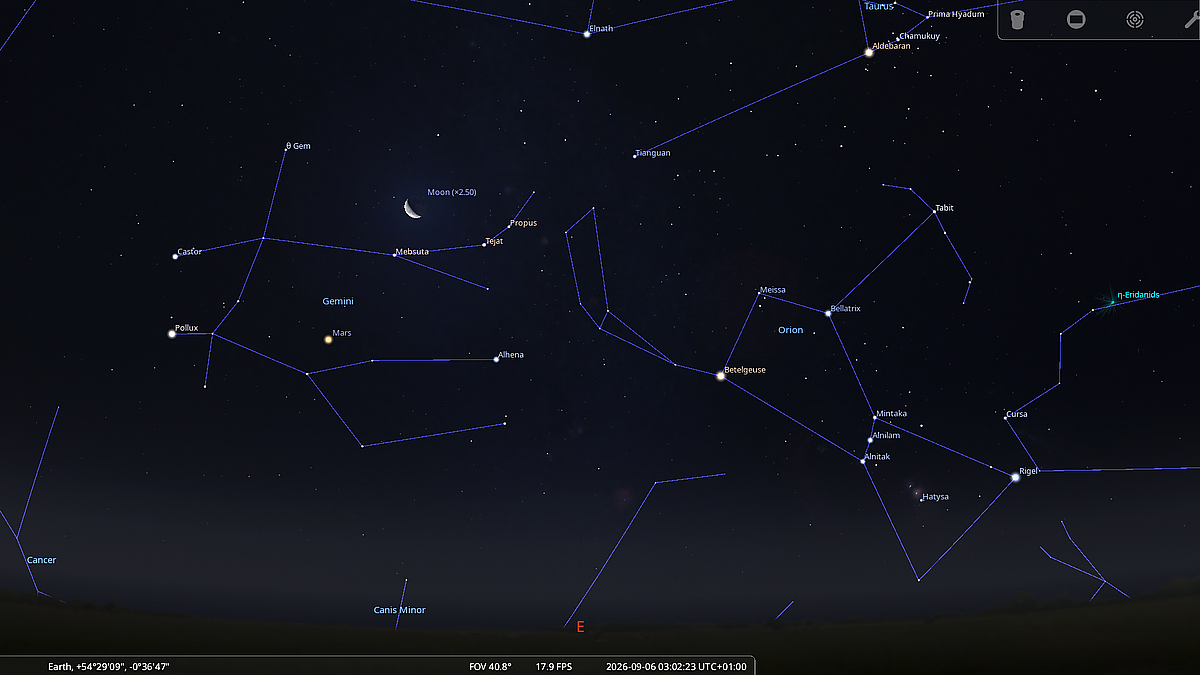
Mars and waning Moon on Sept 6th, viewing at 03:00hrs. (Click for full image)
Although Mars brightens during September, it remains very small through a telescope, with a disc less than 6 arcseconds wide. Surface detail will be difficult to resolve except with the largest amateur instruments or imaging equipment. The waning Moon lies above Mars on the 6th and below it the following day.
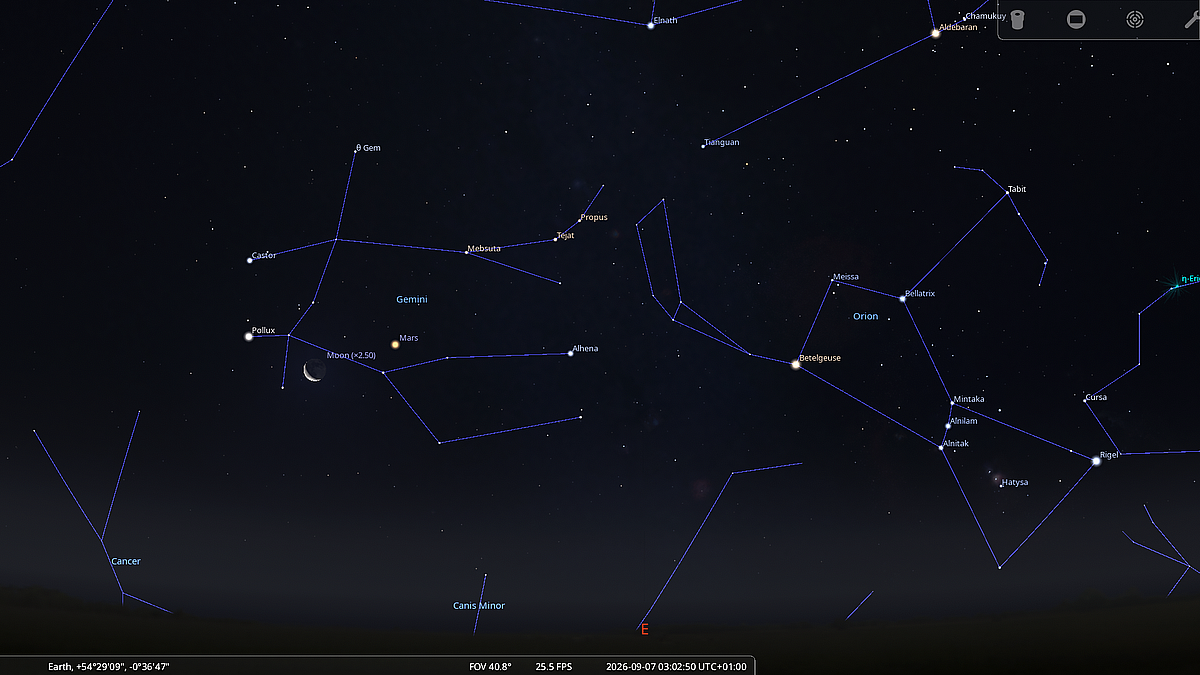
Mars and waning Moon on Sept 7th, viewing around 03:00hrs. (Click for full image)
By the end of the month, Mars begins drawing a little closer to Jupiter in the morning sky, though the two will not reach conjunction until mid-November.
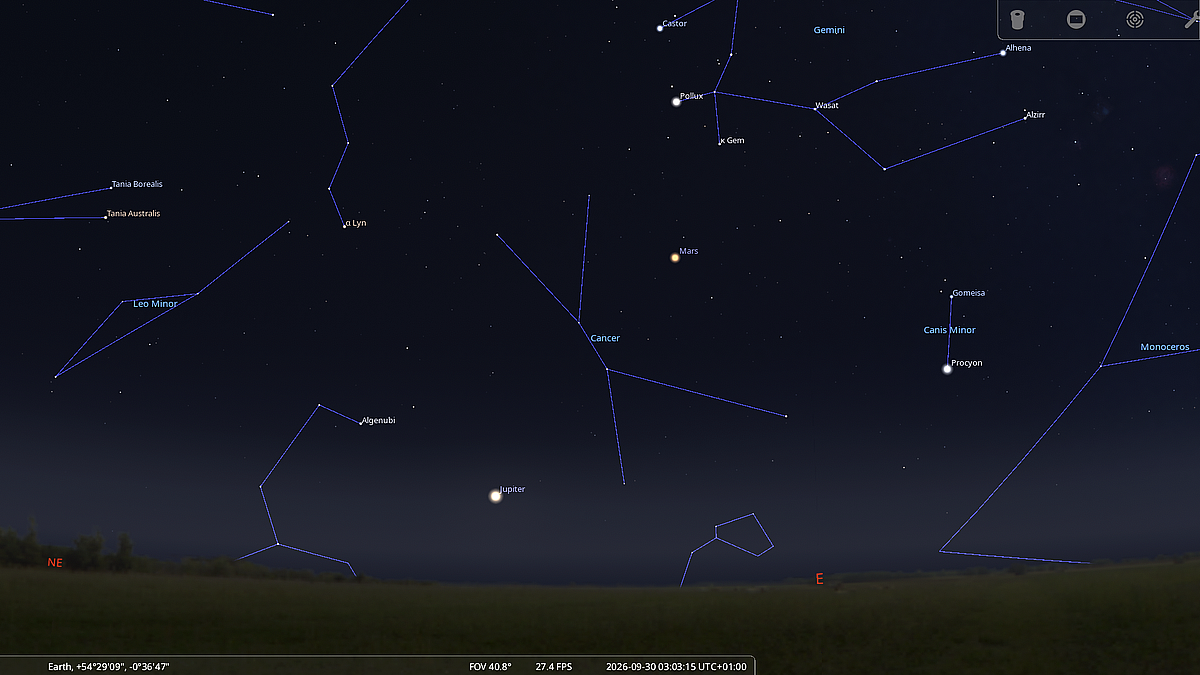
Mars and Jupiter - end of September at 03:00hrs. (Click for full image)
 Jupiter is the last planet to rise in September’s early-morning sky, becoming visible by 04:00hrs at the start of the month and by 02:30hrs by month’s end. It remains in Cancer for most of September, crossing into Leo by early October. Brightening from magnitude -1.42 to -1.62 and climbing to more than 35 degrees altitude by month’s end, Jupiter will be a very conspicuous morning object.
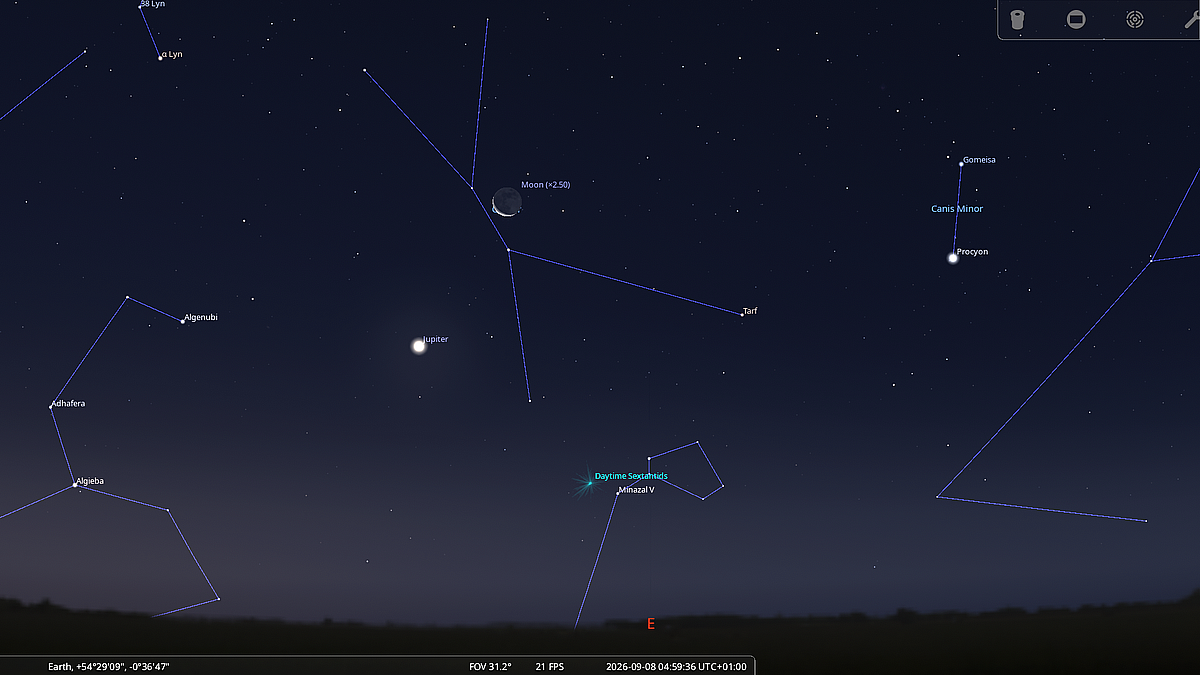
September 8th, 05:00hrs - crescent Moon above Jupiter. (Click for larger image)
Jupiter remains impressive even in small telescopes, its oblate shape plainly visible in the eyepiece. Observers can make out the planet’s darker atmospheric belts, the Great Red Spot when it is in view, and the Galilean moons close to its disc. These moons change position from night to night as they orbit over days to weeks, while Jupiter itself rotates in under ten hours. Their shifting arrangement offers rewarding observing opportunities. An aperture of around 120mm should be sufficient to see the Great Red Spot.
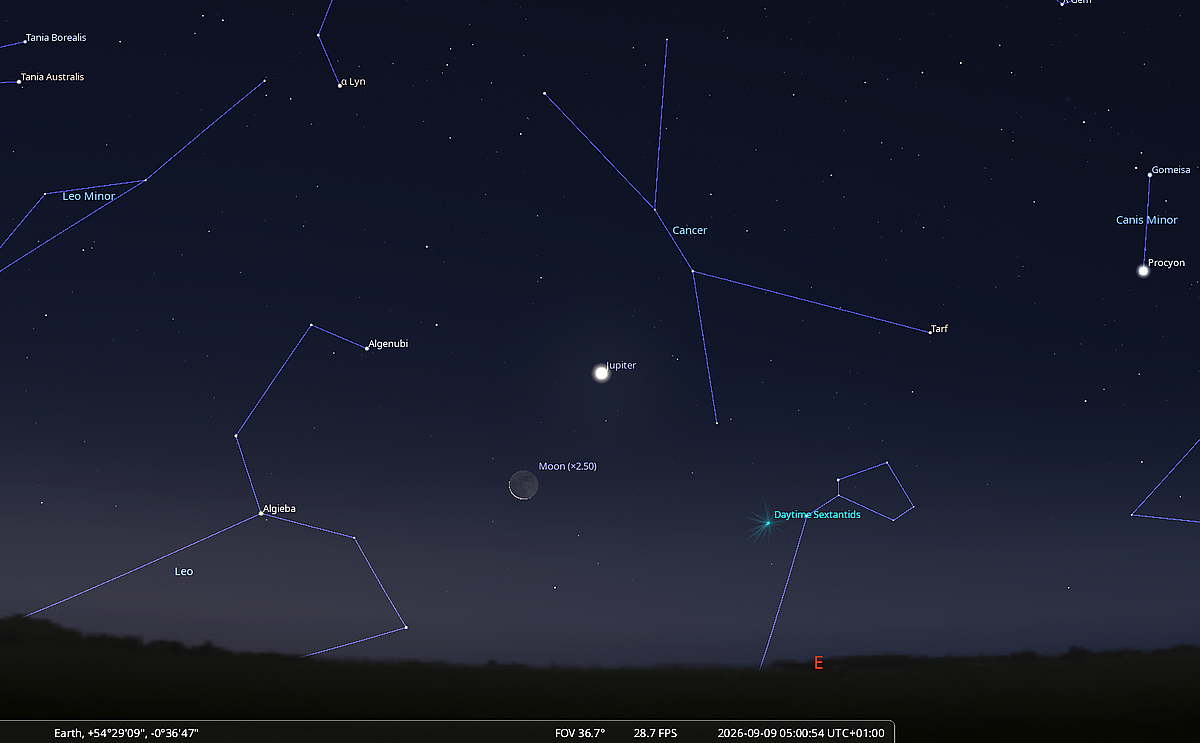
Sept 9th @ 05:00hrs - Crescent Moon and Jupiter. (Click for larger image)
On September 8th and 9th a slim waning crescent Moon pays Jupiter a visit. The 8th will be particularly worth viewing as the Moon covers the open cluster M44 - the Beehive in Cancer by 05:00hrs.
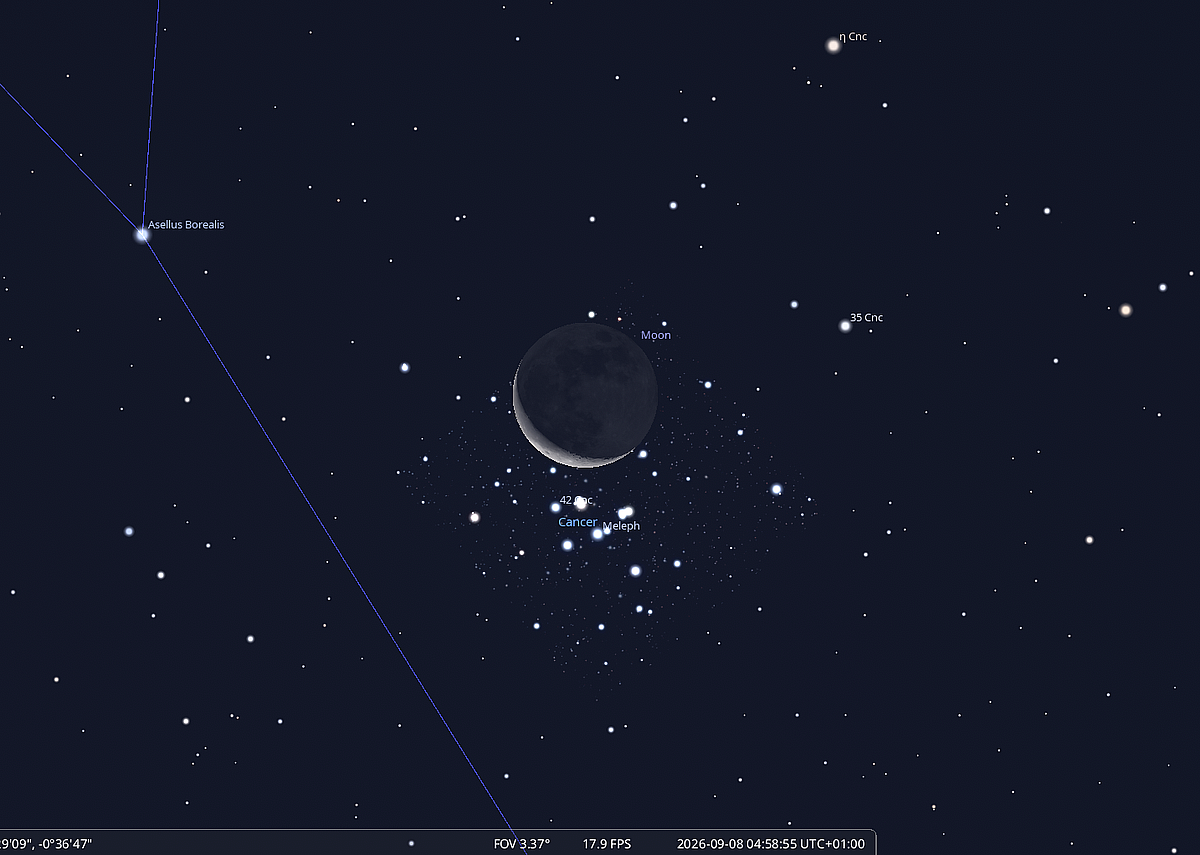
The waning crescent Moon and Beehive cluster at 05:00hrs, Sept 8th. (Click for larger image)
September Meteors & Nova Sagittae 2026
September has no major meteor showers, however there are a number of lesser showers. The Aurigids peak around September 1st, with the eta Perseids peaking on September 9th. Both have ZHR of 5-8 only. The September Lyncids are another weak shower producing a few meteors per hour throughout the month. The Piscids have two peaks, the Sept 8th and 21st with ZHR of 6-7 at best, barely above the sporadic background rates. As with most meteor showers, the early morning hours offer the best chance of spotting a few, although moonlight will slightly interfere with the second Piscid peak.
The peak of the Perseid meteor shower in August occurred in excellent conditions - no moonlight and predominantly clear skies - for once! Numbers pre-midnight on the 12th were modest but picked up substantially according to several WDAS members during the early morning hours of the 13th.

A fine composite image of Perseids - early morning hours of Aug 13th.
Image - Richard Randle. (Click on for full image)
Nova Sagittae 2026 erupted on Aug 25th in the small constellation of Sagitta the Arrow, located within the confines of the Summer Triangle asterism currently high to the south during the evening. You will require a pair of 15 x 70 binoculars, or small telescope to spot the nova at mag +7.2 although it is still considered bright. See chart below.

Location of nova Sagittae 2026. (Click for full image)
The Autumnal Equinox

In the northern hemisphere, meteorological autumn begins on Sept 1st, while astronomical autumn unusually starts on Sept 23rd this year, the date of the autumnal equinox. Either way, autumn is fast approaching as the evenings draw in.
At the autumnal equinox, the Sun appears to cross the celestial equator and move southward, tracing an increasingly lower arc above the southern horizon. At this point, Earth’s poles are tilted neither toward nor away from the Sun, so daylight and darkness are nearly equal worldwide. The northern hemisphere then continues to tilt away from the Sun, bringing earlier nightfall until the Sun reaches its lowest point on the ecliptic at the winter solstice, around Dec 21st.
September Night Sky
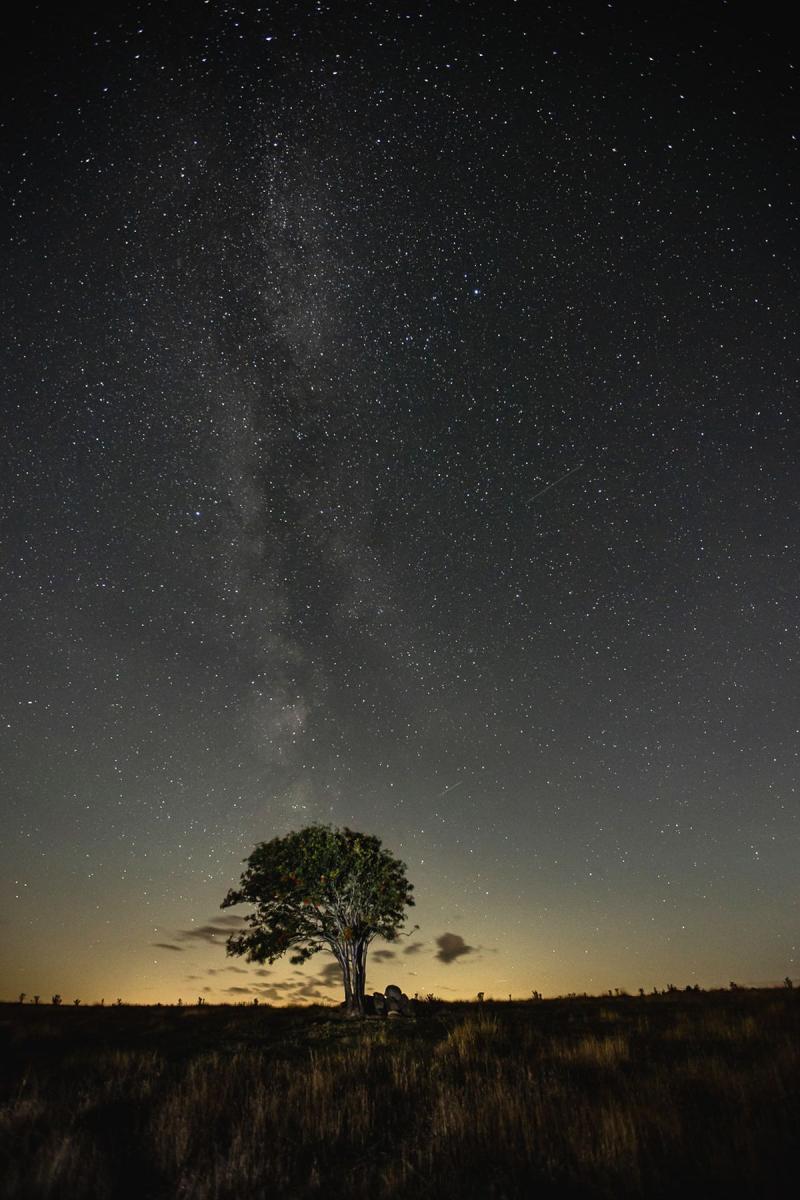
The Milky Way - a highlight of early Autumn night skies
Image - by WDAS member Richard Randle (Click for larger image)
When conditions are favourable, September is one of the best months for amateur astronomers to explore the night sky. By mid-month, evenings darken quickly, with most stars visible by 21:00hrs BST from Whitby, North Yorkshire, and most deep-sky objects accessible by around 22:15hrs. If temperatures remain mild, observing can be especially enjoyable. For UK observers, September is also the ideal month to appreciate the Milky Way at its most striking to the naked eye from dark locations.
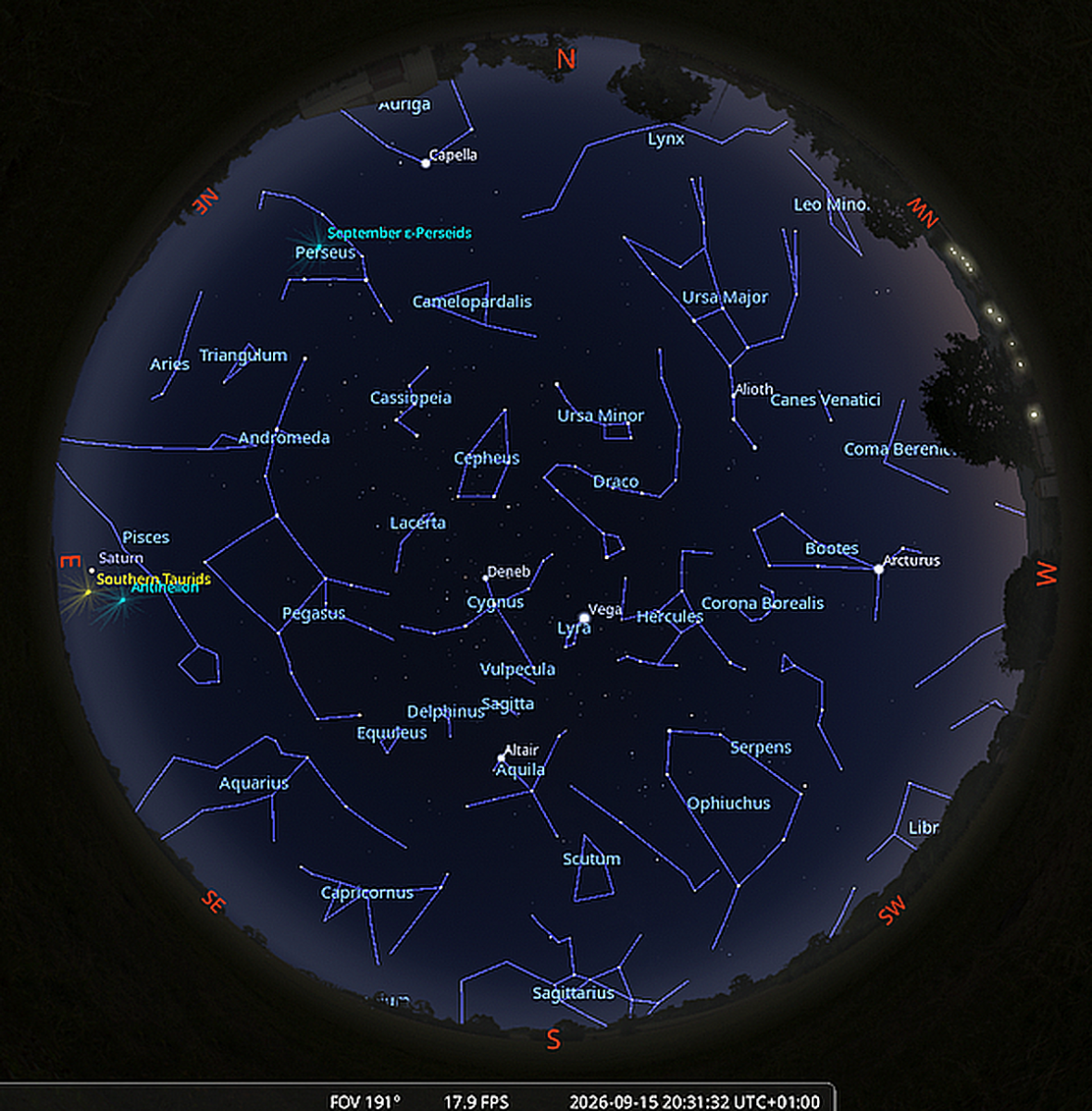
Sept night sky - mid-month 20:30hrs. (Click to enlarge image)
As dusk falls, five stars are among the first to appear: Arcturus in the west; the “summer trio” of Vega, Deneb and Altair overhead and midway up in the south; and Capella low in the north. Over the next hour, the celestial jigsaw gradually fills in as fainter stars emerge by around 22:15hrs. Look west for the brilliant amber glow of Arcturus in Boötes.
Up and to the left of Boötes, look for the graceful arc of Corona Borealis, the Northern Crown, with Alphecca—also known as Gemma—marking the jewel at its centre. If a similarly bright star appears below and to the left, it may be the recurrent nova T Coronae Borealis we are all still waiting on to erupt.

The northwest aspect - mid September around 21:00hrs BST. (Click to enlarge image)
Much of the west-south-western sky is shaped by two large, faint and rather indistinct constellations. Hercules sprawls high in the west above Corona Borealis and is easiest to recognise by its “Keystone” asterism. Below it, the larger, fainter outline of Ophiuchus stretches down towards the south-western horizon.

The southwest aspect, mid-September - 20:30hrs BST. (Click to enlarge image)
High in the west-north-west, the familiar Plough asterism, part of Ursa Major, is well placed. Follow the curve of its handle to find Arcturus and Boötes, then use the two pointer stars in the bowl to locate Polaris due north. Polaris marks the end of the Little Bear’s tail in Ursa Minor. Low in the north-north-east, bright Capella twinkles in the circumpolar winter constellation Auriga, while Draco’s head lies near the zenith, its body winding between the two bears.
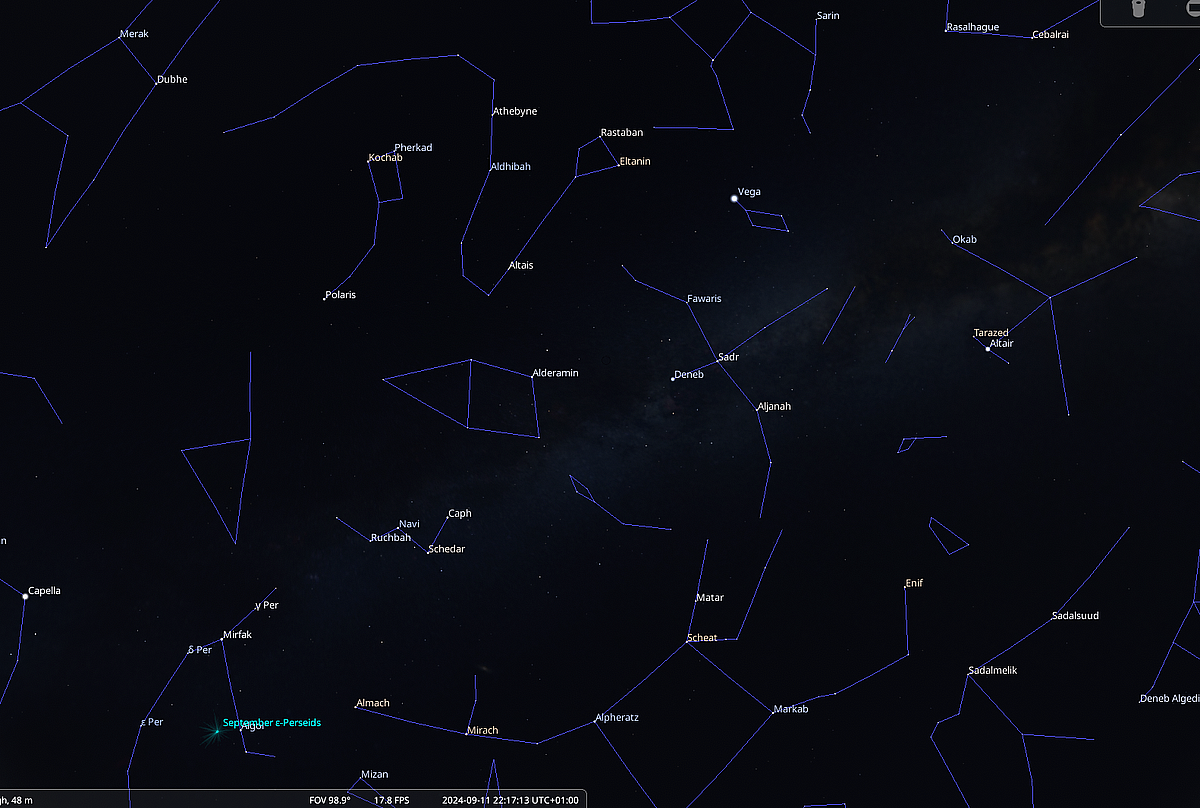
The view overhead, mid-September - 22:15hrs. (Click for full image)
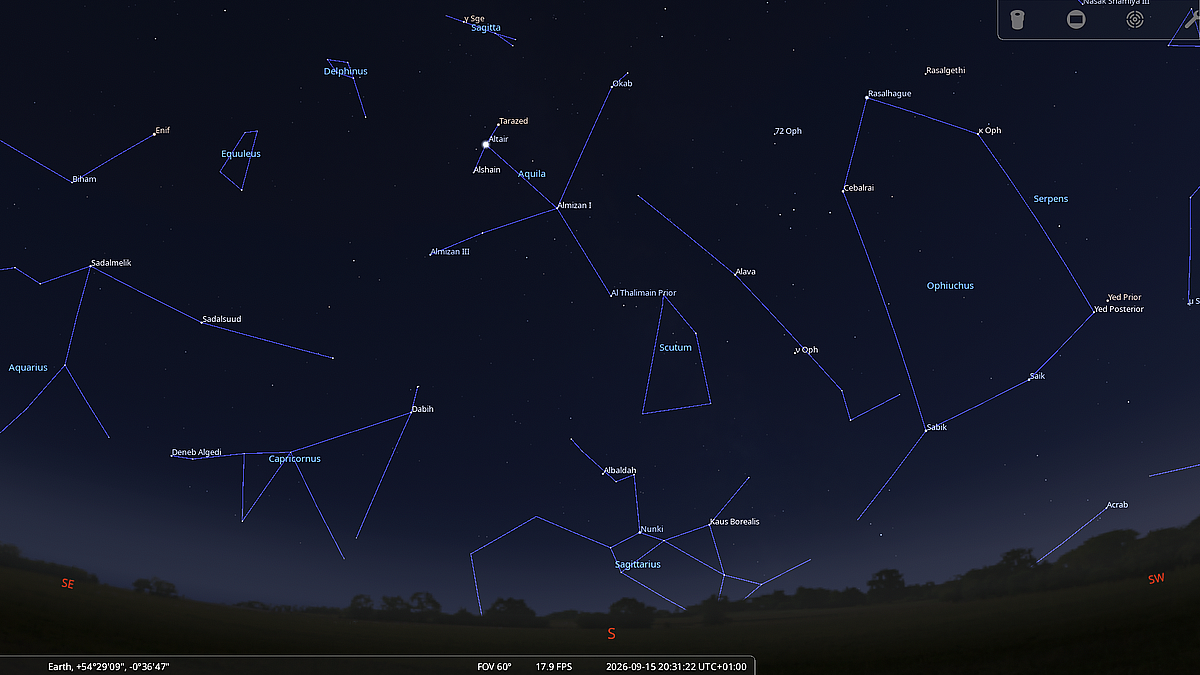
Due south, Sagittarius the Archer straddles the horizon (see In Focus: The Archer, Part 1). If skies are transparent, look for the large “Teapot” asterism, whose outline resembles an angular pot tilted as if pouring a cuppa. With binoculars or a low-powered telescope, take time to explore the rich star clouds and nebulae within Sagittarius.
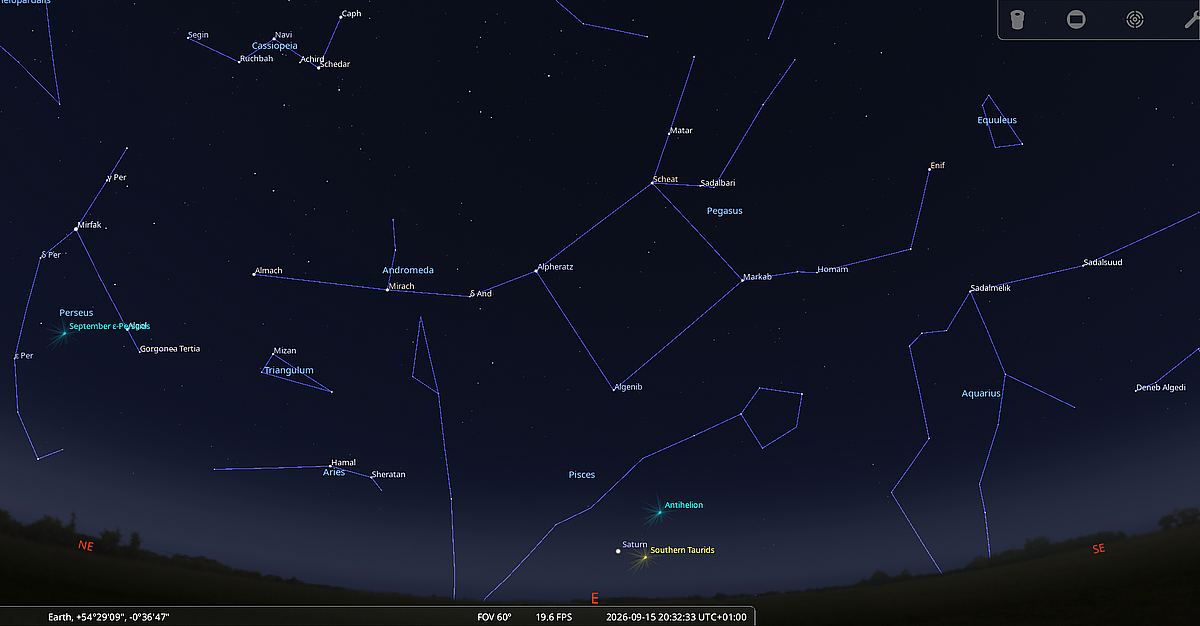
The summer ecliptic runs low above the southern horizon, so much of the south to south-east sky is filled with zodiacal constellations. After Sagittarius come the stars of Capricornus, the Sea Goat. The aquatic theme continues low in the east-south-east with Aquarius, the Water Bearer, and Pisces, the Fish, whose faint stars meander down to the eastern horizon before rising again. Saturn currently lies near the Pisces–Aquarius border.

The aquatically themed aspect from E - SE - mid-September 21:00hrs.
(Click for full image)
High overhead in the south, stretching down towards the SSE, the Summer Triangle constellations—Lyra, Cygnus and Aquila—dominate the sky. Just above Altair in Aquila, look for the small arrow-shaped pattern of Sagitta, with the compact group of Delphinus nearby to its left. With a little imagination, Delphinus does resemble a dolphin leaping from the water, though it is also oddly known as “Job’s Coffin”. Rising from the NNE horizon, the great hero Perseus stands prominently, while the distinctive “W” of Queen Cassiopeia sits above his shoulder.
The eastern sky is dominated by only a few constellations, especially Pegasus, the Winged Horse, standing two to three hand-spans above the horizon. It is easiest to recognise by the Great Square, four stars enclosing an apparently star-poor patch of sky. Between Pegasus and Perseus stretches Andromeda, the chained princess and daughter of Cassiopeia. Within Andromeda’s borders, our neighbouring galaxy can be glimpsed with the naked eye on clear, moonless nights later in the month.
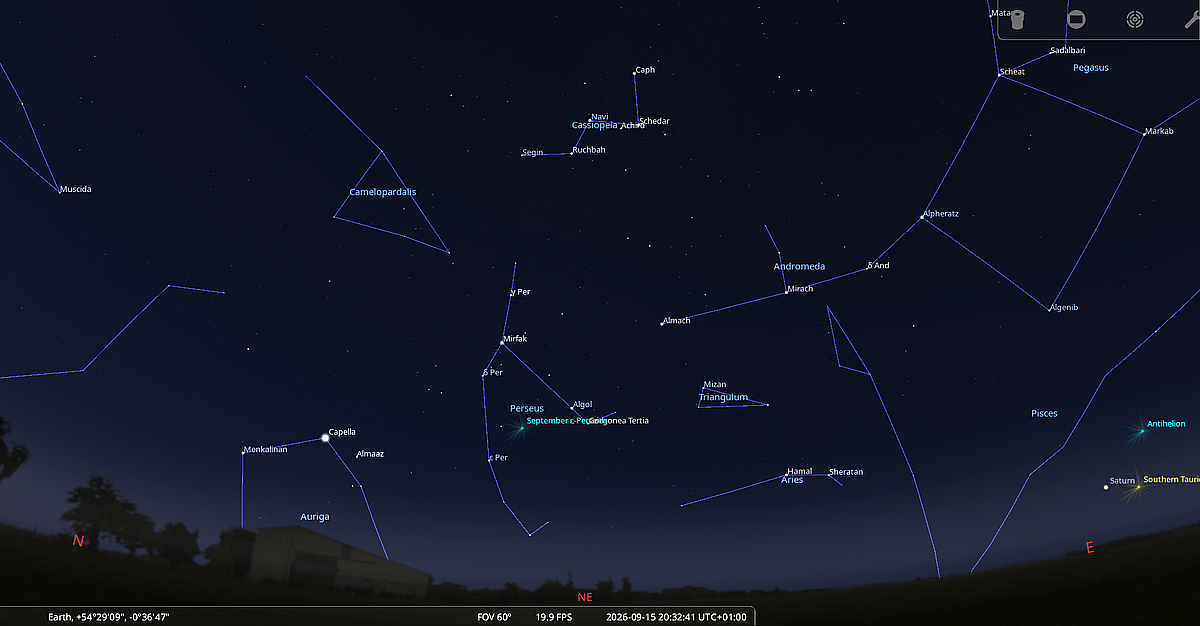
The northeast aspect, mid-September - 21:00hrs BST. (Click to enlarge image)
To find the Andromeda Galaxy, star-hop eastwards from Alpheratz, the upper-left star of the Square of Pegasus, along the well-spaced chain of stars marking Andromeda’s main body. From Mirach, the second prominent star in the chain, turn north and pass two fainter stars. Beside the second, you should see an elongated, misty patch of light: the Andromeda Galaxy, a spiral system similar to our own. It is easy to see in binoculars and, under dark, transparent skies, can also be glimpsed with the naked eye. At 2.6 million light years away, it is the most distant object visible without optical aid. If you struggle to see it, use averted vision—look slightly to one side rather than directly at it.
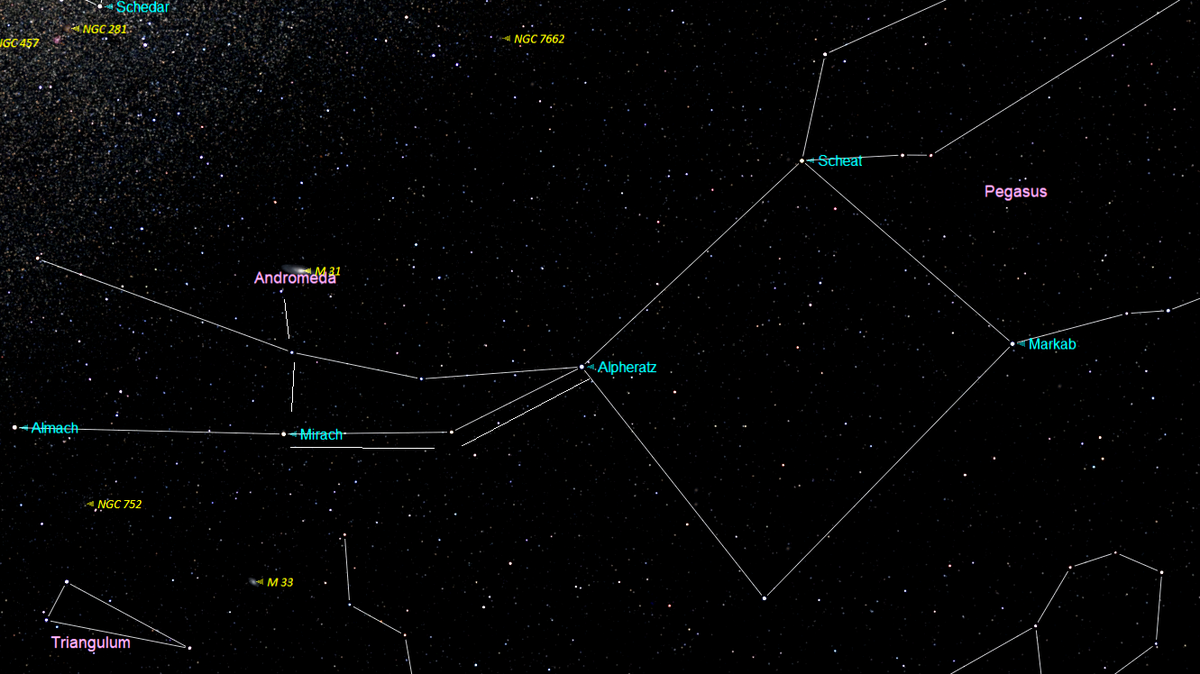
Star - hop from Alpheratz to locate Andromeda Galaxy (click for larger image)
Below Andromeda lie the small constellation of Triangulum and, beneath it, the crooked line of stars forming Aries, the Ram. Along with the Andromeda Galaxy and the Milky Way, Triangulum contains the third major spiral galaxy in our Local Group: M33, often called the other Pinwheel Galaxy. It appears as a faint misty patch in binoculars or rich-field telescopes.
Finally, rising over the ENE horizon is Taurus the Bull, led by the exquisite Pleiades open cluster, or Seven Sisters, marking the bull’s tail. The sight of the Pleiades is a reminder that winter is waiting in the wings, though for now autumn takes centre stage.
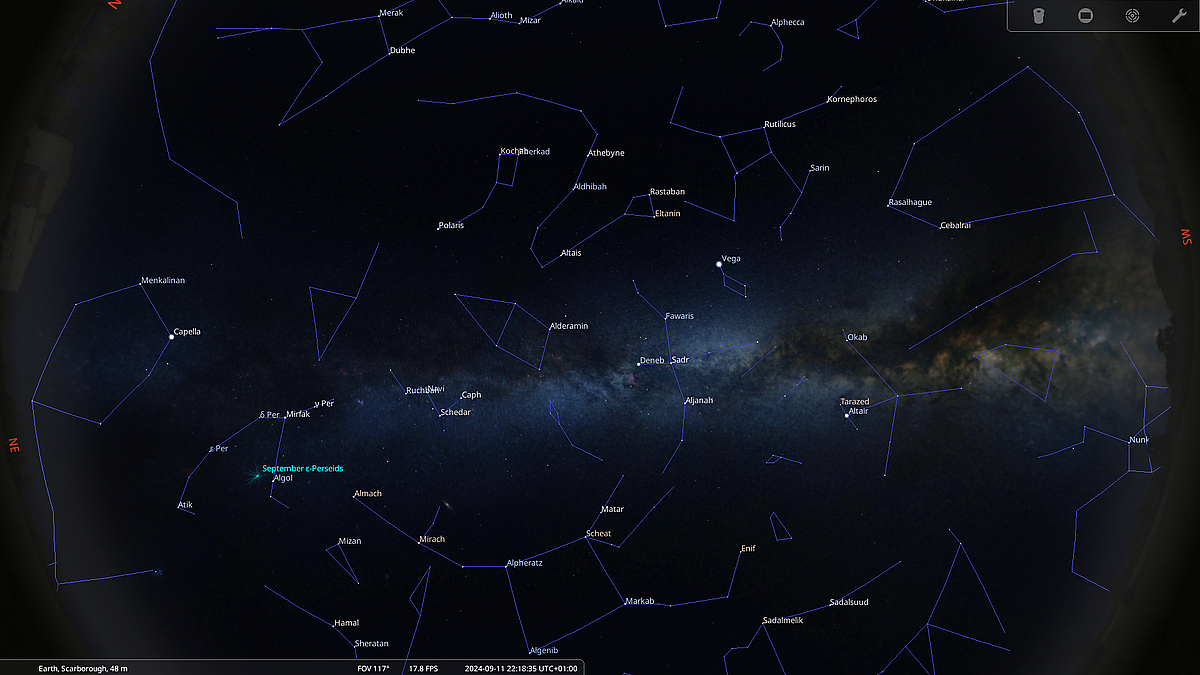
The Milky Way - mid/late September around 21:00hrs (click for larger image)
The Milky Way
By late September, the summer Milky Way is well placed for viewing and, this year, free from moonlight. Choose a dark site and give your eyes about 15 minutes to adapt. The Milky Way should then appear as a ghostly river of light stretching from north-north-east to south-south-west. Trace it from Auriga, where it rises in the NNE, through Perseus and into Cassiopeia’s distinctive “W”. Even modest binoculars will reveal rich star fields across these constellations.
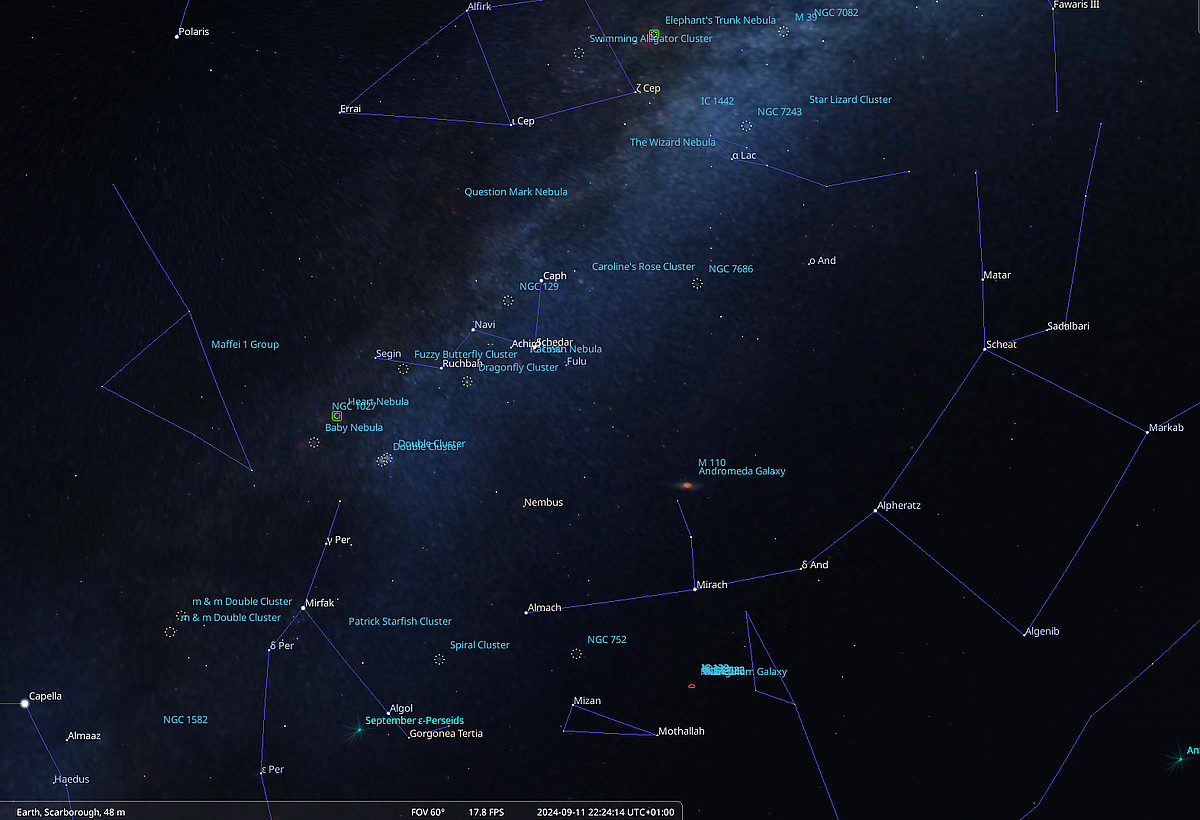
The Milky Way rising in the NE sky - September 22:00-23:00hrs BST. (Click for larger image)
From Cepheus, the Milky Way passes overhead along the length of Cygnus, the Swan, also known as the Northern Cross. Deneb, part of the Summer Triangle, marks the Swan’s tail. Here the Milky Way appears to split into two streams flowing around a darker, elongated band. This feature, the Northern Rift, is a dust cloud about 4,000 light years away that partly obscures the countless stars beyond.
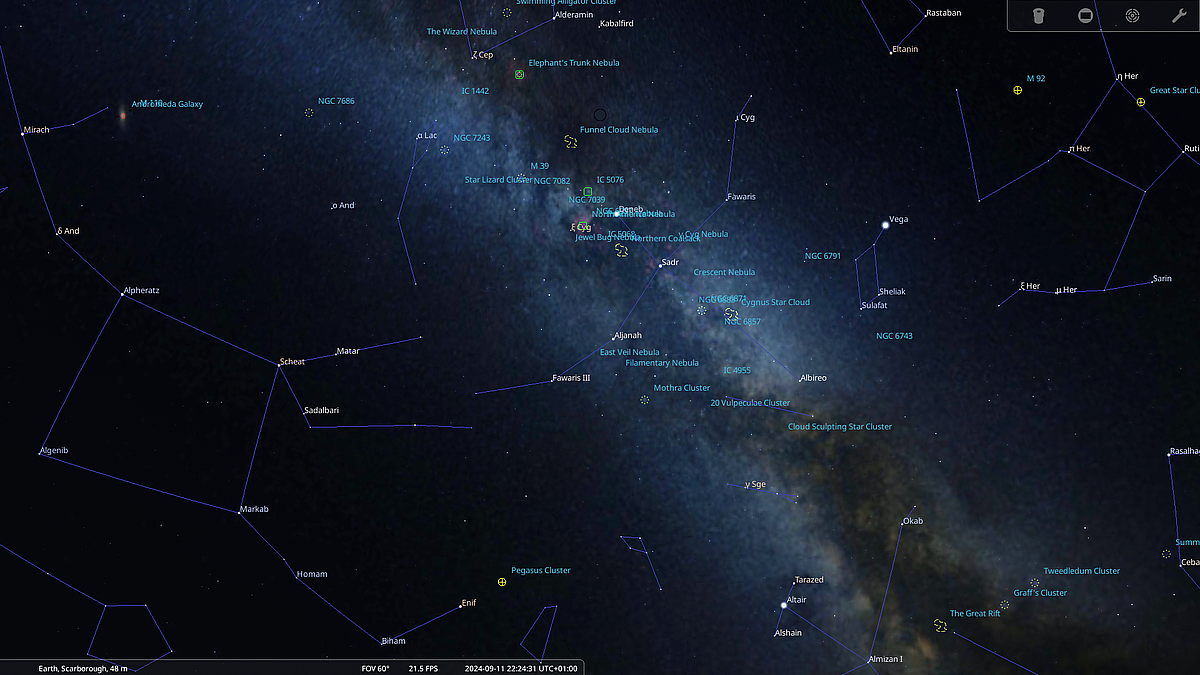
The Milky Way overhead in September, 22:00-23:00hrs BST. (Click for larger image)
Cascading down through Aquila past bright Altair, the southernmost star of the Summer Triangle, the Milky Way broadens before flowing into Sagittarius as it straddles the south-western horizon. In this direction, nebulae and star clusters abound, offering rich rewards for optical observers under transparent skies. The galactic centre lies among the celebrated star clouds of Sagittarius, about 27,000 light years away.
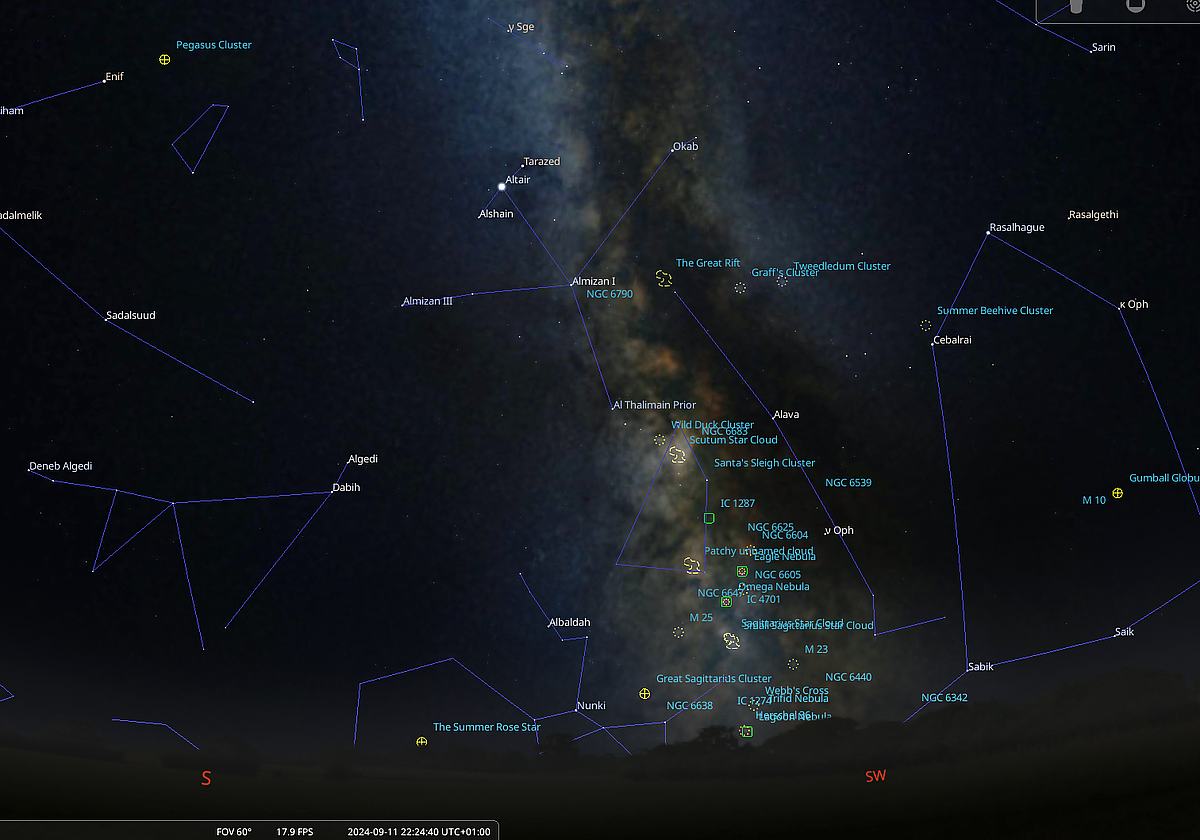
The Milky Way to the SW horizon. September 22:00 - 23:00hrs BST (Click for larger image)
Ancient civilisations revered the Milky Way as a divine watercourse or spiritual path, but its true nature has been understood for more than a century. In recent decades, observations across the electromagnetic spectrum have transformed our view of the Galaxy. It is no longer seen as a classic multi-armed spiral with a central hub, like a Catherine wheel on bonfire night, but as a barred spiral over 120,000 light years across, with two major arms and several smaller ones.
The central bar is made of stars following highly elliptical orbits, spans about 28,000 light years, and bulges at the centre. At its core lies a massive black hole of around four million solar masses. The Sun sits in a quiet stellar neighbourhood, the Orion Spur, about 26,000 light years from the galactic centre and midway between two major arms. The arms themselves are roughly 1,500 light years thick, with the nearest sections about 6,500 light years away.
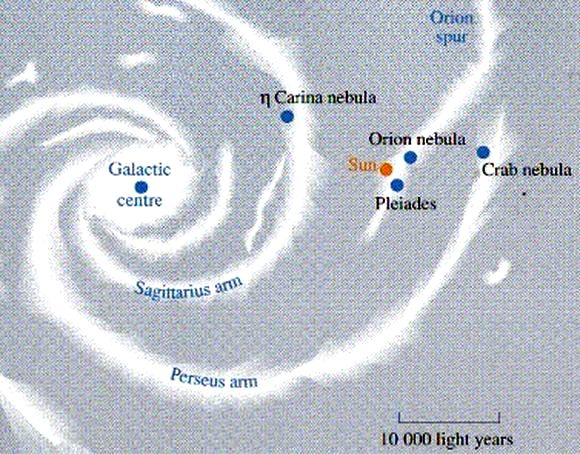 Our Sun's location in the Milky Way.
Our stellar citadel is truly immense: latest estimates suggest it contains 150–350 billion other suns and several trillion planets. Yet all of this accounts for only about 6 percent of the Galaxy’s mass, with the remainder thought to be dark matter.
September therefore offers a wonderful chance to step outside on a clear evening and appreciate the majesty of our galactic heritage. Make time for a leisurely, awe-inspiring cruise along the river of the Milky Way.
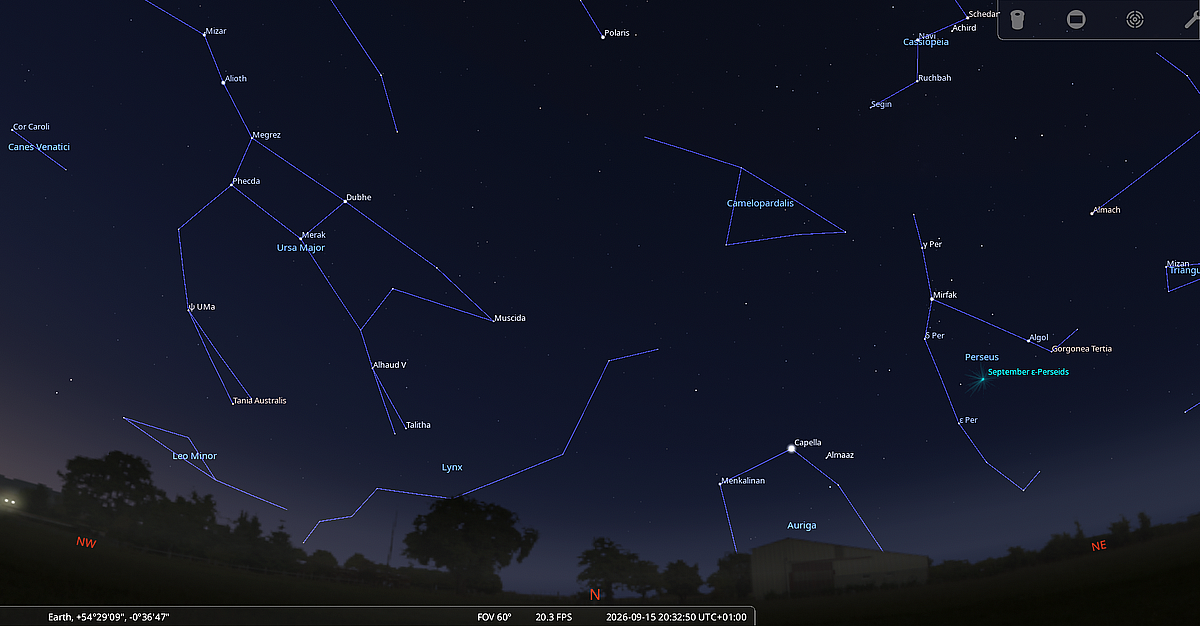
September Sky Charts.
 |
 |
|
Looking North
Sept 15th - 20:30hrs BST |
Looking East |
 |
 |
|
Looking South
Sept 15th - 20:30hrs BST |
Looking West
Sept 15th - 20:30hrs BST |
 |
 |
|
Northern Aspect
Sept 15th - 20:30hrs BST |
Southern Aspect
Sept 15th - 20:30hrs BST |
 |
 |
| Northern Aspect (dawn) Sept 15th - 05:00hrs BST |
Southern Aspect (dawn) Sept 15th - 05:00hrs BST |
Additional Image Credits:
- Planets and Comets where not otherwise mentioned: NASA
- Sky Charts: Stellarium Software and Starry Night Pro Plus 8
- Log in to post comments
