
In this month's Sky Notes:
Planetary Skylights: A Brief Guide to April's Night Sky
 Jupiter is now dropping down in the west heading for the horizon and an encounter with Venus early in June. It will remain a viable observing target only for the first week of May, visible against a darkened sky for just an hour, becoming increasingly challenging for telescopic observation. Jupiter does however remain conspicuous to the naked eye as it descends toward the horizon but is totally outmatched by Venus as the month progresses and the pair draw closer together.
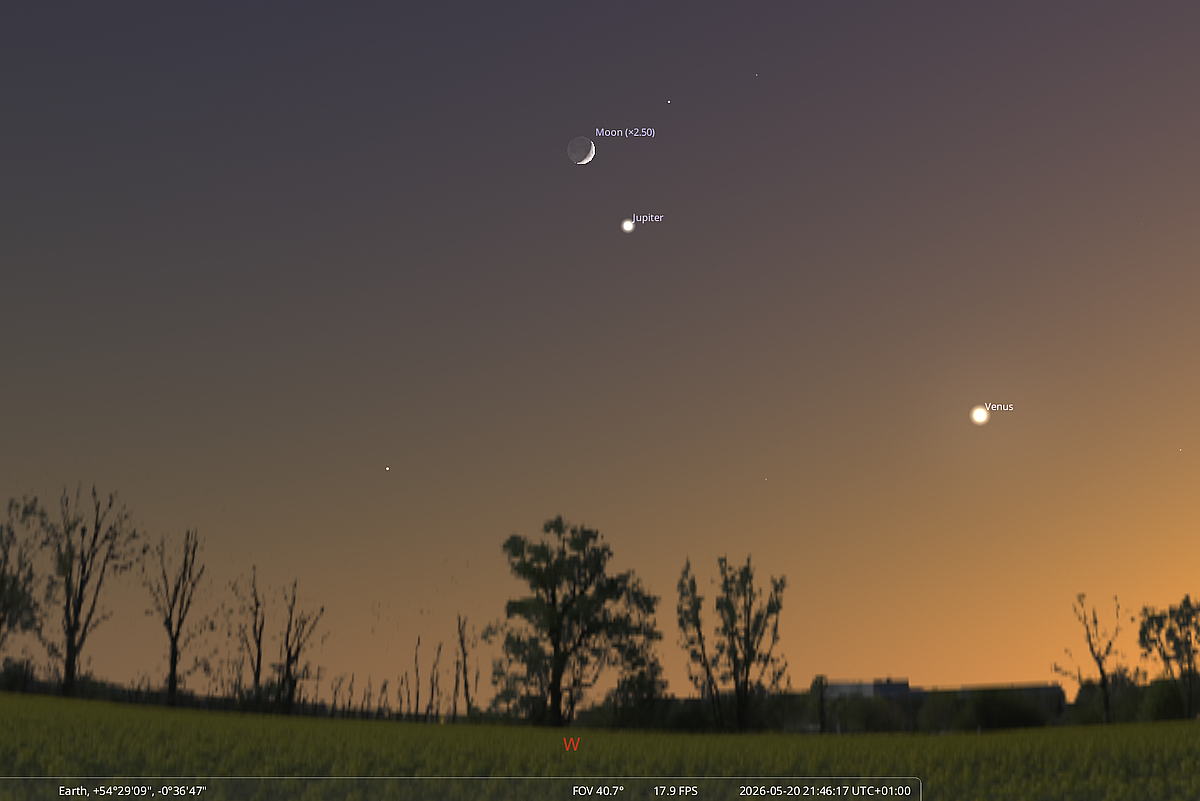
May 20th @ 21:45hrs. Jupiter and crescent Moon in twilight sky. (Click for larger image)
Initially in May, when 'seeing' is favourable, Jupiter will still yield notable views but as it heads towards the northwestern horizon image quality or 'seeing' will decrease due to unstable air. Observers should look for the dark equatorial belts across the oblate dis and the Galilean moons, appearing as small specks of light in Jupiter's equatorial plane. Larger telescopes may initially show additional details, including the Great Red Spot, an immense storm system now a third smaller in size and considerably paler in hue than it appeared a few decades ago. The optimal dates for viewing this feature are May 3rd, 5th, 10th, 15th, 17th, 27th and 29th all around 22:00hrs BST.

Ganymede shadow transit - May 1st @ 21:35hrs. (Click for larger image)
The dynamic orbits of Jupiter's Galilean moons provide fascinating observational interest, not just the daily change in configuration around Jupiter but in particularly shadow transits crossing the disk. These are more limited in the lighter conditions of May as Jupiter drops to the horizon. The most favourable transit events occur on May 1st and 8th - both involving Ganymede, the first around 21:30hrs and the second shortly before midnight. There is a shadow transit of Io on May 18th around 22:00hrs and one of Europa on May 26th around 22:30hrs. A telescope of 100mm (4") aperture and high magnification should be adequate to glimpse the black ‘dot’ like shadows, although instruments of 150mm (6") and above are more preferable.

Ganymede shadow transit - May 8th @ 23:50hrs. (Click for larger image)
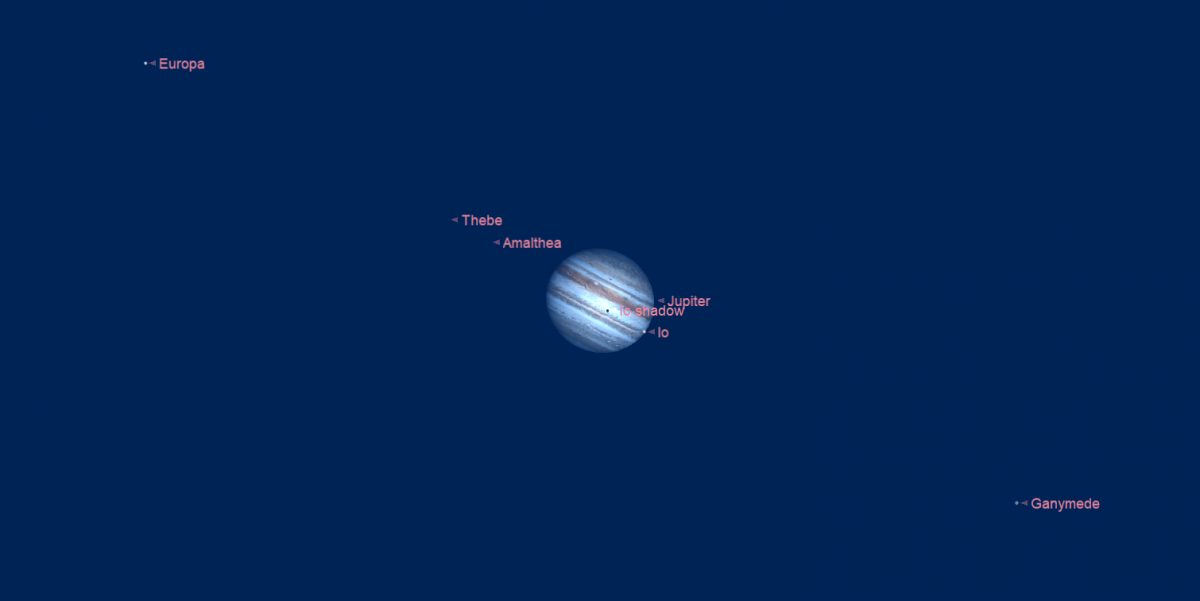
Io shadow transit - May 18th @ 22:00hrs. (Click for larger image)

Europa shadow transit - May 26th @ 22:30hrs. (Click for larger image)
 Venus is now the dominant planetary presence in the evening sky, far outshining Jupiter, the pair setting around 23:30hrs by the end of May. At magnitude -4.0, Venus is certainly eye catching above the west horizon, although it may be obscured by taller buildings or elevated landscapes. By the end of the month Venus and Jupiter are drawing closer together in the sky for a close encounter in early June.

May 18th @ 21:45hrs, Venus and crescent Moon above west horizon. (Click for full image)
Observing Venus through a telescope will reveal little detail, the planet perpetually shrouded in cloud. It should however be possible to discern a phase, which diminishes from 88% to 79% over the course of the month. On May 18th a very slim crescent Moon lies to the right of Venus, view around 21:45hrs BST. A day later the Moon lies between Venus and Jupiter.

Venus, Jupiter and crescent Moon May 19th @ 21:45hrs. (Click for full image)
 Mercury undergoes a mediocre apparition for UK observers near the end of May, visible very low in the west in late evening twilight. An observer will certainly require a flat western aspect and clear skies down to the horizon to be able to spot the elusive 'messenger', and at the critical time. Start scouring lower right of Venus and just above the western horizon shortly before 22:00hrs, a few days before the end of the month. It may be better to use binoculars to help pick Mercury out of the bright twilight, before attempting to spot it with the naked eye, but it may be visible at mag -0.6 Time will not be on the observer’s side, perhaps 15 minutes at best before Mercury drops too low. The planet will gain in elevation as we head into June but will also be diminishing in brightness. A challenge then, but worth having a go!
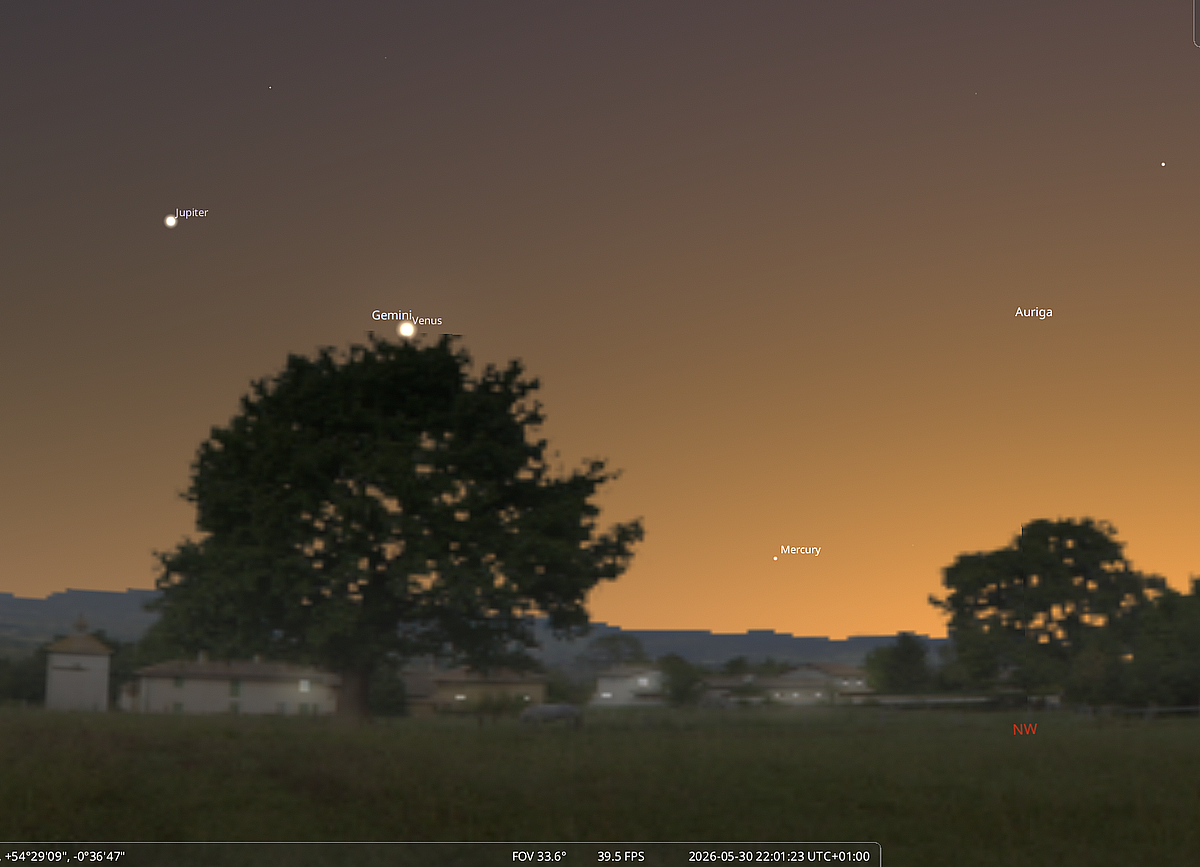
Challenging Mercury in late evening twilight above WNW horizon - end of May @ 22:00hrs.
(Click for full image)
 Saturn returns to the dawn sky towards the end of the month but will be challenging to spot in the in the morning twilight glow due east. You will need to be up at 03:00hrs during the final week of May to have a chance in spotting it or just wait until late Summer when it becomes a late evening object.

Saturn above east horizon - May 30th @ 03:45hrs. (Click for larger image)
May Meteors

The Eta Aquarid meteor shower is this month's major shower with peak activity falling in the predawn hours of May 6th. Considered a strong shower from more southerly latitudes, the ZHR can be as high as 50 or so. From the UK the shower's radiant is quite low with Aquarius only just rising in the early morning hours at this time of year, observed rates being in the 10-15 per hour bracket. The shower is one of two associated with debris particles deposited over time by comet Halley, the other shower being the Orionids seen in late October. Eta Aquarids are some of the swiftest meteors at 67km/s or 41miles/sec. View to the east, south, and high to the southeast around 03:30hrs in the early hours of the 6th and you should hopefully spot a few bright examples. Moonlight from a waning gibbous Moon will somewhat hinder observations.
Noctilucent Cloud/Aurora/T Cor B
The end of May is normally the start of the Noctilucent cloud season, so keep an eye out post 23:00hrs above the northern horizon.
Noctilucent cloud only forms during the summer months becoming visible long after sunset, often around midnight and only above the northern horizon. NCL formations exhibit a characteristic silvery-blue hue and are filamentary in structure appearing quite beautiful.
Our Sun is still active and therefore the chances of auroral activity continues, however the shorter nights do not aid the observer with this. Keep abreast of the various aurora alert websites – you never know!
And finally, the recurrent nova T Corona Borealis has still not erupted keeping astronomers waiting on tender hooks. There is speculation the outburst could occur at the next 228-day perihelion orbital passage, which is on June 25th, 2026, followed by another in February 2027. But then again, it could erupt anytime. Keep abreast of the media.
May Night Sky
With the hours of darkness continuing to erode, astronomical twilight (the deepest level of darkness) is not reached from UK latitudes as we head through May, not returning until early August. Constellation recognition during the evening becomes increasingly tricky with a semi-viable observing window of little more than 3 hours by the month's end, taking it into the realm of the dedicated astronomer! All is not lost for the casual 'star gazer' however and by utilising the more conspicuous stars, together with the odd, brighter star pattern, you may still navigate around the night sky.

Mid-May night sky - around 23:00hrs BST. (Click for full image).
Over the duration of the first few weeks of May, the last vestiges of seasonal winter constellations are lost to bright twilight. Canis Minor and Gemini, highlighted by the stars Procyon, Castor and Pollux respectively, last to depart in the west. The prominent circumpolar ‘winter’ star, Capella, in the constellation of Auriga, drops down toward the NW horizon in preparation for its 'summer holiday' low to the north. Ahead of the charioteer, the stars associated with the great hero, Perseus, sweep along the NNW horizon.

Setting seasonal winter groups and circumpolar 'tourists'. (Click for full image)
The familiar Plough or Big Dipper asterism forming the hindquarters of Ursa Major - the Great Bear, is located almost overhead during May, the asterism emerging around 23:00hrs. Follow the natural sweep of 3 stars in the handle of the Plough and ‘arc to Arcturus’, the brilliant amber star in Boötes located high in the SSE. Flatten this curve out and then 'speed on to Spica' - chief star in Virgo located down in the south.

Virgo, Bootes, Libra and Ophiuchus - the Southeast aspect. (Click for full image)
Lower right of Spica, note the faint outline of Corvus the Crow, a constellation sometimes known as 'Spica's spanker', referencing the type of sail this outline suggests. To the right of Corvus, perpetually out of reach, the bird's drinking cup, Crater stands. These two less prominent, constellations are nevertheless quite distinctive and ride upon the coils of Hydra - the water snake. This predominantly faint constellation, largest in the heavens, is only visible in its entirety above the S horizon from SE to SW, during the first few weeks of May from UK latitudes.
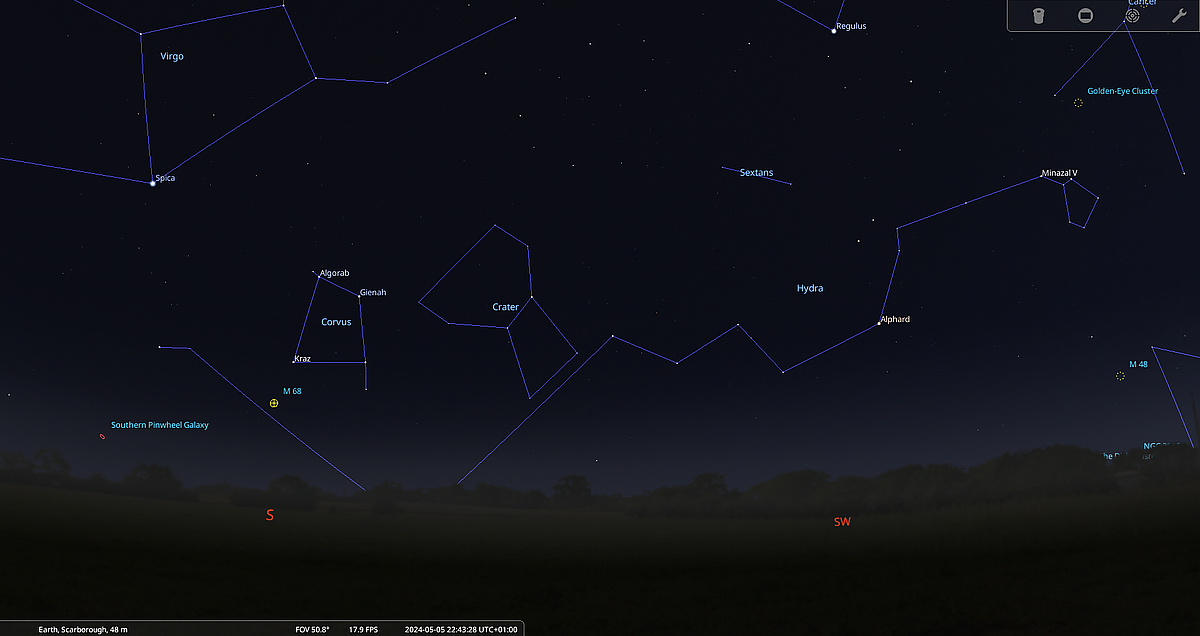
Corvus, Crater and Hydra - early May, post 22:30hrs BST. (Click for full image)
Higher in SSW stands Leo, the spring skies signature constellation, identified by the ‘sickle’ asterism, a stellar arrangement highlighted by Regulus, least brilliant of those 1st magnitude stars visible in the night sky from the UK. The 'sickle' asterism, so named because it resembles the outline of that farming implement, looks like a backwards question mark emanating from Regulus. The hindquarters of Leo are marked by a triangular arrangement of stars with the star Denebola marking the rear point.
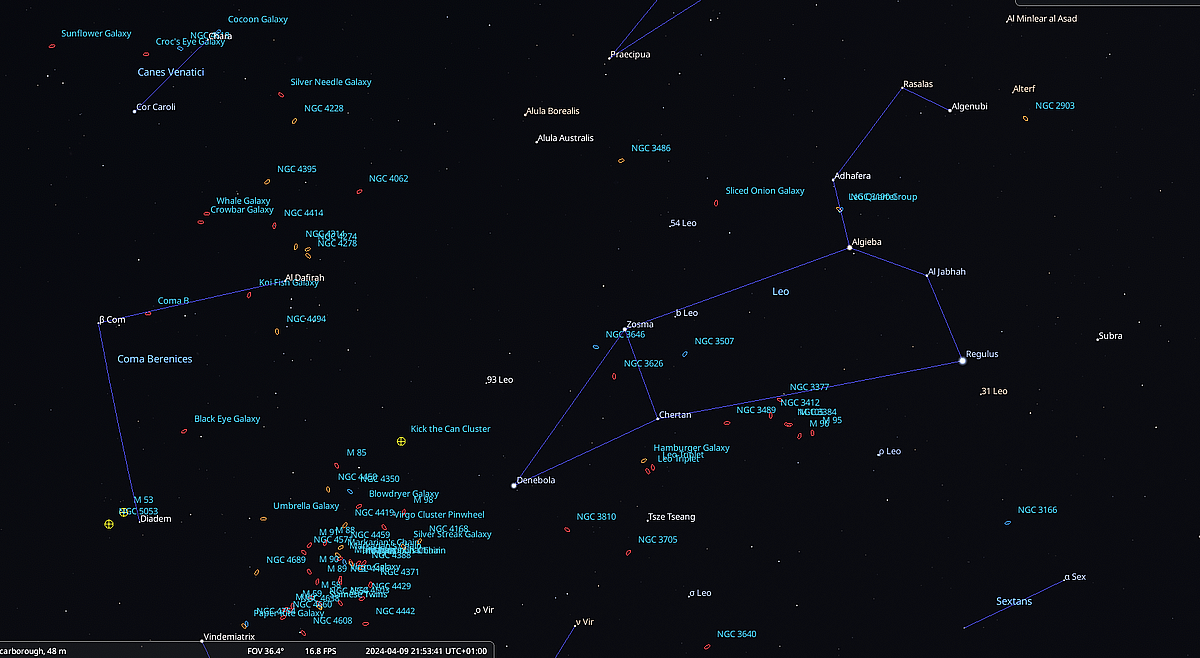
Deep sky objects in Leo, - the 'heart' of the spring sky. (Click for full image)
The area of sky behind Leo and above Virgo has only a smattering of faint naked eye stars probably only visible around midnight. These mark Coma Berenices, a constellation rich in deep sky objects (galaxies mostly) but also includes the messier object M53, a globular cluster. The constellation also contains the Coma galaxy cluster, some 300 million light years distant.
Virgo itself is the largest zodiac constellation and contains many deep sky targets in the Virgo galaxy cluster. The constellation occupies much of the aspect above the southern horizon during May, its outline somewhat resembles a bowl with a crooked leg (a bit like a distorted ‘Y’ pattern). The majority of the cluster members lie above the bowl of the 'Y' and can be identified in amateur scopes, but in ever lighter skies, this task will become increasingly challenging. The whole region of sky bounded by the 'bowl', Coma and the hindquarter of Leo is often referred to as the 'realm of the galaxies', being a window onto the wider universe, well away from intervening galactic gas and dust. Should insomnia strike when nights are clear in May, see how many 'fuzzies' you can track down.
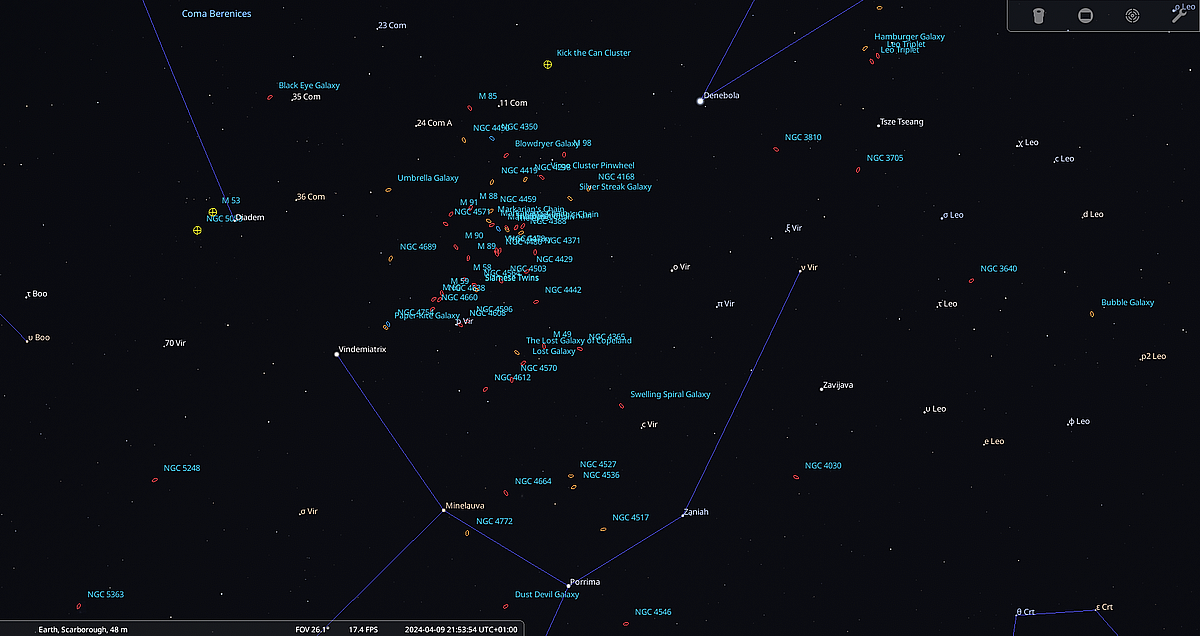
The realm of the galaxies - bowl of Virgo. (Click for full image)
Late in the month, or if observing in the wee small hours, the Scales, or Balance of Libra marks the forward boundary of seasonal summer constellations, especially those located on the ecliptic. The ancient Greeks called the stars we now associate as Libra the Chelae, or “claws,” and were once considered as being part of Scorpius. The constellation's brightest stars: Zubeneschamali and Zubenelgenubi have names derived from Arabic phrases meaning 'northern claw' and 'southern claw' respectively.
Note the bright orange hue of Antares chief star in Scorpius low to the SSE late in May shortly after 23:30hrs. More to be said on these groups and the large, faint, constellation occupying much of the SE aspect above the horizon next month: Ophiuchus, a constellation sometimes neglected during the short light nights of early/mid-summer but rich in DSOs.
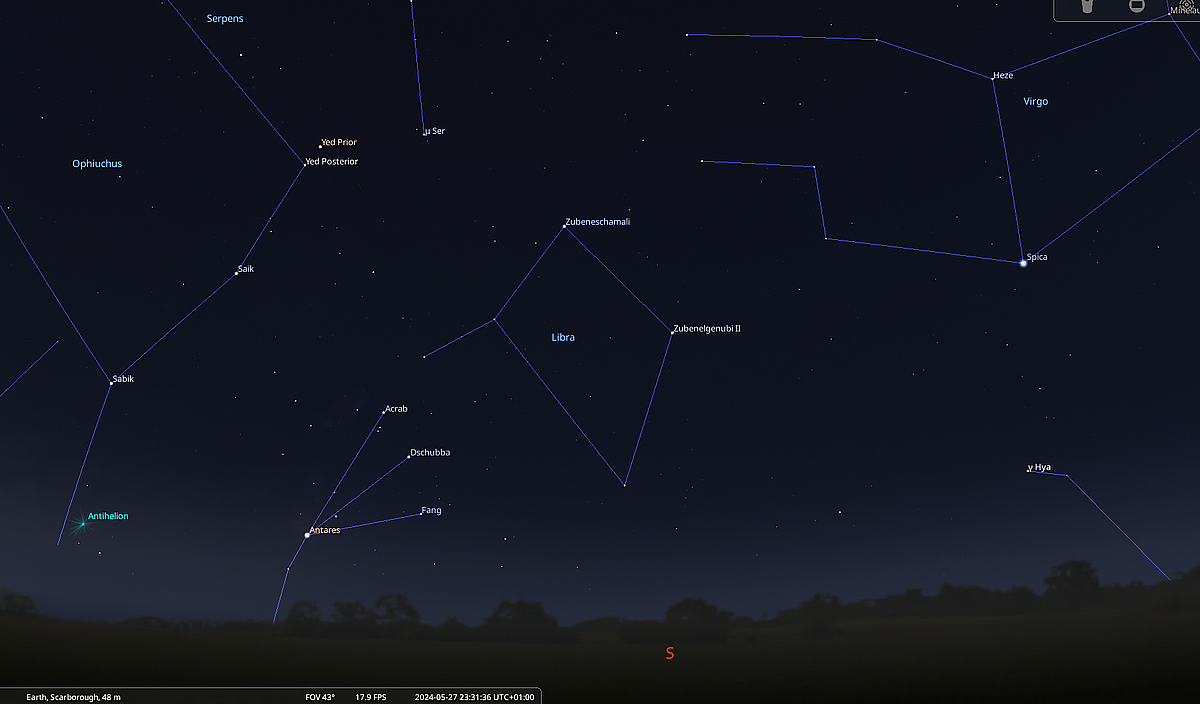
The Scales of Libra - and claws of Scorpius. (Click for full image)
Return now to brilliant Arcturus at the base of the constellation Boötes, the outline of which reminds somewhat of a 'thin kite'. Arcturus is visually the 4th brightest star in the heavens and only surpassed by Sirius from UK shores. It is for 8 months of the year, the brightest star visible at mag -0.05. Lying approximately 37 lights years away, Arcturus is the closest example of an orange giant star and is perhaps 7 billion years old was once not dissimilar to our own Sun. Arcturus has the largest proper motion (real motion through space) of any bright star, a rate of 2 arcseconds per year, cutting across our Sun's trajectory as it orbits around the galaxy. In less than half a million years a telescope will be required just to spot it at all.
Eastwards of Boötes lies the distinctive circlet of stars marking Corona Borealis - the Northern Crown, said to represent the golden crown made by Hephaestus, the god of fire and worn by Princess Ariadne of Crete when she married the god Dionysus (Roman god Bacchus). The constellation is appreciated best in binoculars. The centre star in the tiara is known as Alphecca or Gemma. Keep watch to the lower left of the circlet for the recurrent nova T Cor B, due to erupt again (we hope) this year. It will appear as bright as Alphecca (mag +2) should it do so.
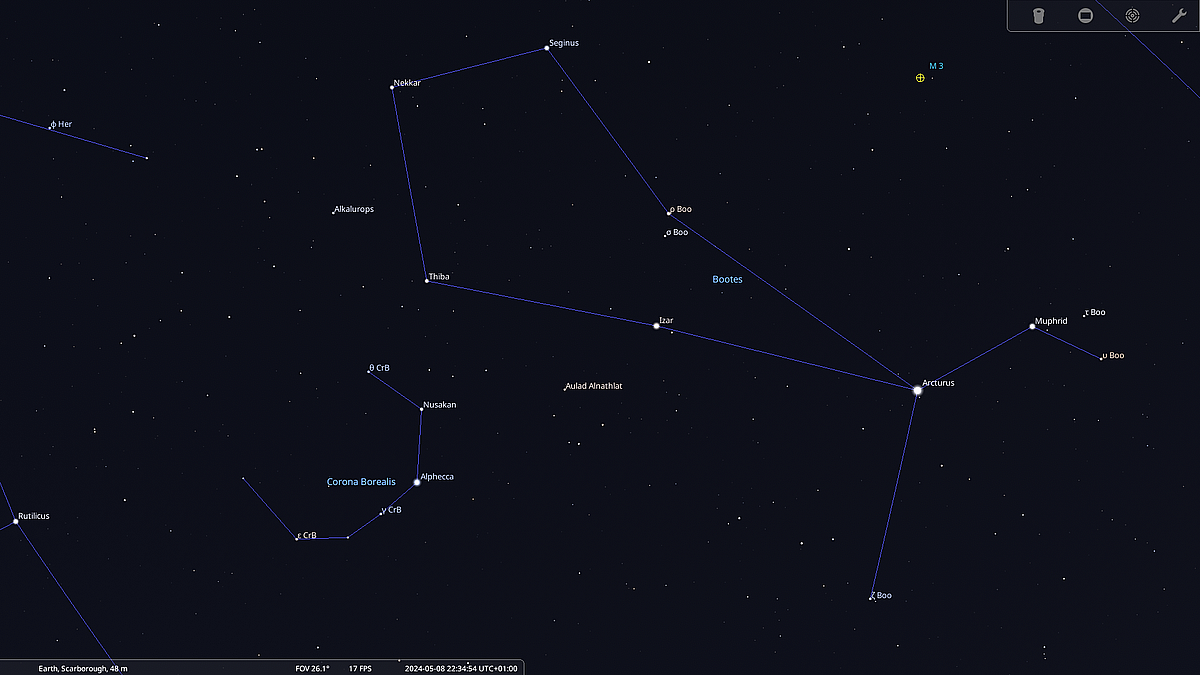
The Herdsman and the Northen Crown. Bootes and Corona Borealis. (Click for full image)
The great hero Hercules follows the crown, a large, ill-defined constellation that contains no real bright stars and is best identified by the Keystone asterism named after its shape. The constellation does however contain the wonderful globular cluster M13 located a third of the way down the right-hand side of the Keystone, marked by eta and zeta herculis. Another fine globular, M92 lies above the keystone stars of pi and eta.
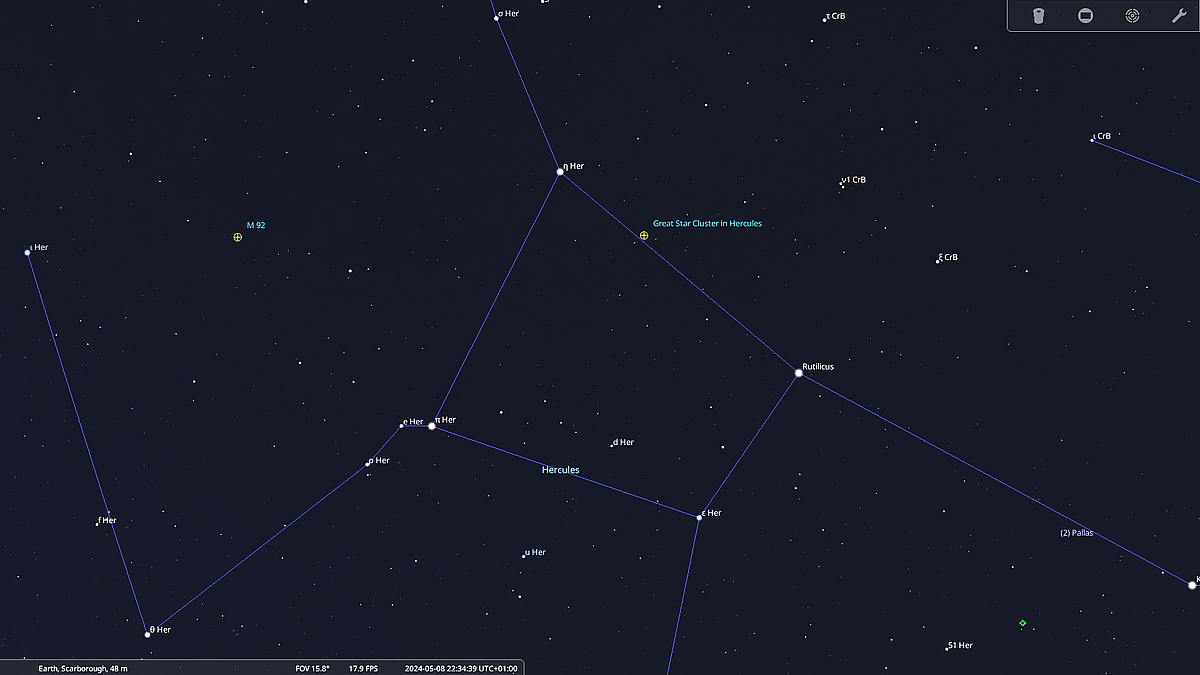
The Keystone asterim in Hercules with M13 and M92 globular clusters. (Click for full image)
Finally, turning to the east, look for the sparkling steely blue hue of Vega in the constellation of Lyra rising in the ENE after its winter long flirtation with the north horizon. It is accompanied by Deneb in Cygnus located lower still in the NE. These circumpolar summer luminaries are now on the comeback road, the third and non-circumpolar member of the 'summer triangle', Altair in Aquila, will become visible low to the east by mid-month.
Serious deep sky observing may then be difficult and inconvenient, but should conditions prove to be mild and clear, it remains a joy just to step outside and admire the ever-changing aspect of the night sky.
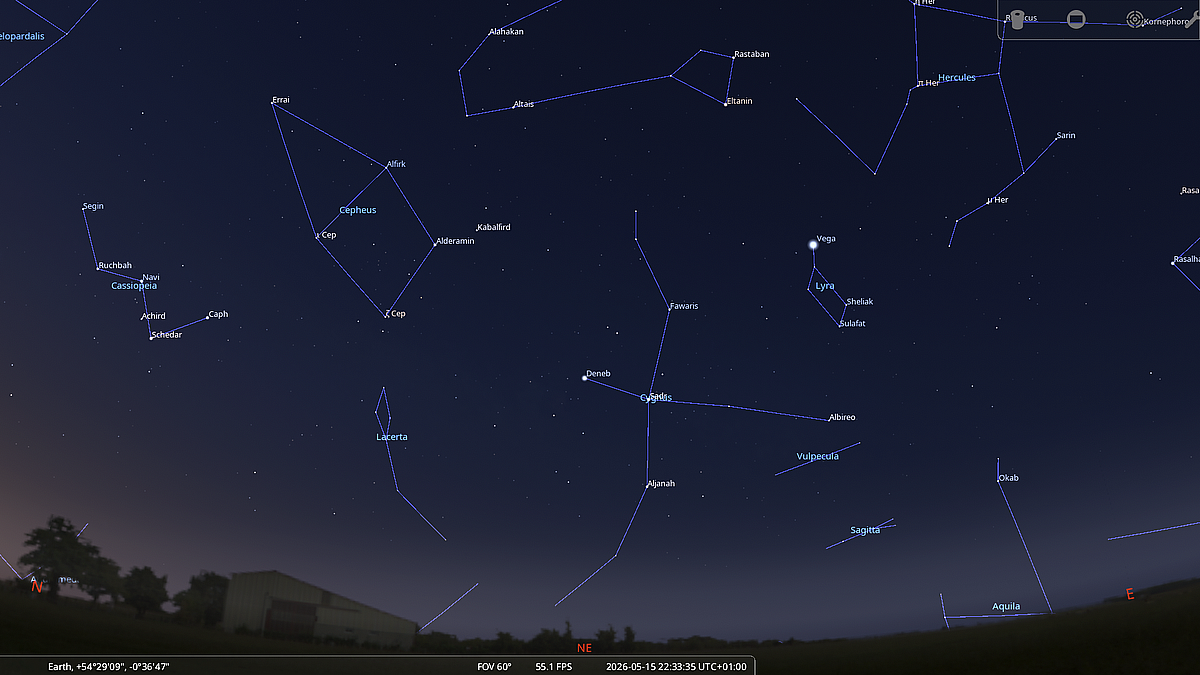
The stars of summer start to rise off the NE horizon. (Click for full image)
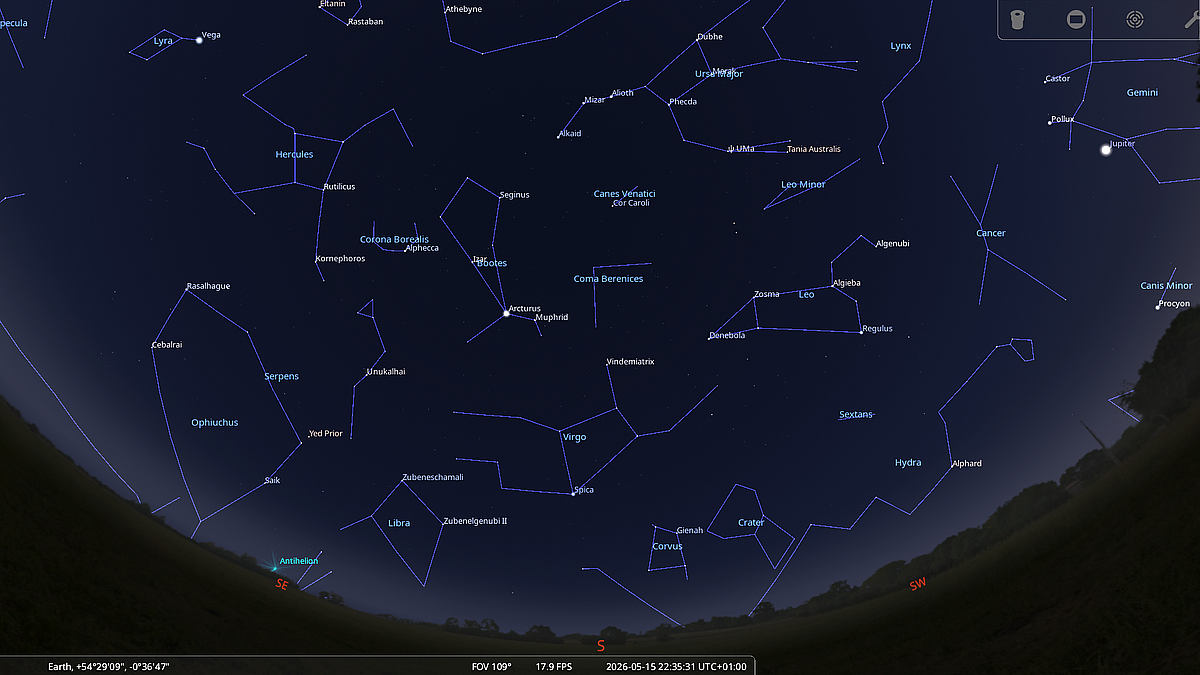
May 2026 Sky Charts
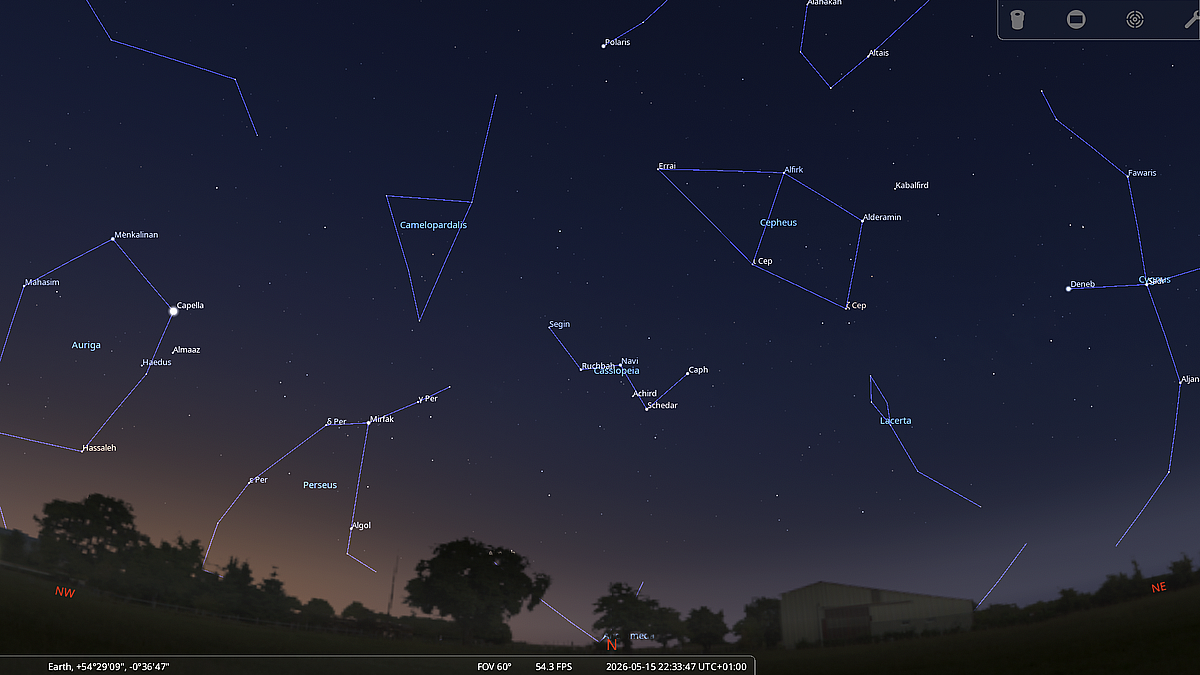 |
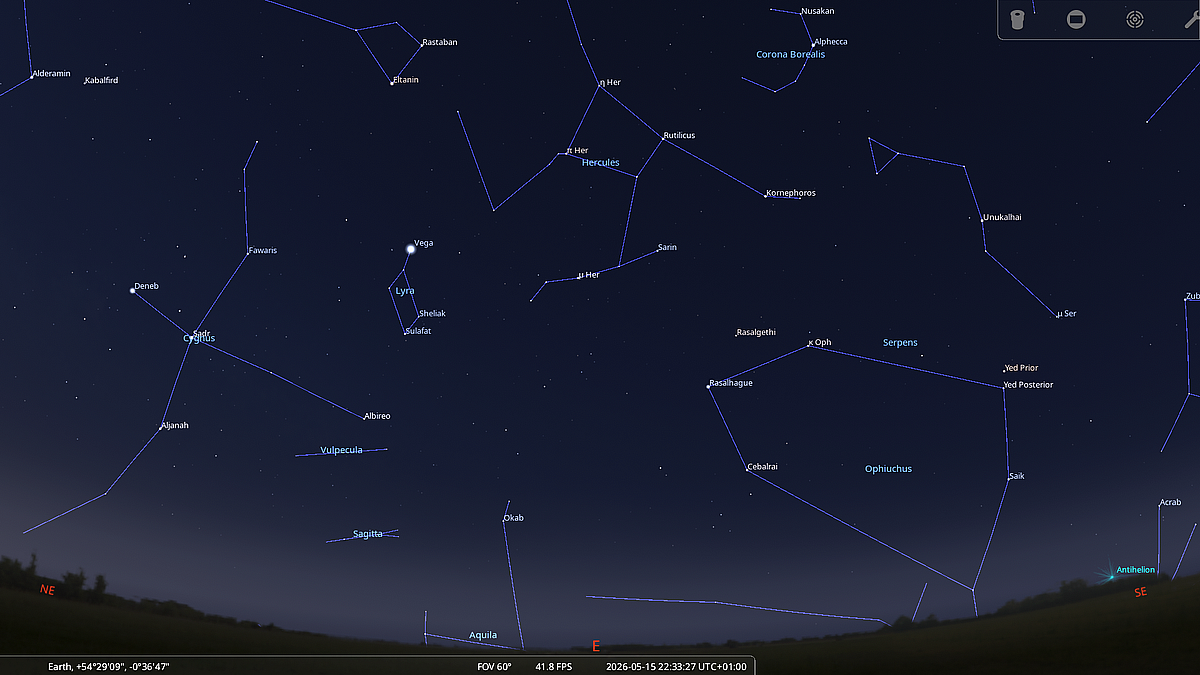 |
|
Looking North
May 15th - 22:30hrs BST |
Looking East |
 |
 |
|
Looking South
May 15th - 22:30hrs BST |
Looking West
May 15th - 22:30hrs BST |
 |
 |
|
Northern Aspect
May 15th - 22:30hrs BST |
Southern Aspect
May 15th - 22:30hrs BST |
 |
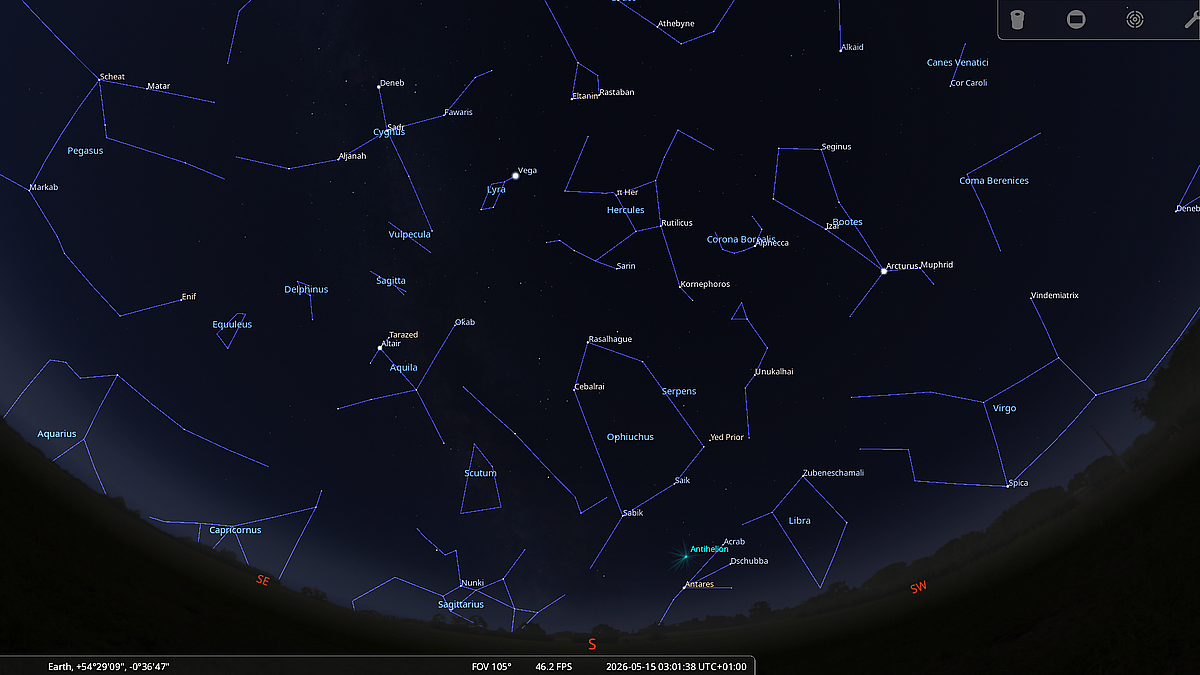 |
| Northern Aspect (dawn) May 15th - 03:00hrs BST |
Southern Aspect (dawn) May 15th - 03:00hrs BST |
Additional Image Credits:
- Planets and Comets where not otherwise mentioned: NASA
- Sky Charts: Stellarium Software and Starry Night Pro Plus 8
- Log in to post comments