
In this month's Sky Notes:
- Planetary Skylights.
- March Meteors.
- The Spring Eqinox.
- March night sky.
- The Messier Marathon.
- March 2026 Sky Charts.
Planetary Skylights - Brief
Jupiter remains the most dominant planet in the night sky, although Venus will grow more prominent in the evening twilight. Saturn departs. Uranus is a telescopic object in Taurus.
 Jupiter remains conspicuous in the night sky amongst the stars of Gemini high to the south as darkness falls. Jupiter’s observing window diminishes from almost 9 hours at the start of March to less than 6 after British Summer Time (BST) comes into operation, still sufficient to scrutinise Jupiter and its satellite family. Jupiter's brightness slightly decreases from -2.5 to -2.3 magnitude during March. On March 26th, a Qtr. phase Moon lies above Jupiter.

March 26th @ 20:00hrs GMT - Jupiter and Moon. (Click for full image)
Jupiter will continue to be a fine spectacle in the eyepiece, the dark equatorial belts across the oblate disk, along with the Galilean moons, visible in instruments as small as 60mm (2.36”) aperture. Telescopes of more than 100mm (4”) aperture utilising medium/high magnification will reveal additional details such as the Great Red Spot, a vast storm system that has decreased in size and intensity over the past three decades. Optimal dates to observe the GRS are March 1st, 4th, 6th, 11th, 16th, 18th, 21st, 23rd, 28th and 30th between 19:30hrs and 21:30hrs GMT.
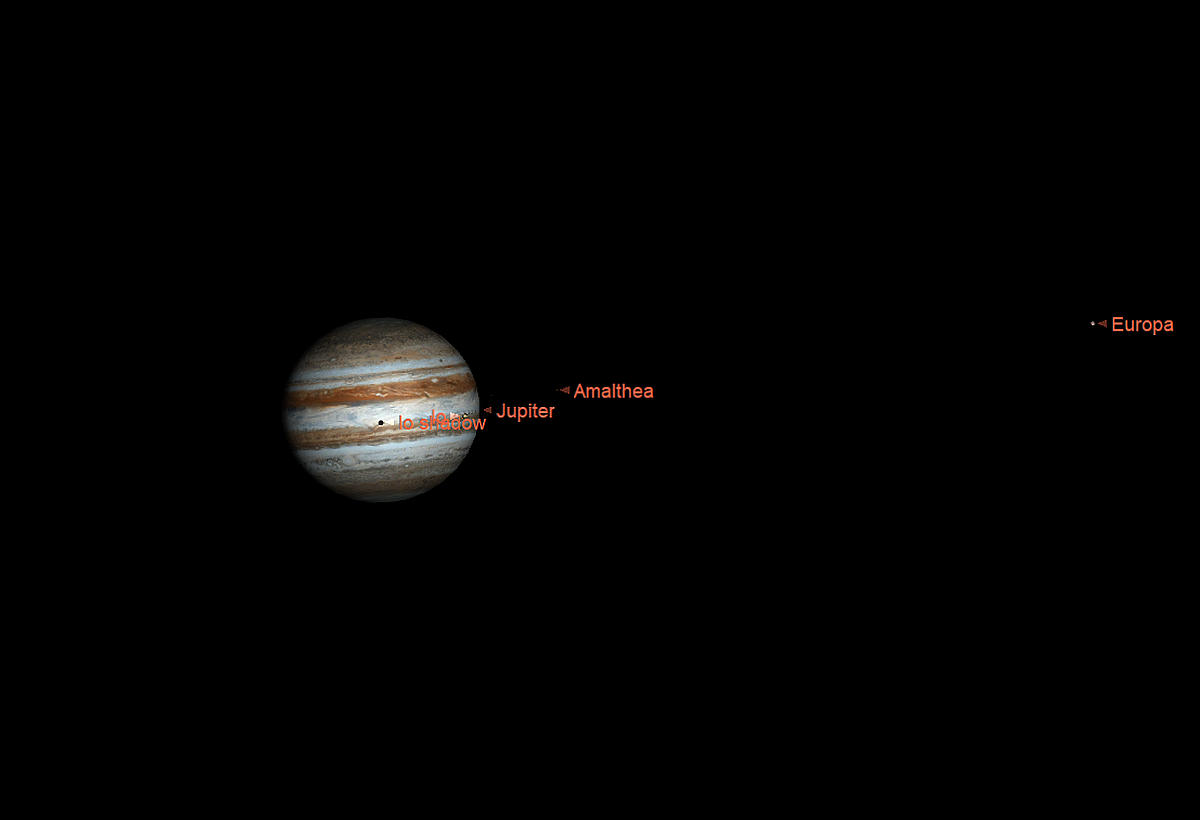
Io shadow transit March 10th - 20:00hrs GMT. (Click for full image)
The dynamic orbits of Jupiter's Galilean moons offer a fascinating spectacle from night to night, especially when shadow transits are visible. Favourable March evening events include; Io on March 10th at 20:00hrs, Europa on March 23rd at 21:00hrs and Ganymede on March 19th at 20:00 hrs and again on March 26th at 23:00hrs BST times. A 100mm aperture with high magnification should be adequate, but 150mm (6") instruments would be more suitable.
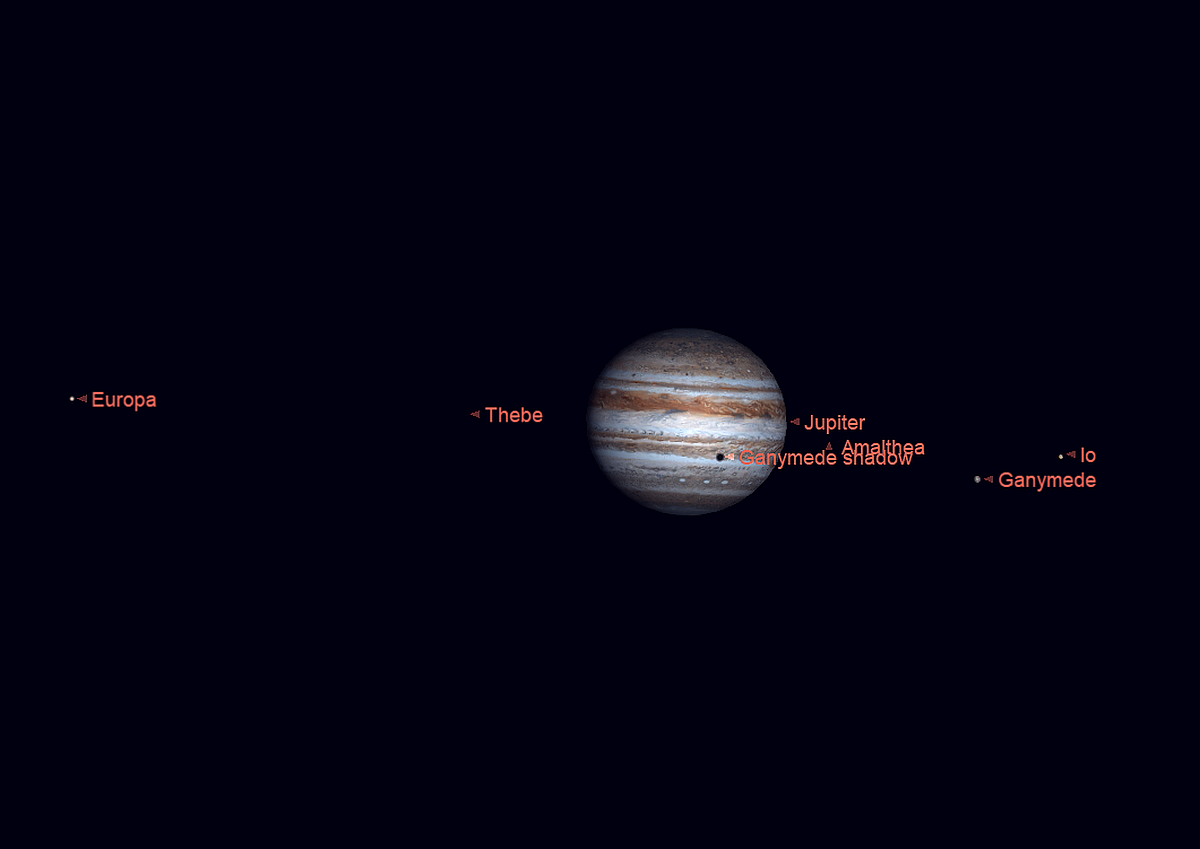
Ganymede shadow transit March 19th @ 20:00hrs GMT. (Click for full image)
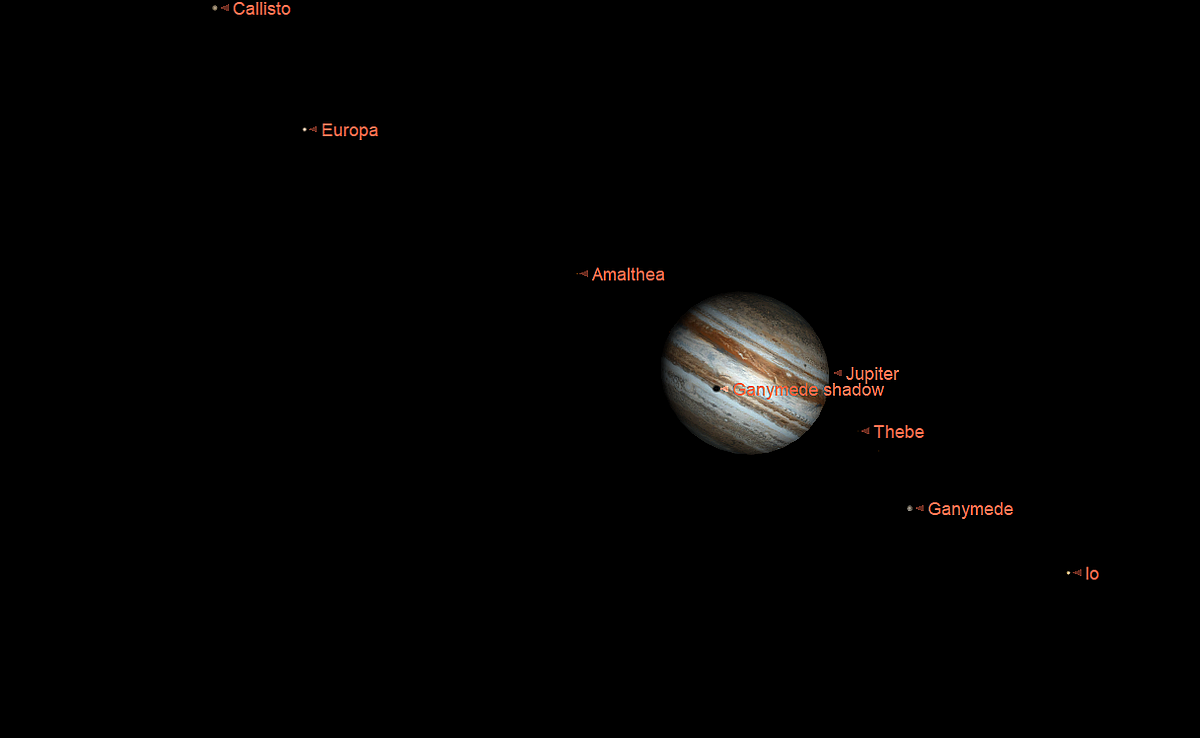
Ganymede shadow transit March 26th @ 23:00hrs GMT. (Click for full image)
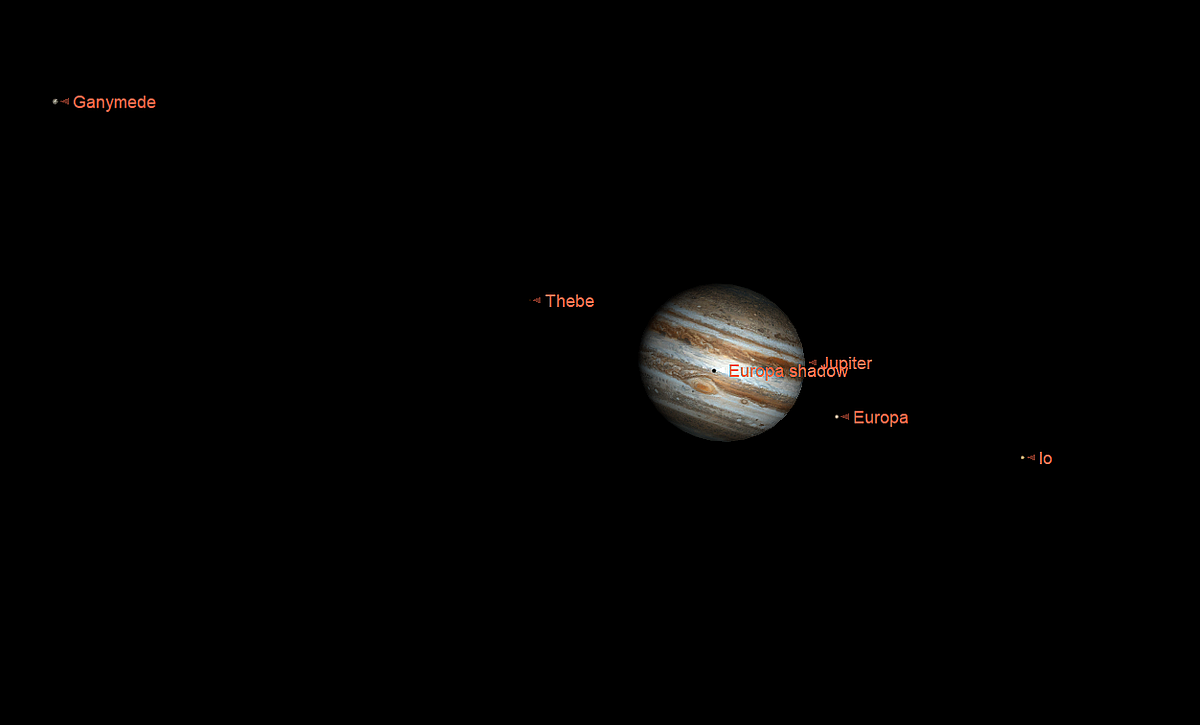
Europa shadow transit March 23rd @ 21:00hrs GMT. (Click for full image)
 Uranus is well placed to track down in the evening sky approximately 4 degrees lower right of the Pleiades star cluster in Taurus. At mag +5.6 Uranus is technically visible to the naked eye but requires binoculars just to show as a brighter speck. Instruments of 80mm plus (3"+) will hint at a planet and above 150mm (6") should clearly define the very small 3.7 arcsecond grey-green disk.
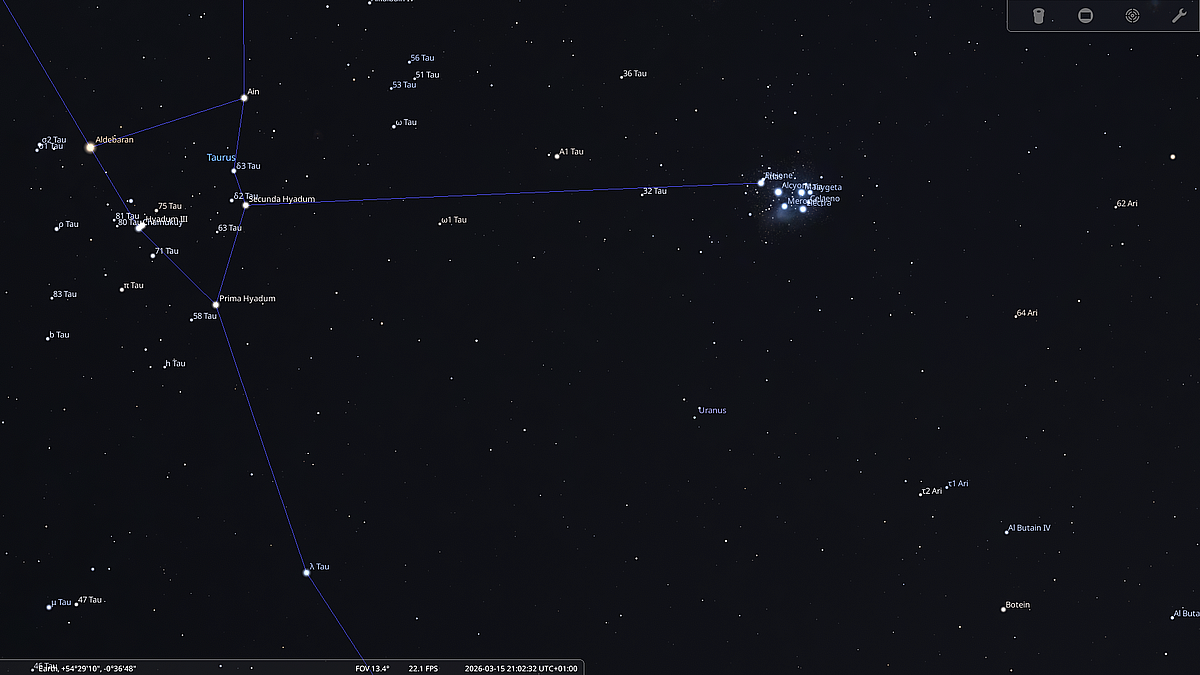
Uranus & Pleiades, mid-March, 21:00hrs general chart. (Click for full image)
Uranus is located just below and right of the pairing of 13 and 14 Tau (both 5th magnitude stars) and is now moving in prograde motion, slowly edging back toward them. Uranus starts to set before midnight by mid-March.
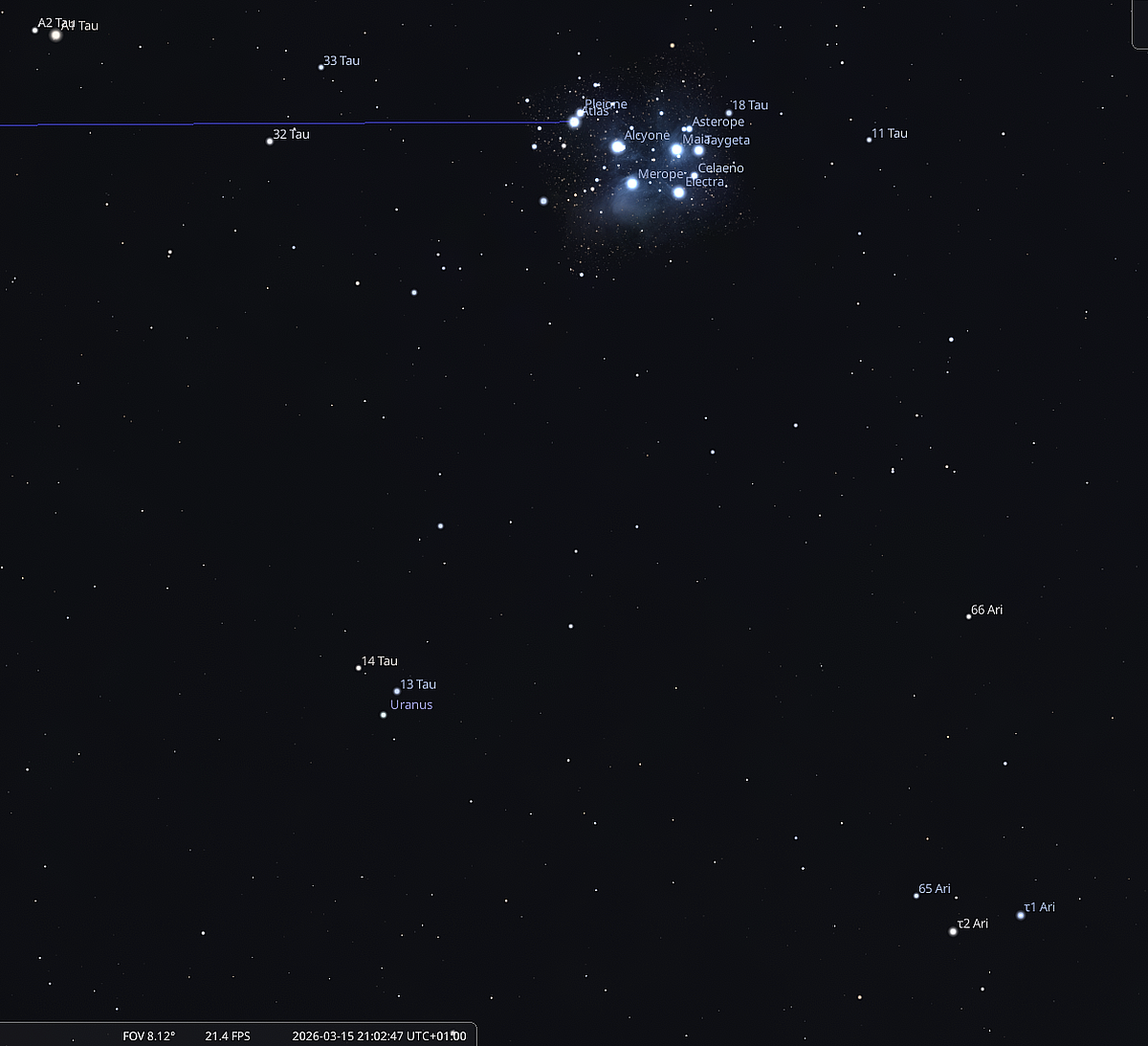
Detailed location chart for Uranus, mid March @ 21:00hrs GMT. (Click for full image)
 As March commences you can find Venus just above the west horizon as evening twilight falls gaining slowly in altitude as the month progresses. At mag -3.9 Venus will appear bright, but its true brilliance will be tempered somewhat by the low altitude and semi-dark sky. It is involved in a conjunction with departing Saturn during the first week in March, but a clear unobstructed west horizon is required to spot them. View throughout the first week from 18:15-18:30hrs GMT.
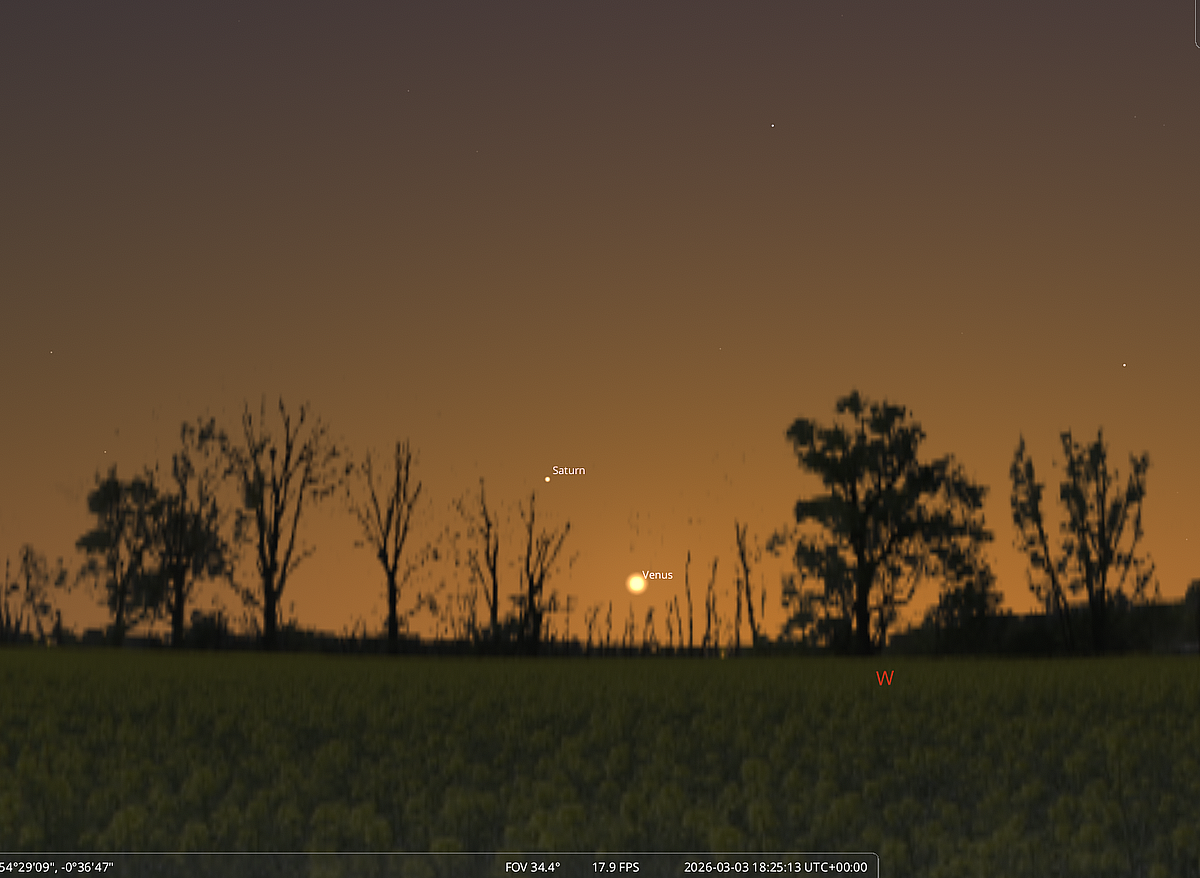
Venus and Saturn conjunction - image shown is March 3rd @ 18:25hrs. (Click for full image)
A very slim crescent moon will be visible above Venus on the 20th, view from 18:30-20:00hrs. Telescopically, Venus is rather bland with little but a phase noticeable - almost full during March. It is often better to view Venus in twilight reducing the glare and allowing any subtle detail to be observed in the duvet of cloud covering the surface to be observed.
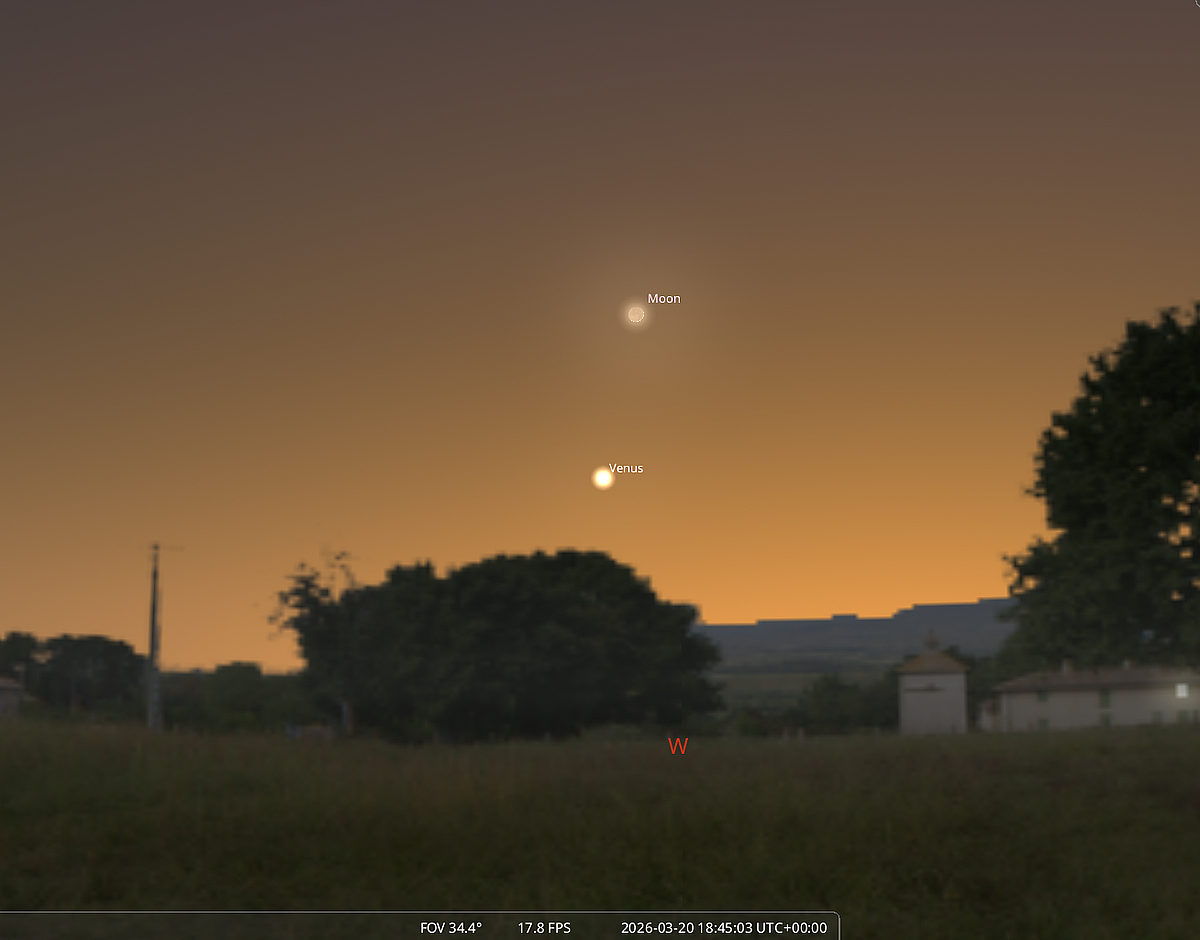
Venus and crescent Moon on March 20th @ 18:45hrs. (Click for larger image)

Venus and crescent Moon on March 20th @ 20:00hrs. (Click for larger image)
 Saturn’s autumn/winter apparition finally comes to a close for UK observers at the end of the first week of the month, but not without one final encounter highlight. As Saturn drops to the west horizon it meets brilliant Venus coming the other way. The view through a telescope is likely to be disappointing, poor seeing close to the horizon robbing us of any clarity, so the conjunction may best be appreciated with the naked eye or a pair of binoculars. View between 18:00 - 18:30hrs.
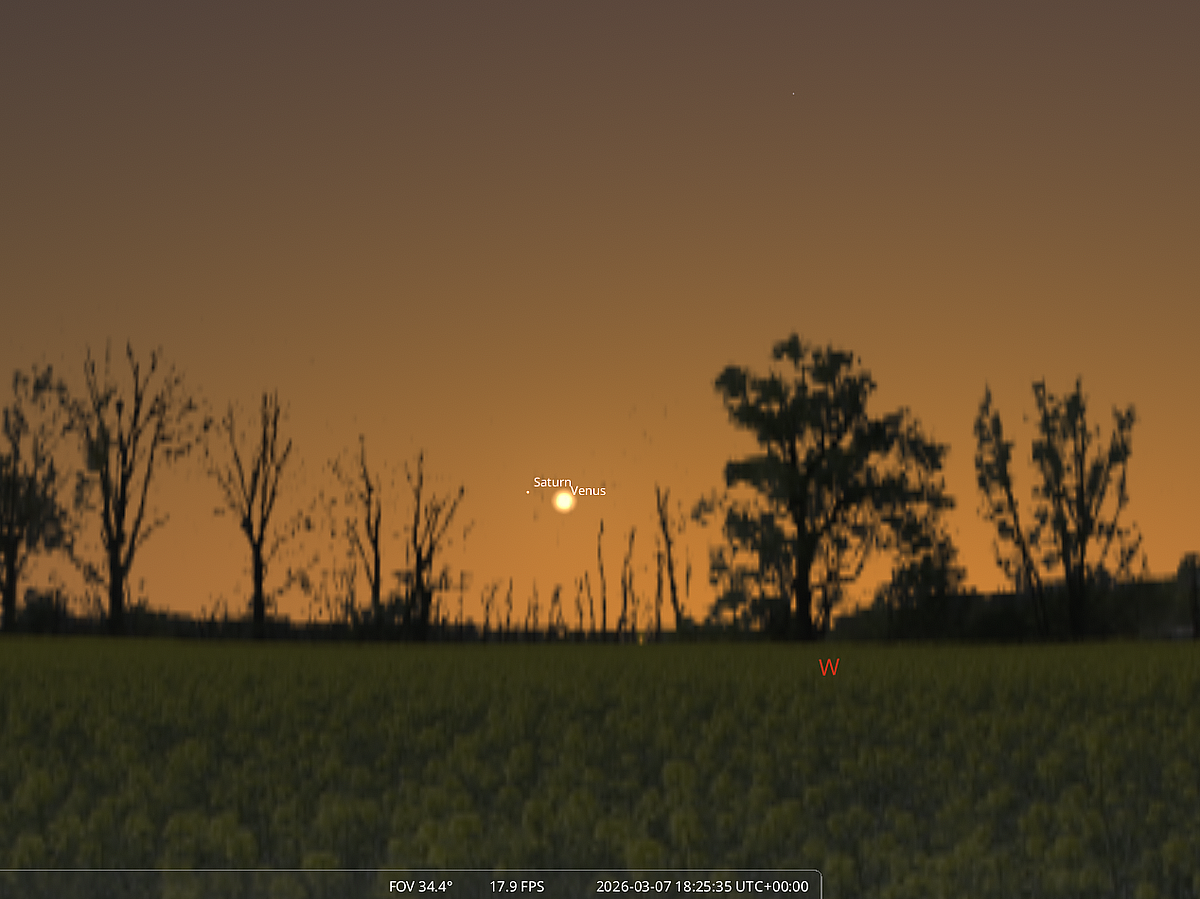
Saturn and Venus conjunction - image shown is March 7th @ 18:25hrs. (Click for full image)
March Meteors

March, like February, is another month with no recognised meteor showers of note. That said, sporadic meteors seen during the period late January to early March are often brighter than average and it has been suggested this 'fireball season', may be a very old, depleted shower, similar in nature to the Geminids. Towards the end of March there are signs of activity from the various and complex Virginid shower, but numbers remain low with 'peak activity' not reached until April. The main radiant lies near Spica and Kappa Virginis, but typically just a few meteors per hour are recorded by an observer. True Virginids are often slow moving and long in duration, occasionally very bright (Jupiter brightness) producing flares along their path.
The Spring Equinox

Spring bursts forth! Hole of Horcum - North York Moors. Image - M Dawson
The date of the Spring or Vernal Equinox, marking the start of astronomical spring in the northern hemisphere falls on March 20th this year. The Vernal Equinox represents a specific moment when the Sun's path on the ecliptic crosses the celestial equator as it appears to move northwards in the sky for the northern hemisphere.
During the spring or autumnal equinox, the Earth's orientation is such that neither pole is inclined toward the Sun, resulting in nearly equal hours of daylight and darkness for all locations. This term, equinox, comes from Latin meaning "equal night". However, it is not entirely accurate that both day and night are exactly 12 hours long on this date, as daylight is still slightly longer. The actual date where daylight and darkness are equal, known as the equilux, occurs a few days before the spring equinox.
As Spring begins, the length of day increases significantly in most areas, except for the tropics, where day lengths remain relatively constant throughout the year. The greatest increase occurs around the spring equinox. Afterward, days continue to lengthen but at a decreasing rate. On the longest day of the year, the summer solstice, this daily difference becomes zero. Locations farther from the equator experience larger day-to-day changes. For example, in Whitby, the day of the spring equinox is 3 minutes longer than the previous day; in Athens, approximately 2000 kilometres or 1200 miles farther south, the difference is about 90 seconds. The Vernal Equinox is also known as the 'First point of Aries', named because the Sun used to be in front of the constellation Aries when it crossed the celestial equator. Although still called the 'first point of Aries', its position is now in Pisces due to precession, which is the Earth's slow wobble.
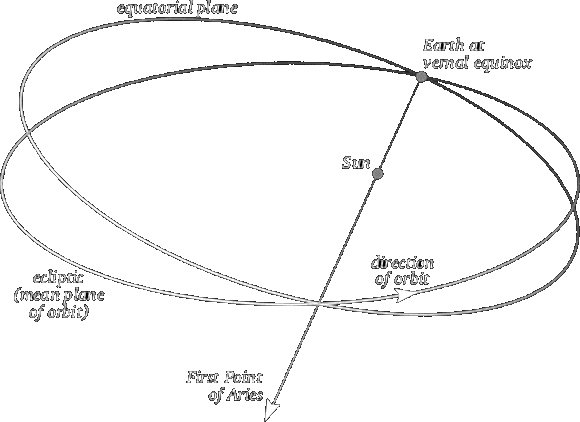
For thousands of years, people have observed that certain star patterns rise just before the Sun at specific times and considered this significant. They mapped the apparent path of the Sun against these constellations, known as the Ecliptic. The broader zone along which planets travel is called the Zodiac, named for the 12 constellations associated with living creatures. The zodiac constellations extend about 8° north and south of the ecliptic. The origins of the zodiac signs date back to Babylonian astronomy around 1500 BC, which evolved into modern astrology. The Babylonians chose 12 zodiac signs, excluding Ophiuchus.

The Ecliptic and Zodiac constellations arranged around the celestial sphere.
Zodiac literally means 'circle of little animals'. Libra was once considered part of Scorpius, specifically its claws. Ophiuchus, the serpent-bearer, immediately following Scorpius, was originally regarded as a zodiac group. When the stars of Libra were given their own status, Ophiuchus was no longer included in the zodiac, which simplified matters for astrologers. For those who have difficulty remembering the order of the zodiac constellations, the following rhyme may be useful.
The Ram, the Bull, the Heavenly twins and next the Crab the Lion shines, the Virgin, and the Scales.
Scorpion, Archer and Sea goat, the man who pours the water out and Fish with glittering tails.
March Night Sky
March is considered one of the best months for observing the night sky for residents of the Northern Hemisphere, including those in the UK. It is a month of significant change encompassing the start of both meteorological spring (March 1st) and astronomical spring (March 20th or 21st). The latter date also marks the Vernal or Spring Equinox. Additionally, in the UK, March heralds the transition to British Summer Time (BST), with clocks advancing by one hour on March 29th this year. Thoughts may well turn to spring but the reach of winter is sometimes long, occasionally offering a sting in the tail.
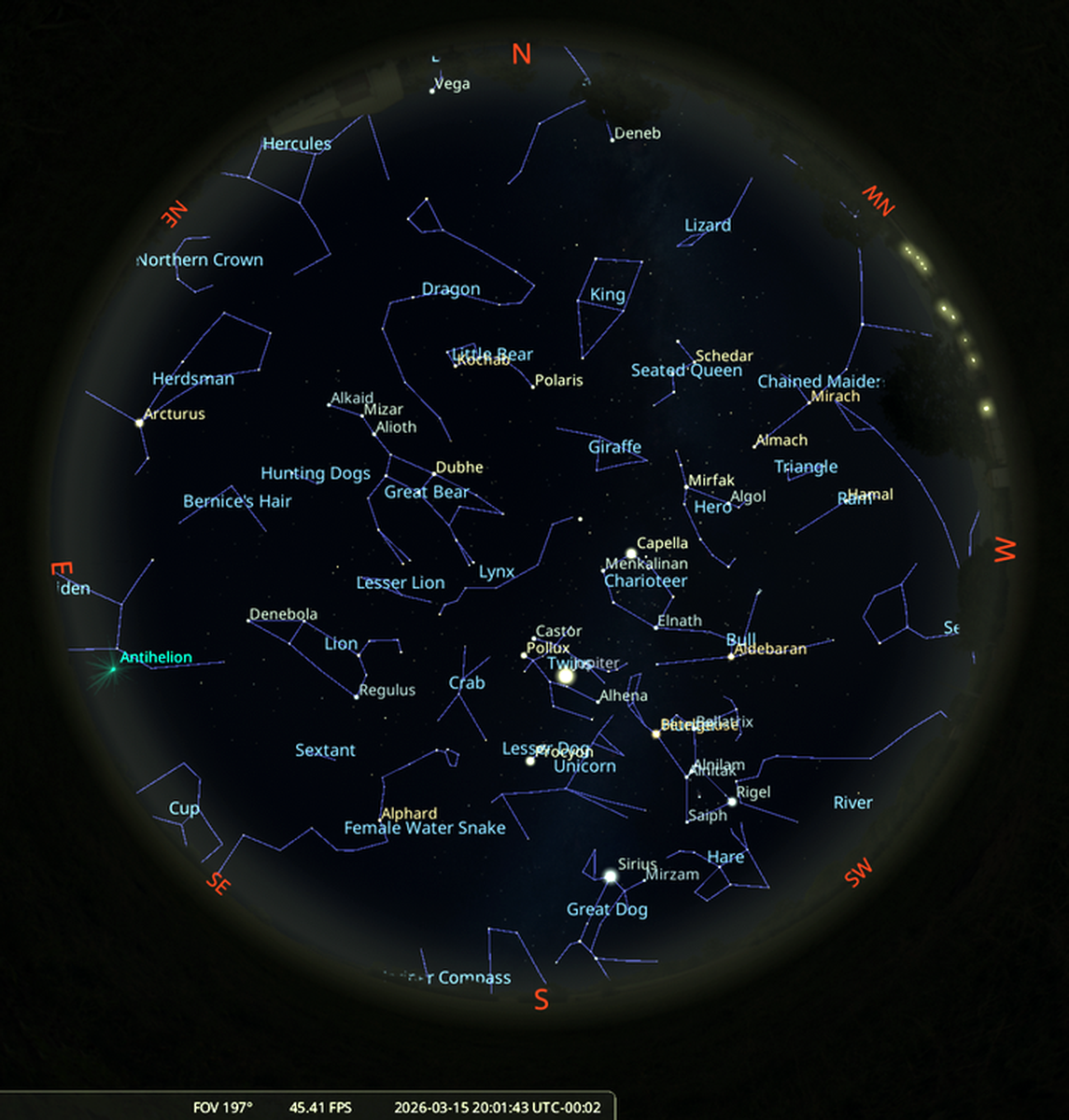
The March night sky, mid-month, mid-evening. (Click for full image)
Amateur astronomers regard March highly favourably for observing the night sky with hours of darkness still surpassing those of daylight until near its conclusion. Evenings should be more conducive to extended observation sessions. Additionally, Earth's pole inclination and orbital position around the Sun allows for the viewing of constellations associated with all four seasons over the course of a single night. Moreover, if moonlight is absent, there exists the possibility of undertaking an extensive celestial observation challenge, the Messier Marathon.
Prior to the commencement of British Summer Time, which is not until March 29th, there is still reasonable visibility of autumnal constellations. As darkness falls, look in the west-northwest (WNW) direction for the Great Square of Pegasus with the stars of Andromeda extending upwards from the horizon towards the figures of Perseus and Cassiopeia high in the NW. Circumpolar summer stars occupy the celestial margins just above the northern horizon, here Vega in Lyra and Deneb in Cygnus catch the eye when not obscured.

Mid-March - northwest aspect @ 20:00hrs GMT. (Click for full image)
The well-known Plough (or Big Dipper) asterism in Ursa Major stands vertically in the northeast. The 'pointer stars' - Dubhe and Merak, marking the rear of the bowl, used to locate Polaris, the Pole Star in Ursa Minor. The celestial dragon, Draco, winds between these two constellations, its head marked by an irregular quadrilateral of stars situated due north not far from the bright star Vega.
As twilight deepens in early March, the distinctive 'W' pattern of Queen Cassiopeia occupies the zenith overhead. This awkward observing location (without lying down), will also see Perseus, whose outline resembles a distorted Pi symbol and Auriga the Charioteer, highlighted by the brilliant circumpolar star Capella, pass through it.
High to the southwest, the 'V' pattern of the Hyades star cluster marks the head of Taurus, pointing down to the northwest horizon. The conspicuous marmalade hue of Aldebaran, the 'eye of the bull', masquerades as a true member but resides at half the distance of genuine cluster members, being approximately 65 light-years closer. To the west of the Hyades, the beautiful Pleiades star cluster, or Seven Sisters, continue to flee from the advances of the mighty hunter Orion, who strides into the western half of the sky, accompanied by the sparkling tableau of winter.
Orion is identified by the sloping line of belt stars, with the first-magnitude luminaries Rigel and Betelgeuse framing the belt. At opposite ends of their life cycles, both are destined to end their days as supernovae. Betelgeuse, a red supergiant, is already nearing the end of its life, potentially just thousands of years hence, while white Rigel has some millions of years remaining, still a mere blink of the cosmic eye.
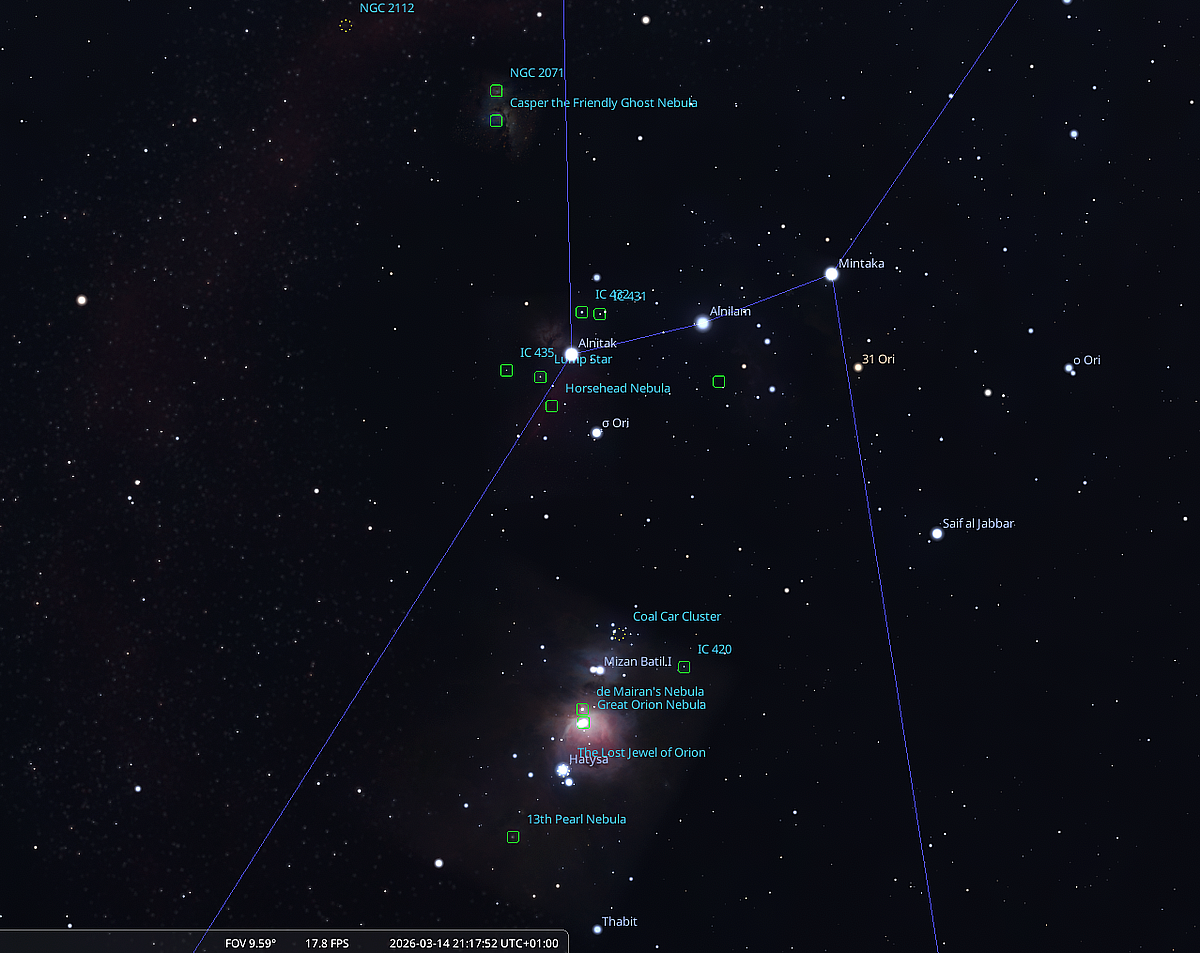
Central Orion and Nebulae. (Click for full image)
Situated beneath the belt stars marking the middle star in the sword of Orion lies one of the most celebrated objects in the night sky, the Orion Nebula. This region of stellar birth is approximately 1300 light-years away and around 2.4 million years old. It comprises a vast cloud of gas and dust 25-35 light-years in extent where star formation is actively occurring. The nebula hosts the richest star cluster within our galactic vicinity, although many stars remain obscured. While the nebula appears as a misty spot through small binoculars, it can be breathtaking when observed through a telescope. Observers should look for the Trapezium star cluster, the 'bully' boys of the creche, visible in even small telescopes. It is the intense radiation from these stars, perhaps a few hundred thousand years old, that has excavated a huge cavity in the cloud allowing observers to view them.
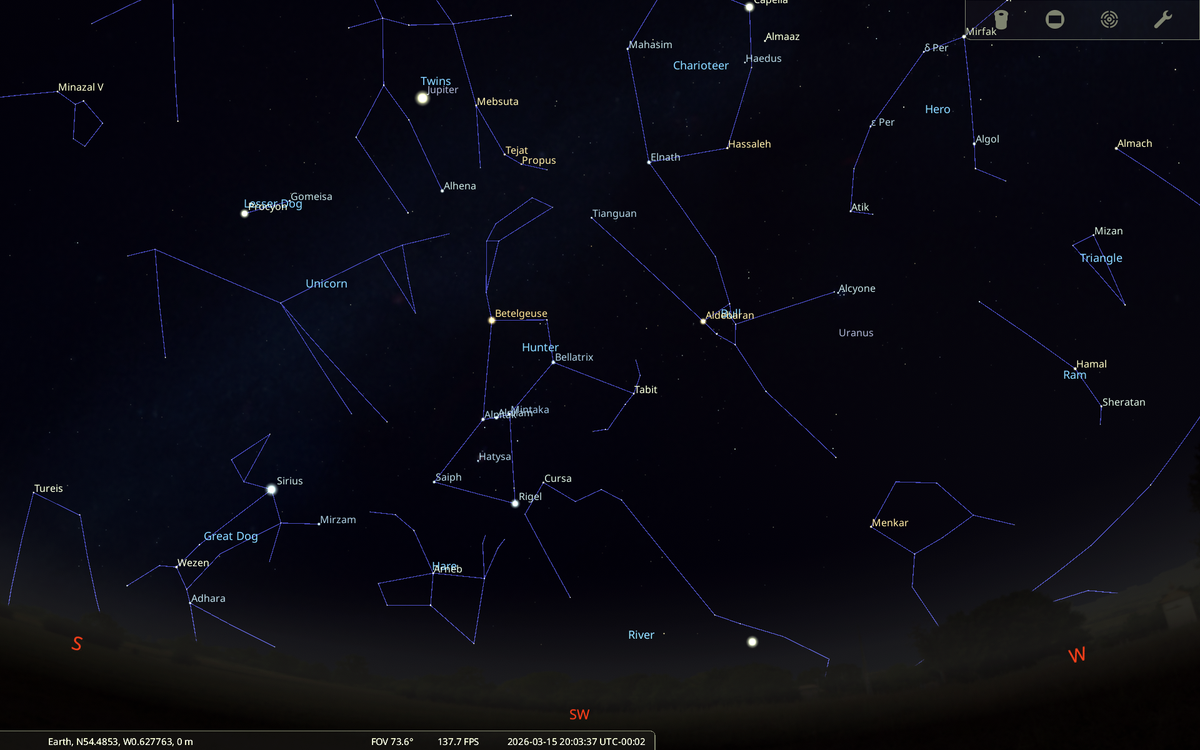
Mid-March, mid-evening, southwest aspect @ 20:00hrs GMT. (Click for full image)
Orion's two hunting dogs, Canis Major and Canis Minor, follow their master across the sky. The belt stars of Orion point towards Sirius, the brightest of all night stars in the constellation of Canes Major visible due south as night falls. The lesser dog, Canis Minor is highlighted by Procyon, another notable winter star found well above Sirius almost level with Betelguese. The brightness of both stars is down to their proximity to Earth, being 8.6 and 11 light-years away respectively. Both stars have companion white dwarf stars that are challenging to observe even with large instruments.
The Winter Milky Way flows up beside Orion, separating the two dogs. Below Orion's feet, above the SSW horizon, lies the timid celestial hare Lepus. To the left of Orion is the modern constellation Monoceros, the Unicorn. Its stars are faint, but the area contains numerous star clusters and nebulae that are not visible to the naked eye but worth seeking out with a telescope. Below the Unicorn, Puppis, part of the defunct constellation Argo Navis, straddles the southern horizon and contains several rich galactic clusters and nebulae, including the Messier objects M46, M47, and M93.
Eridanus, the longest constellation in the sky, occupies much of the area lower right of Orion. The river starts near Rigel, marked by Cursa (Beta Eridani), and flows parallel to the southern horizon before descending into the southern hemisphere, ending at the brilliant star Achernar. To the upper left of Orion, one can observe the Twins of Gemini, distinguished by the two stars, Castor and Pollux. Castor, situated further north, is slightly dimmer than its twin Pollux, which emits a pale amber glow. While Castor appears solitary to the unaided eye and through binoculars, it is a sextuplet system, with the brightest two components separable in modest telescopes under stable atmospheric conditions. The planet Jupiter currently dominates Gemini.

Mid-March, mid-evening - southeast aspect @ 20:00hrs GMT. (Click for full image)
As March advances, winter constellations gradually shuffle westward, allowing spring constellations to seize the celestial centre stage. The unremarkable stars of Cancer follow Gemini and signify the transition between seasons. Although faint, Cancer is home to the splendid open cluster M44, also known as the Beehive Cluster or Praesepe. The most prominent constellation of spring, Leo the Lion, follows next, identifiable by the distinctive 'Sickle' asterism at the base of which lies bright Regulus, positioned almost on the ecliptic.
Ahead of Regulus and below Procyon, a faint but distinct 'knot' of stars marks the head of Hydra, the largest constellation by area in the entire night sky. Hydra's chief star, Alphard - known as the 'Lonely one' due to its isolated location, is recognizable by its amber hue and relative brightness. It is situated some distance below the head. Hydra is so large, only by the early morning hours at the month's end is the entirety of the snake visible. Hydra is accompanied by two constellations resting on its coils: Crater the Cup and Corvus the Crow. Corvus is sometimes referred to as Spica’s spanker. More on this next month.
Look towards the east to note the returning brilliant amber hue of Arcturus in the constellation Boötes, the Herdsman. It is the second brightest star visible from the UK after Sirius. Upper left of Boötes sits Corona Borealis, the delicate crown very much the attention of astronomers across the globe waiting for nova T Cor B to erupt.

Mid- March - mid-evening - northeast aspect @ 20:00hrs GMT.
(Click for full image)
Finally, toward the latter part of March, Spica, chief star in the constellation Virgo, reappears in our skies after being below the horizon for almost six months. The symbol of crop sowing joins the throng of 1st magnitude stars already visible in the sky, its appearance signalling longer, warmer days are ahead, banishing the majority constellations associated with the long, dark nights of winter from view.
The Messier Marathon
Should overnight skies fall clear this month, particularly the mid-March/Spring equinox period, astronomers may consider undertaking an observing challenge, a race against time and a test of observational dexterity. Known as the Messier marathon, this endeavour involves identifying between sunset and sunrise, as many objects catalogued by the renowned French astronomer Charles Messier, the leading comet discoverer of the mid-18th century.
Over the intervening years, the Messier catalogue has been revised multiple times and currently lists 110 objects. These include galaxies, star clusters, nebulae, and the catalyst for Messier's work, the supernova remnant in Taurus known as the Crab Nebula (M1). The great nebula in Orion is identified as M42, the Pleiades as M45, the Andromeda galaxy as M31, and the Ring nebula as M57.
On any given clear night, at least a few dozen Messier objects may be visible. However, due to their distribution in the sky, early spring is particularly suited. Galaxies and open star clusters are abundant throughout the winter/spring constellations visible during the first part of the night, while globular clusters and nebulae associated with summer skies are abundant before dawn. Hence, the concept of the Messier Marathon emerged, an all-night endurance race to 'bag' as many entries before sunrise. A simple pair of binoculars is sufficient to view a significant number of these objects, some of which are easily visible to the naked eye.
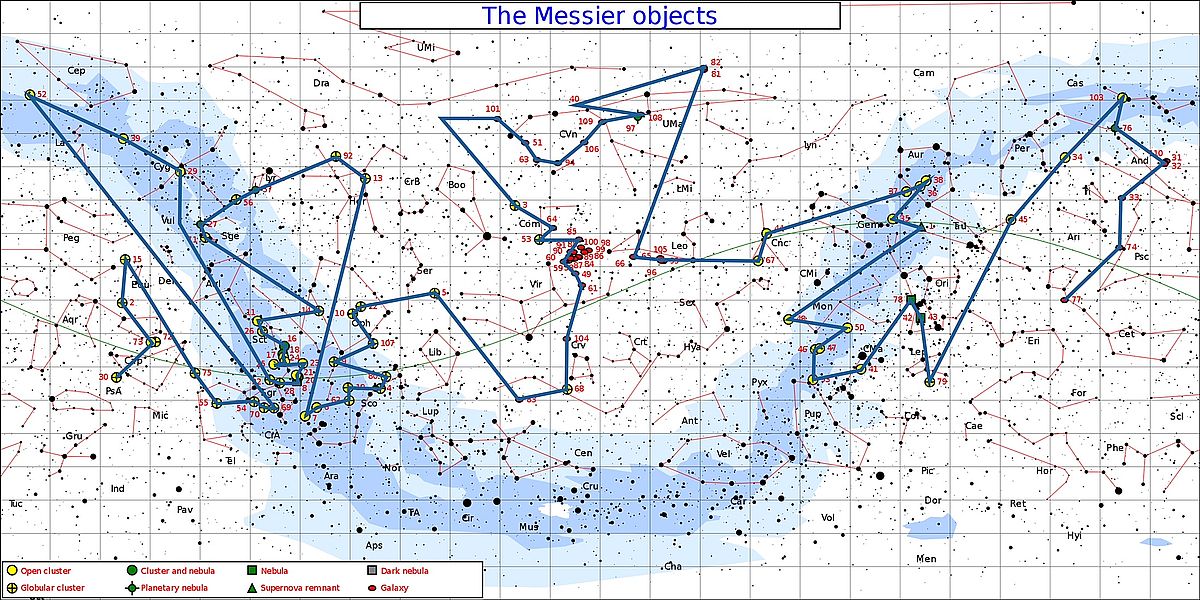
A observational guide path for Messier objects.
Image credit; Jim Cornmell and Mark Hardaker. (Click for full image)
All the entries can be observed with a 120mm reflector or refractor telescope. Therefore, with modest equipment, a sky chart or app and basic knowledge of the night sky, even novice astronomers can identify around three dozen objects without burning too much midnight oil.
Dark sky factors are quite favourable this year, with moonlight absent during the first 3 weeks of the month, creating ideal conditions for deep-sky observations, provided the weather co-operates.
Attempted by amateur astronomers in the Northern Hemisphere, where the challenge is only possible, very few complete it successfully. From mid-northern latitudes - including the UK, it is not actually possible to observe all 110 objects, those observers stationed at more southerly northern latitudes being more favoured. Nevertheless, it is still fun to strive for personal bests. We’ll look in more detail at the March meeting.
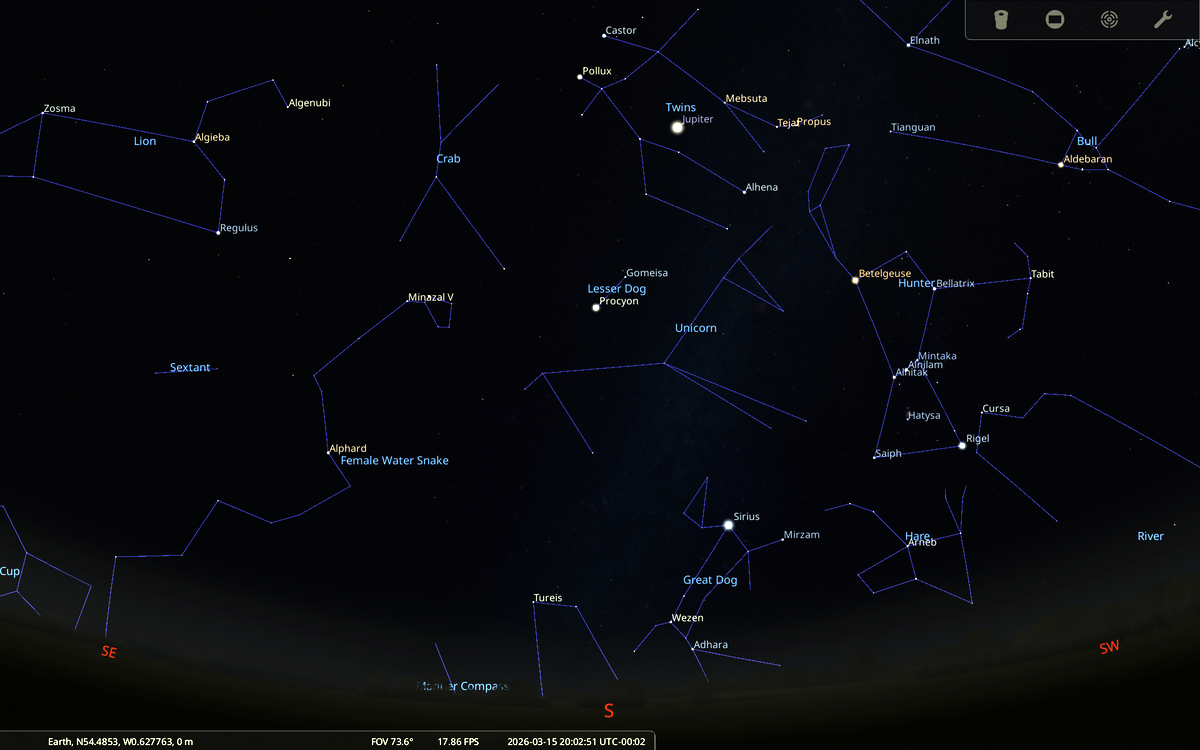
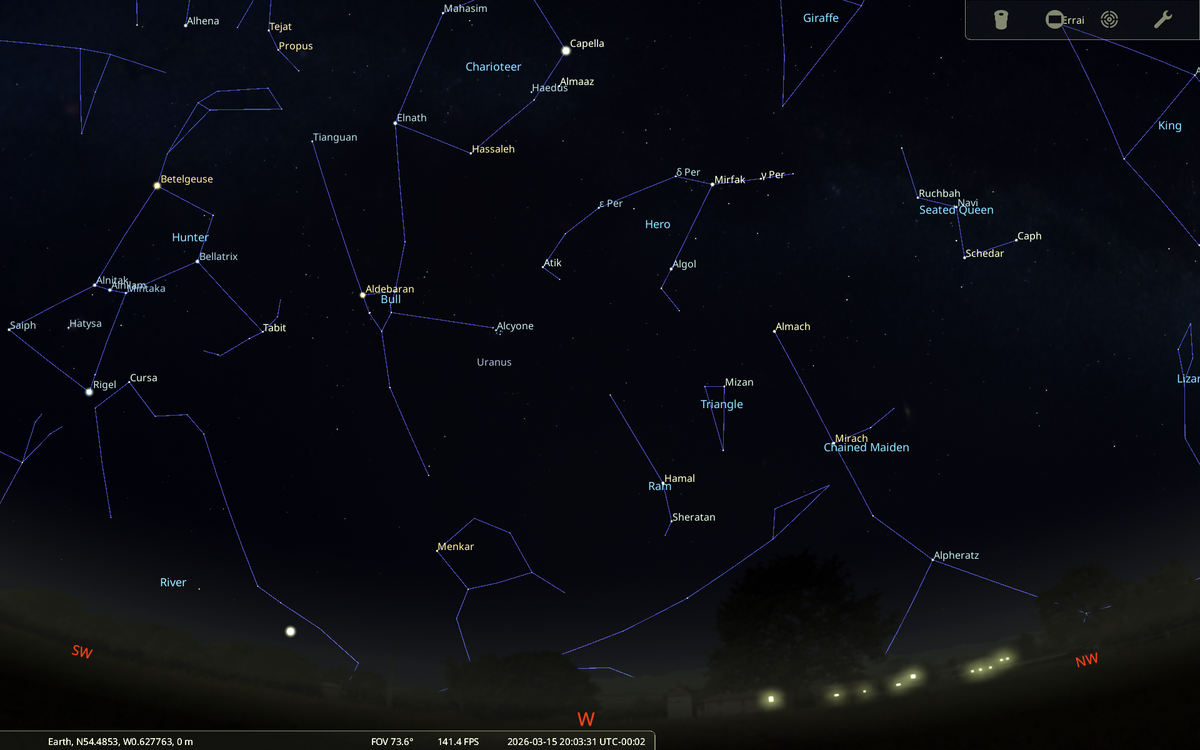
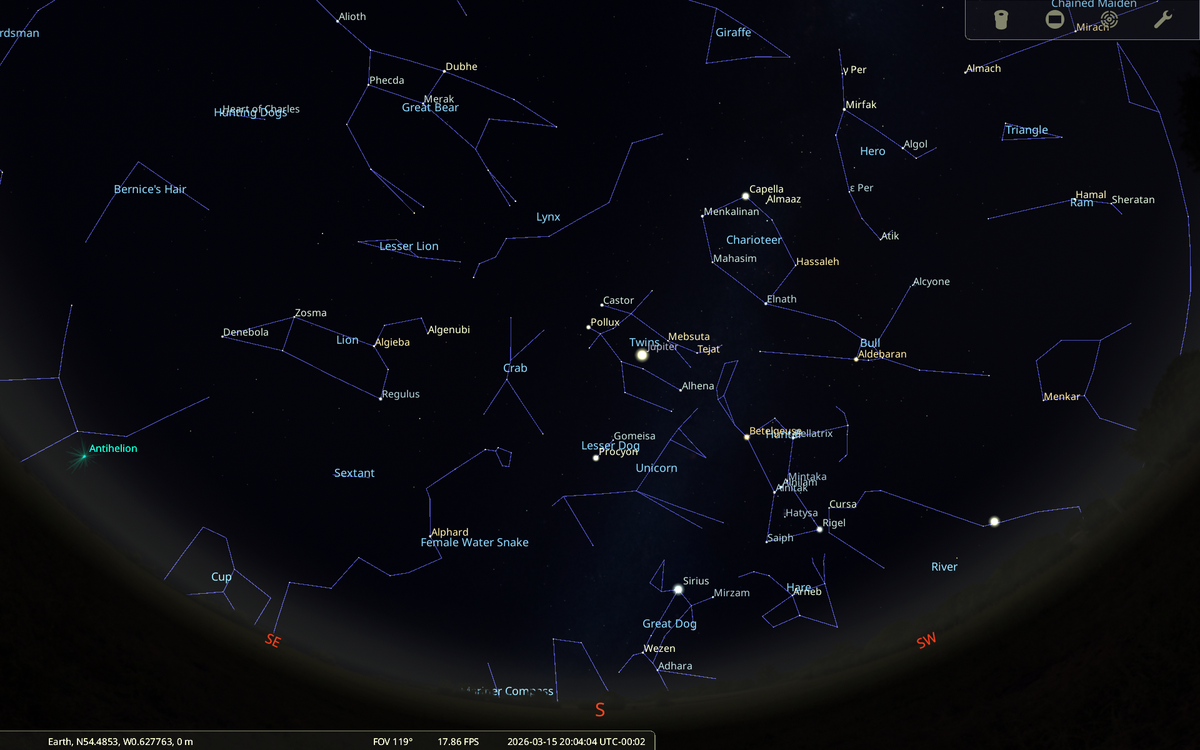
March 2026 Sky Charts
 |
 |
|
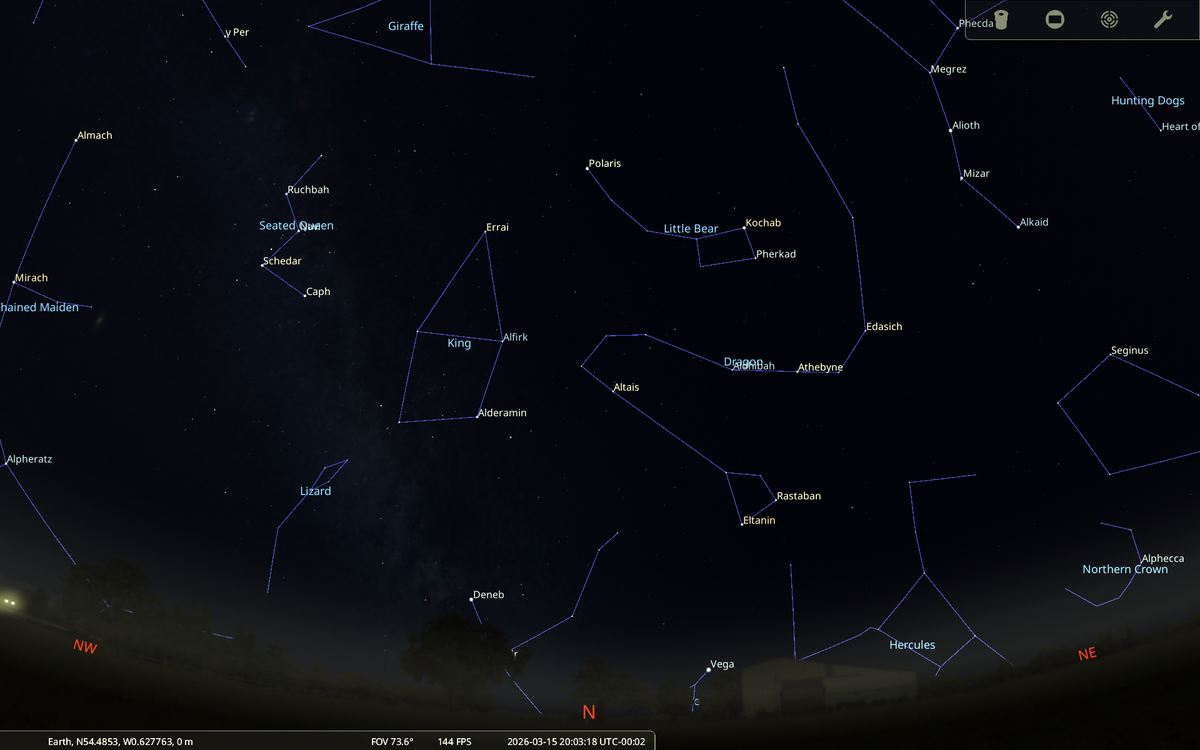
Looking North
Mar 15th - 20:00hrs |
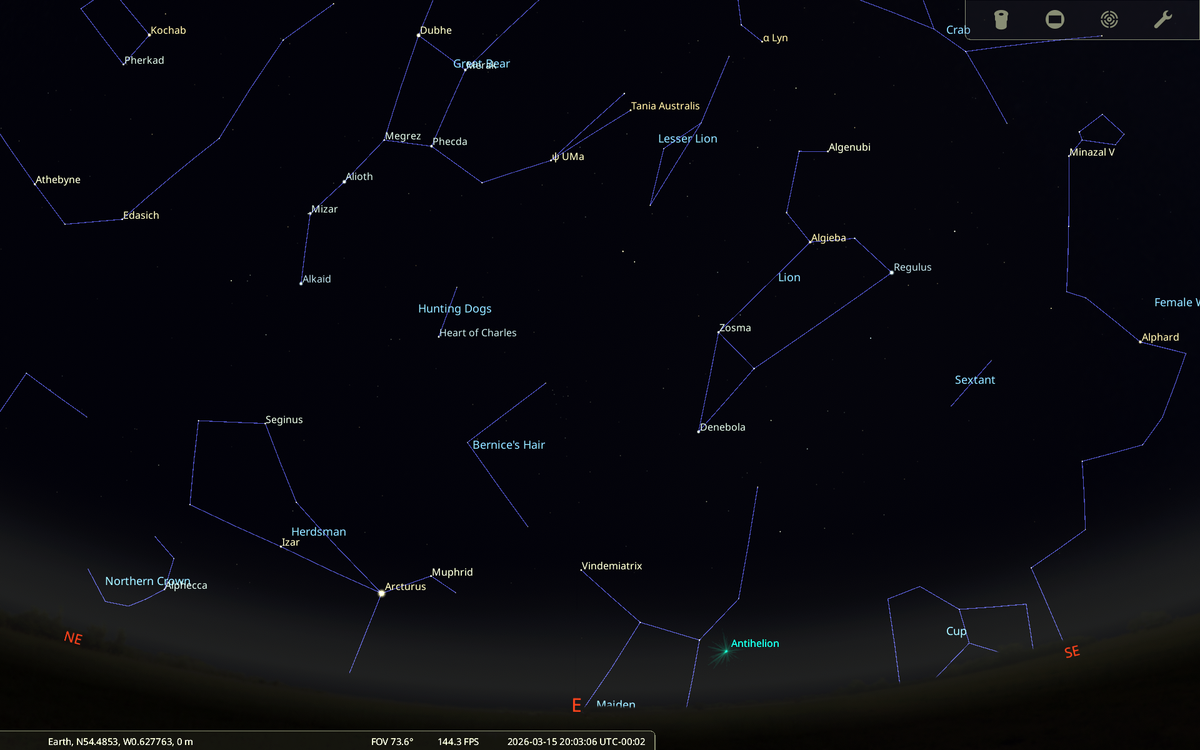
Looking East |
 |
 |
|
Looking South
Mar 15th - 20:00hrs |
Looking West
Mar 15th - 20:00hrs |
 |
 |
|
Northern Aspect
Mar 15th - 20:00hrs |
Southern Aspect
Mar 15th - 20:00hrs |
 |
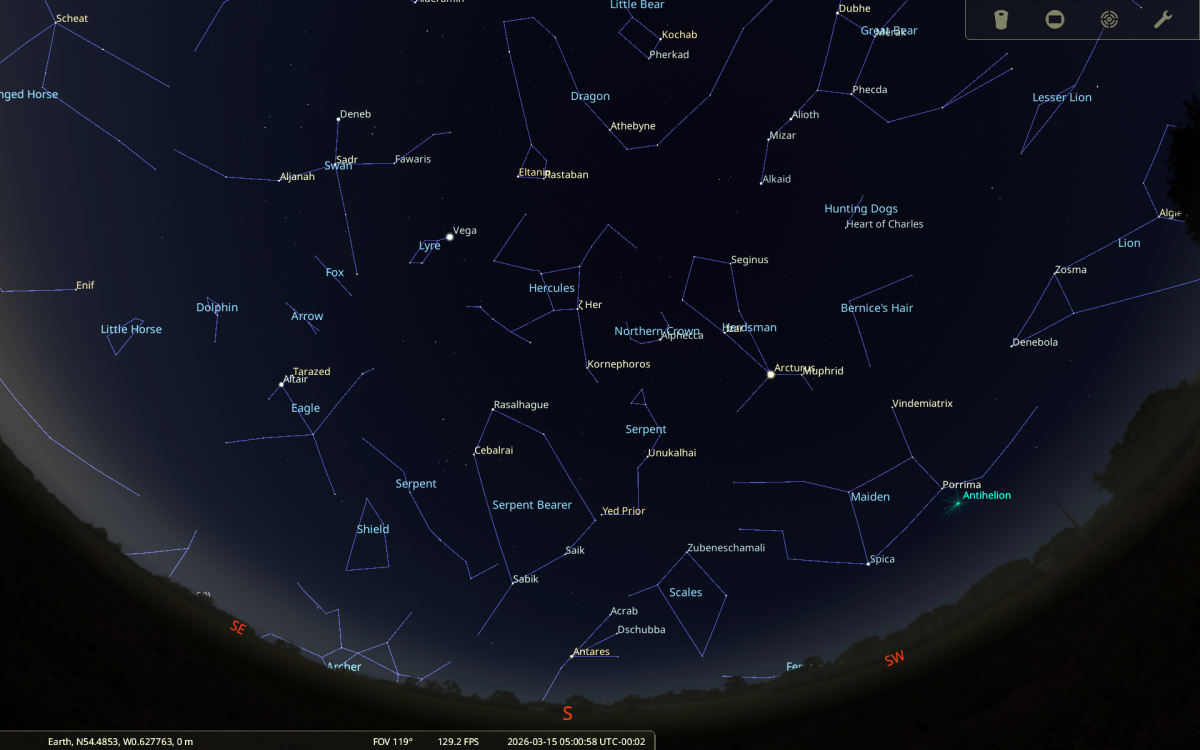 |
| Northern Aspect (dawn) Mar 15th - 05:00hrs |
Southern Aspect (dawn) Mar 15th - 05:00hrs |
Additional Image Credits:
- Sky charts/Sky chart images credits: Stellarium and Starry Night Pro Plus 8
- Log in to post comments

