
In this month's Sky Notes:
- Planetary Skylights
- December Meteors & Comet 31/ATLAS
- Winter Solstice
- December Night Sky
- December 2025 Sky Charts
Planetary Skylights: A Brief Guide to December's Night Sky
Jupiter dominates the evening sky heading for opposition next month. Saturn remains well placed to the south in the evenings. Neptune is a telescopic object 4 degrees NW of Saturn. Uranus resides 4 degrees below the Pleiades requiring a telescope to appreciate. Mercury undergoes a dawn apparition low in the southeast.
 Jupiter increasingly dominates the evening sky this month, coming to opposition in the new year. Jupiter rises in the northeast shortly before 19:00hrs GMT at the beginning of December and two hours earlier by the end. The planet is positioned just below the main outline of Gemini and is moving retrograde, east to west, in relation to the background stars. With a minimum magnitude of -2.55 Jupiter is very prominent posing no problem in recognition. The Moon lies left of Jupiter on Dec 7th.

Dec 7th - Jupiter & Moon. (Click for larger image)
Jupiter is a worthy object to target no matter what sized telescope is being used, even more so this winter and early spring riding high in the sky from UK shores. Viewing through the eyepiece Jupiter exhibits an oblate disk some 48 arc seconds in diameter flanked by the Galilean moons - visible as bright specks of light. The dark equatorial belts will be readily visible in instruments as small as 60mm (2.5”), mounted binoculars will even pick up the Galilean moons. Larger apertures will reveal an increasingly amount of detail, with the less evident polar regions and finer northern and southern temperate belts becoming more noticeable. When turned in our direction seek for the great red spot (GRS) feature - a colossal hurricane type storm. In recent decades the GRS has diminished in size by perhaps a third and grown paler in hue.
The GRS can be observed in 100mm (4”) scopes but will be more obvious with 150mm (6”) instruments at medium powers. Look for the GRS on Dec 3rd, 5th, 8th, 10th, 12th, 17th, 19th, 20th, 22nd, 24th, 27th and 29th from 19:30hrs - 22:30hrs GMT.

Ganymede shadow transit - Dec 23rd @ 20:00hrs GMT. (Click for larger image)
The Galilean moons, Jupiter's four large satellites are fascinating to follow, the configuration of which constantly changes as they orbit around Jupiter. The inner 3 Galilean moons are in a 1:2:4 orbital resonance, Io orbits in 1.8 days, Europa in 3.6 and Ganymede in 7.2 days. At 16.7 days Callisto is not quite in resonance but will become so in the future. Because of this resonance the observer enjoys a different pattern of moons each night, and in fact can discern a shift in their positions relative to one another over the course of just an hour or so. (Especially when in proximity to one another).
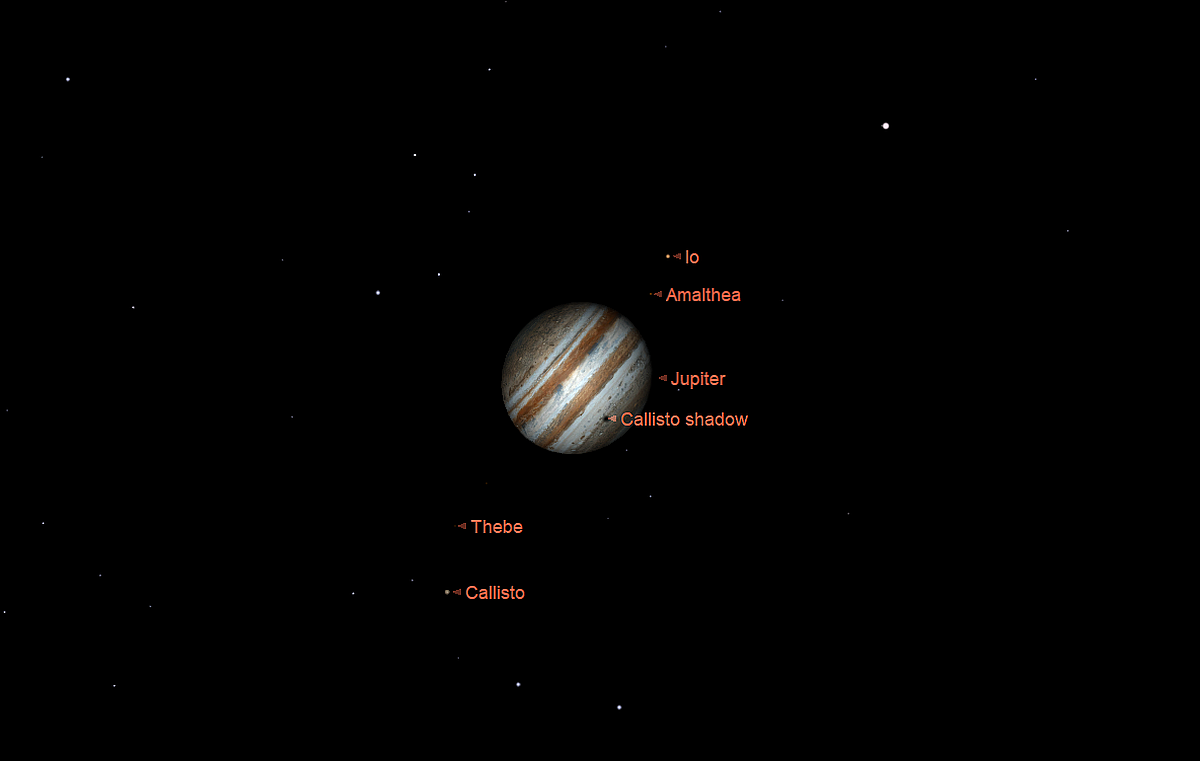
Callisto shadow transit Dec 7th @ 20:45hrs. (Click for larger image)
The satellites also provide shadow transits as the moon sweeps in front of Jupiter’s disk. All four Galilean moons have shadow transits during December (visible as black dots on the disk), the most favourable occurring on the following dates, Ganymede - Dec 23rd around 20:00hrs, Europa - Dec 17th @ 21:30hrs, Callisto - Dec 7th @ 20:45hrs and Io – Dec 8th @ 20:15hrs GMT.
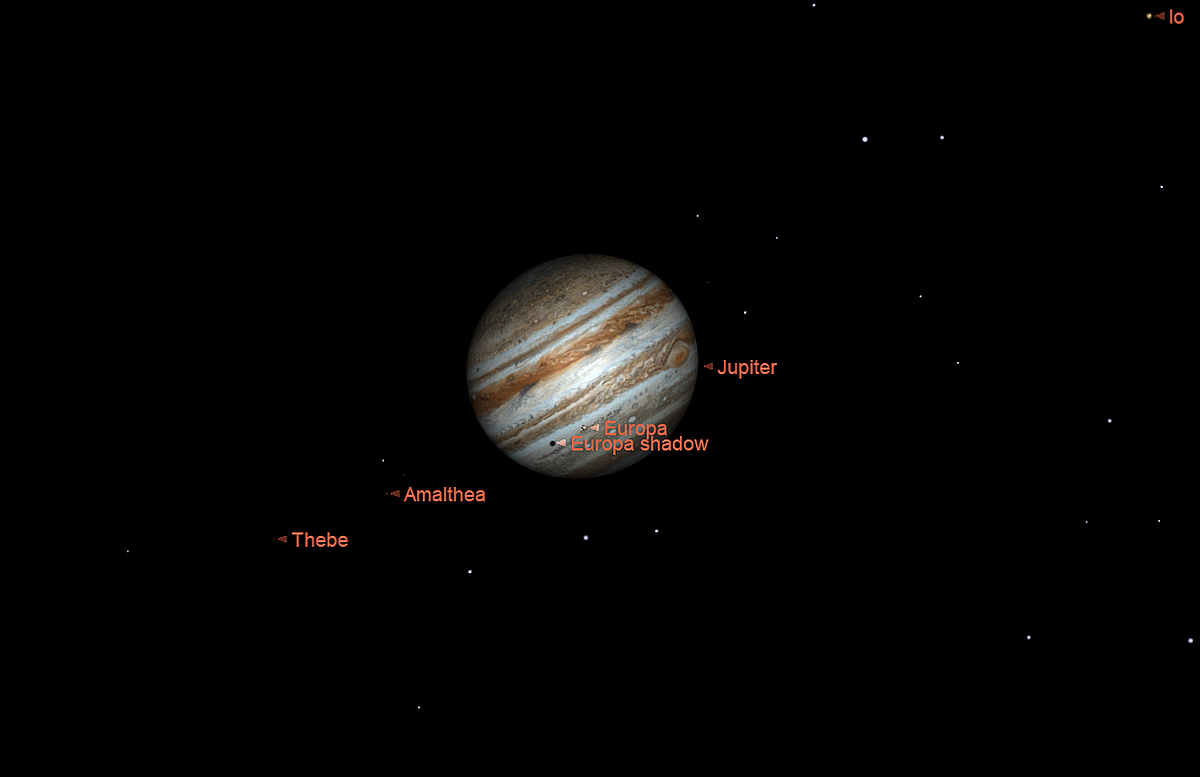
Europa shadow transit - Dec 17th @ 21:30hrs GMT. (Click for larger image)
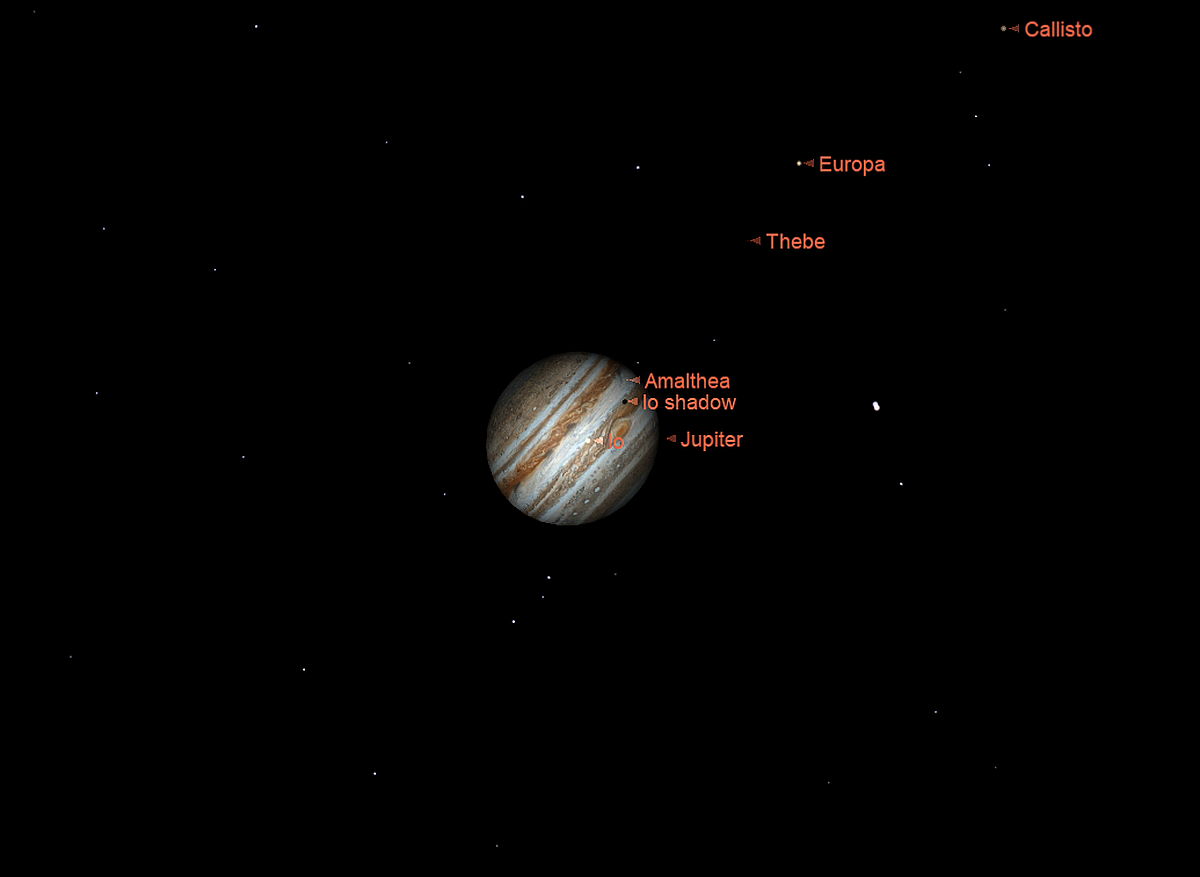
Io shadow transit - Dec 8th @ 20:15hrs GMT. (Click for larger image)
 Saturn continues to be an excellent target throughout December, although by the end of the month Saturn will be setting around 22:30hrs GMT from UK latitudes. The best views of Saturn will therefore be afforded during early/mid - evenings when Saturn will be visible in the south and southeast. At magnitude +0.84, Saturn appears conspicuous against the fainter aquatic stellar backdrop of the Pisces/Aquarius border - a region devoid of brighter stars. Saturn culminates a very respectable 33 degrees above the horizon - a few degrees shy of the celestial equator, which it finally crosses in the spring of 2026, unseen from view being in conjunction with the Sun.
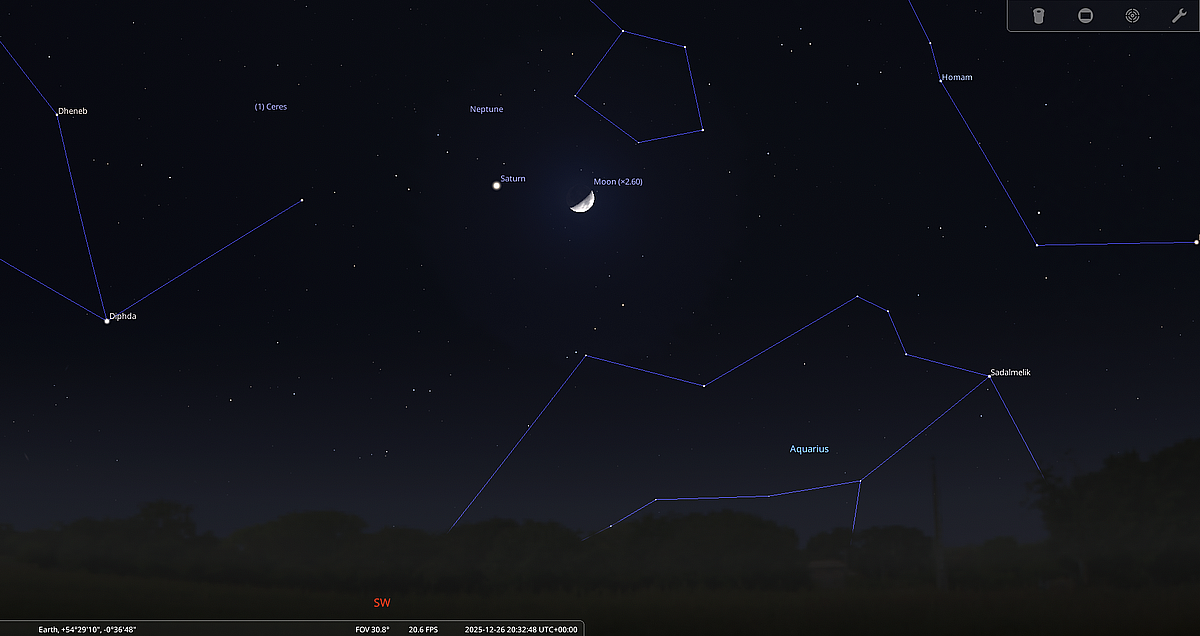
Dec 26th @ 20:30hrs GMT - Saturn and Qtr Moon. (Click for larger image)
Through the eyepiece Saturn is normally a splendid sight, however this being a 'ring plane crossing year' the rings are presently less than half a degree open and the appearance may be unfamiliar to observers. This does however afford an opportunity to glimpse a number of Saturn’s satellite moons normally hidden by the rings glare, Dione, Rhea, and Tethys should all be visible with modest-sized telescopes. Titan—by far Saturn’s largest moon—is typically seen as a nearby point of light. Our Moon lies near to Saturn on Dec 26th.
 Neptune also is well placed for telescopic observation in the evening sky, but you will require a telescope to identify it. The outermost planet may be tracked down approximately 4-degrees upper left of Saturn, the nearest stars with designations being 29 & 27 Psc. With a magnitude of +7.8, Neptune is visible as a faint ‘star’ through binoculars, it’s tiny blue-grey disk only visible through a telescope. At 2.8 arc-seconds in diameter it is discernible in instruments of 100mm (4") aperture, however telescopes exceeding 150mm (6") utilising medium/high magnification will reveal it more clearly. Neptune is setting shortly after midnight.

General location chart for Neptune, December 20:00hrs GMT. (Click for larger image)

Detailed location chart for Neptune, mid-December. (Click for larger image)
 Uranus is well placed to track down in the evening sky approximately 4 degrees lower right of the Pleiades star cluster in Taurus the Bull. At mag +5.6 Uranus is technically visible to the naked eye from exceptionally dark locations in the UK, to verify a good star chart or App may be necessary. Binoculars will show it as a speck, but apertures of 80mm plus (3"+) are required to spot the tiny 3.7-degree grey-green disk. Instruments above 150mm (6") will clearly reveal this. Uranus lies very close to the pairing of 13 and 14 Tauri (both 5th magnitude stars) and is just 0.1-degree south of 14 Tauri on Dec 14th and 0.2 degrees south of 13 Tauri on Dec 22nd. Uranus culminates over 50 degrees above the south horizon, not setting until almost dawn.

General location chart for Uranus - early December. (Click for larger image)

Detailed chart for Uranus - early December. (Click for larger image)
 Mercury has its best morning apparition of the year and may be glimpsed low in the SE dawn sky for most of December. Start looking for the elusive innermost planet shortly before 07:00hrs during the first week of December. Slowly gaining in brightness and elevation, Mercury reaches greatest elongation west (20+ degrees) on Dec 7th. Mercury will then appear as a 1st magnitude star approximately 8 degrees above the SE horizon at 07:15hrs and should be readily apparent in binoculars.
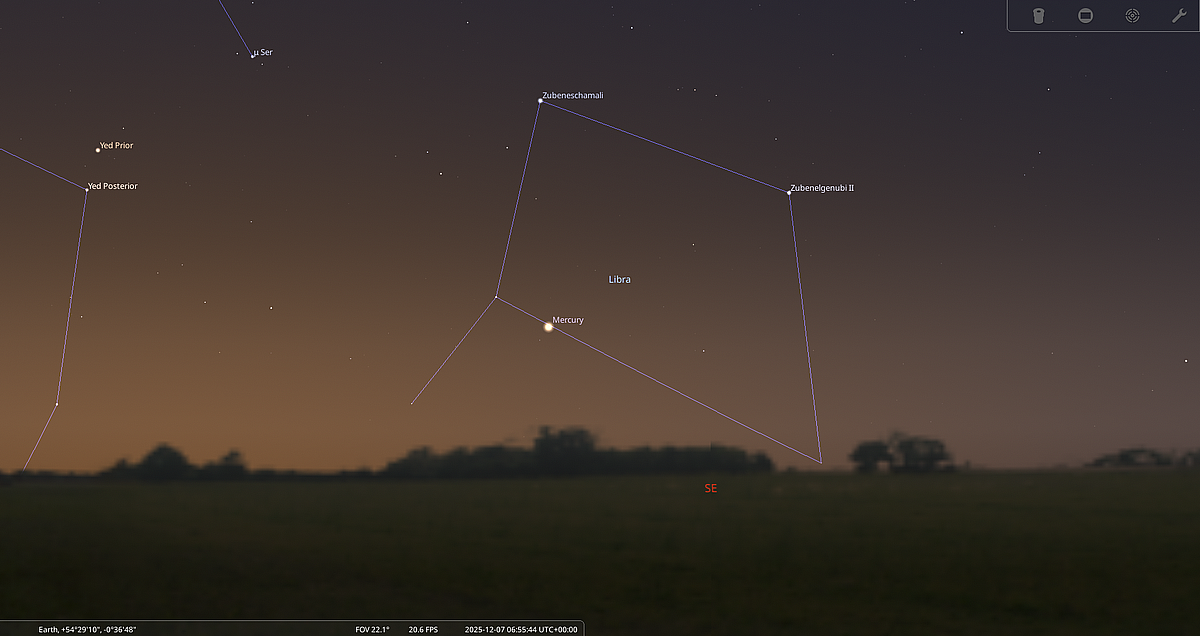
Mercury in the dawn sky - Dec 7th @ 07:15hrs (Click for full-sized image)
Over the following week or so, Mercury will grow in apparent brightness slowly slipping back down toward the horizon. It should then appear as a mag -0.5 object around 07:25hrs, 5-6 degrees up from the SE horizon. Should skies be very transparent observers may pick it out with just the naked eye. For the remainder of the month Mercury sinks ever lower, brightening still further but becoming mired in twilight around 07:45hrs.
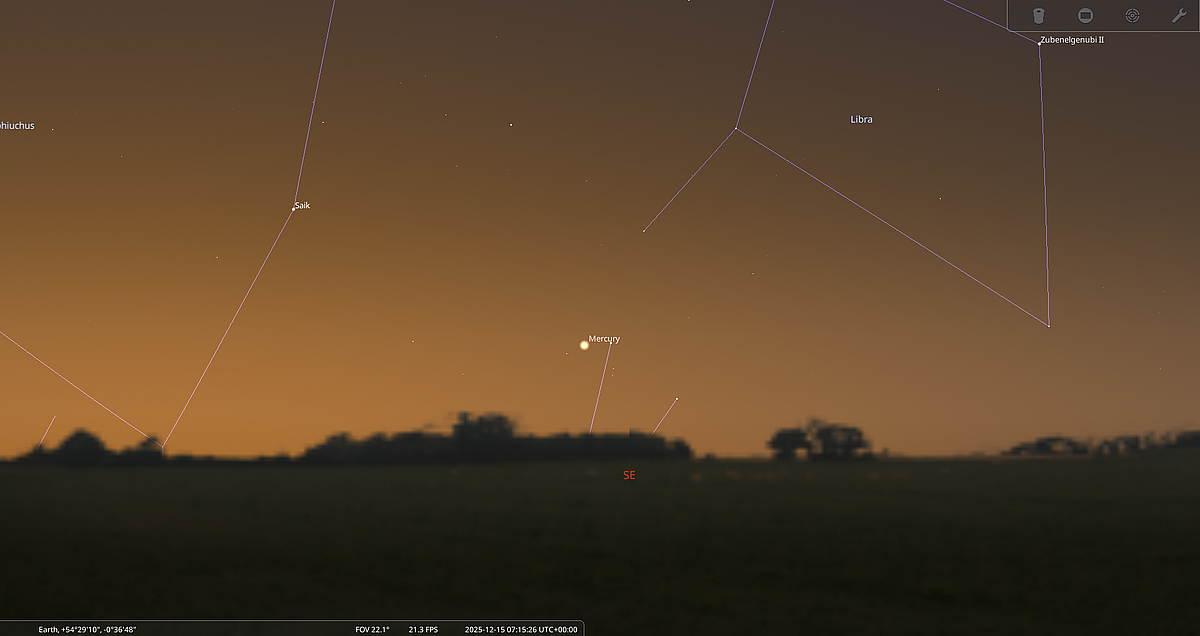
Mercury above the SE horizon Dec 15th @ 07:15hrs. (Click for full-sized image)
Mercury is rather challenging to observe with a telescope, the small size, low elevation and growing twilight all conspire, ensuring Mercury reveals very little in the eyepiece. If 'seeing' is good, Mercury will exhibit a phase, which at the start of December is 37% illuminated and 87% by the 20th. On December 17th a very slim crescent Moon lies to the right of Mercury.

Mercury and crescent Moon - Dec 17th @ 07:15hrs. (Click for full-sized image)
December Meteors

Meteor activity reaches a peak at this time of year as two major meteor showers occur within the space of 20 days with a lesser shower sandwiched in between. From almost mid-December to the first week in January, given a clear sky during the hours of darkness the chances of spotting a few shooting stars are relatively high!
First up are the Geminids, considered now to be the most prolific and reliable annual meteor shower. The Geminids are active from December 7-16, reaching a peak this year overnight of December 13th/14th (the actual predicted peak is for 03:00hrs UT). Geminid debris stems from a small asteroid called Phaethon which may even be the nucleus of a ‘dead’ comet. During a perihelion passage, Phaethon passes within ten million miles of the Sun causing the object to deposit material over great swathes of the inner solar system. It is only within the second half of the 20th century that Geminid activity has increased to the levels now recorded, a result of Earth passing through a denser debris strand, a situation that will continue only for another hundred years or so.
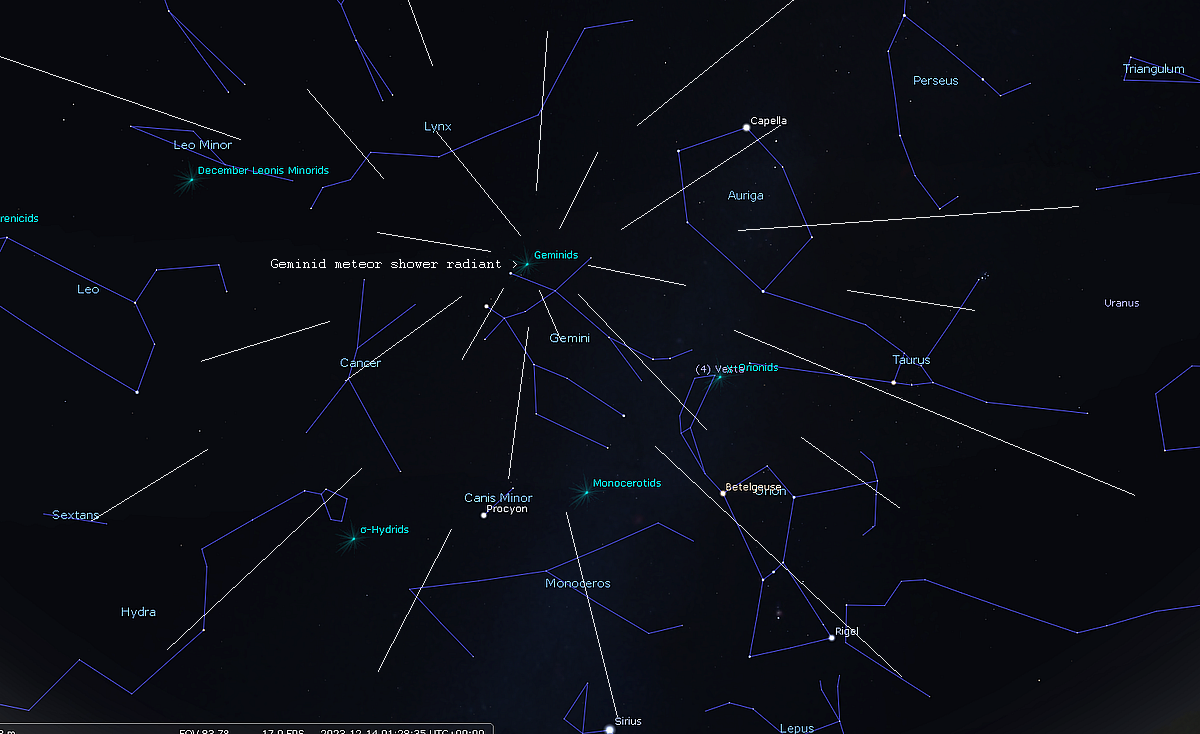
Location of Geminid Meteor shower. (Click for larger image)
The shower radiant lies close to Castor, in Gemini, visible in the east by 18:00hrs. Under ideal conditions the Zenith Hourly Rate (ZHR) exceeds 120; however, observed rates are always lower. A typical Geminid meteoroid is about the size of a large coffee granule, entering the Earth’s atmosphere at speeds of 35km/s, less swift than Perseids. Brighter Geminids regularly produce long luminous trails, sometimes quite colourful. Colours in meteors usually originate from ionized elements released as the meteor disintegrates, with blue-green typically originating from magnesium, calcium radiating violet, and nickel glowing green. Red, however, typically originates from energised nitrogen and oxygen in the Earth’s atmosphere.

Prospects for the 2025 shower are very good with moonlight from a waning last Quarter Moon during the early hours of the morning subduing numbers only to a small degree. Observed rates will peak around 03:00hrs with an observer would expect to spot 40 - 60 meteors per hour. The ZHR (Zenith Hourly Rate) can exceed 130 and appears to be creeping up each year. Viewing late evening of the 13th, when the shower radiant is lower to the east horizon will yield some meteors - perhaps several dozen from 20:00hrs to midnight. The evening hours are however the best time to try and catch an 'earth grazer', bright, slow moving, long duration meteors that travel horizontally across the sky. Earth grazers are rare but prove to be especially memorable, if you should be lucky enough to witness one.
Conditions for the less prolific Ursid meteor shower are even more favourable with moonlight absent. The shower is active from Dec 17-25th, peaking this year in the early morning hours of Dec 22nd. Hourly rates of around 10 - 12 are the norm, but occasionally and erratically, Ursids can produce strong outbursts. The radiant lies close to Kockab in Ursa Minor - the Little Bear. Moonlight will interfere slightly late on the 21st and into the early morning hours of the 22nd.
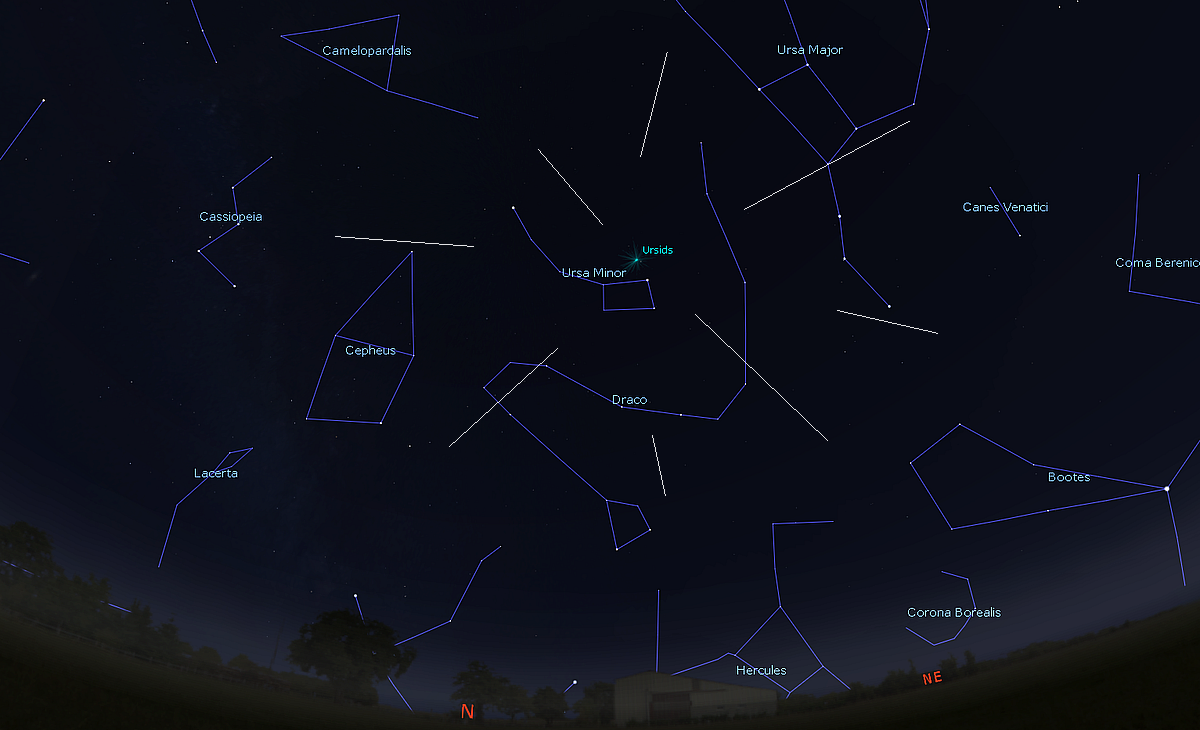
Location of Ursid meteor shower radiant. (Click for larger image)
Finally, although not in December, the second major meteor shower within the space of 20 days peaks in early January - the Quadrantids. Peak night will be Jan 3/4th and can produce rates upwards of 100. There will be strong moonlight this year drowning out many examples, and often the weather also plays a part. More on this shower next month.
Comet 31/ATLAS
Is it an alien spacecraft - No. Is it a messenger from God – No. Is it an interstellar comet - yes! Please don't believe some of the lurid, fanciful and alarmist drivel circulating on some online media sites (I’m sure you won’t). Comet 31/Atlas is just that - a comet, admittedly from outside our solar system and influence of the Sun, but a comet all the same. It is an interstellar wanderer, (a rare beast, the media would also have us believe) just the 3rd in the last decade. Or couched another way, statistically that makes the 300th in the last 1000yrs, the 3000th in last 10000 years - doesn't seem so rare now, does it? It is one major failing of humans - having such comparatively short lifespans, otherwise we might make more sense of it all! Oh, to be a Vampire!
But let's not belittle 31/ATLAS too much, it may not come within 180 million miles of Earth appearing as a faint mag +10 object (expected), so a telescopic object only. No, that would be unfair. The comet should be visible to instruments of 3"+, although a scope of 8" (200mm) will be required to verify that it is a comet!
It does though contain 'stuff' that is not from our Sun's immediate neighbourhood. That's what makes it special, a 'building block' of someone else’s backyard, a hairy herald from another stellar street. So, take a 'peek' if you can from behind Mother Sols skirt as this pale rider passes harmlessly through solar town. It won’t be seen again; an interstellar drifter astronomers hope may divulge a few secrets - given the scale of scientific attention being levelled at it! A tale from a tail – so to speak.

Approximate Passage of comet 31/ATLAS throughout December. (Click for larger image)
If you have internet access and would like to observe comet 31/ATLAS yourself, check on reputable sites – such as NASA or The SkyLive.com – where you will also find up to date and detailed finder charts for the comet’s location throughout December. The comet will be traversing just below Leo and as such will be an early morning object for UK observers. Good luck – and should the comet stop, or back track, well, that really will make Christmas interesting!!
Finally, there has been strong auroral activity in the past month visible from locations as far south as North Devon. Frustratingly, locations on the North Yorkshire coast were clouded out on said relevant dates, one was in daylight hours anyway! I'm sure there will further activity in the coming year - hopefully not hidden from our view! Keep watch.
And finally, finally, astronomers are still waiting for T Cor Bor to erupt as a nova. Looking like 2026 now!
The Winter Solstice

The Winter Solstice falls on December 21st in the northern hemisphere this year, the date marking the Sun's lowest position in the sky. The tilt of the northern hemisphere away from the Sun has now reached its maximum and useful daylight is at a minimum, barely 7 ½ hrs from the latitude of Whitby - the shortest day, the Sun appearing just over 12 degrees above S horizon at local noon. Latest sunrise and earliest sunset however do not occur on this date. The Sun rises latest around Dec 28th but sets earliest mid-month. Astronomical winter commences for the Northern Hemisphere, but conversely days will slowly start to lengthen again. Cause for a celebration?
The significance of the Winter Solstice to our ancestors was probably due to the fact it did mark the start of the lengthening of days, a cause for ritual celebrations associated in their eyes with the death and rebirth of the Sun.
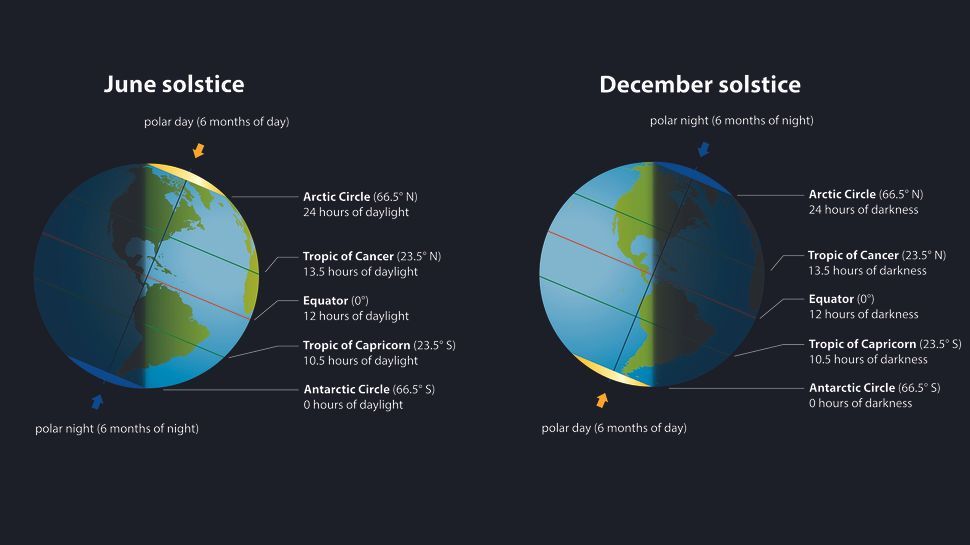
The 'solstices' - summer and winter. (Click for full-sized image)
There are many Winter Solstice festivals and celebrations in the northern hemisphere. The celebration we enjoy (or endure dependant on your view of modern day Christmas) the Christian celebration of Christmas did not become a major festival until the 9th century, although the date of December 25 was pioneered by the Roman Emperor Constantine as far back as 336 A.D, perhaps to weaken established pagan celebrations that occurred around the Winter Solstice, remnants of which remain. Happy Winter Solstice everyone!
December Night Sky
November certainly did live up to the 'varied weather conditions' billing given last month. A month of all seasons, from almost summer like conditions at the start, then a wet and wild spell, leading into an arctic blast bringing snow, before finishing off all over the place. For the eleventh month of the year, November was a weather roller coaster and needs counselling!
Dependable December has now arrived, bringing the start of both meteorological and astronomical winter, the winter solstice and festive 'cheer'. Before sweeping us to the threshold of a new year, new beginnings and whispered rumours of spring. Mmm, we'll see!
In the heavens seasonal autumnal constellations may still occupy the night sky centre stage, but as Earth spins silently toward a date with the winter solstice and the onset of astronomical winter in the northern hemisphere, the eastern aspect - late evening, is already resplendent with the majestic celestial offerings of this coming new season.
Our focus of attention will be directed toward this brilliant ensemble of stellar jewels shortly, before doing so however, let's look at the bigger celestial picture starting to the North.
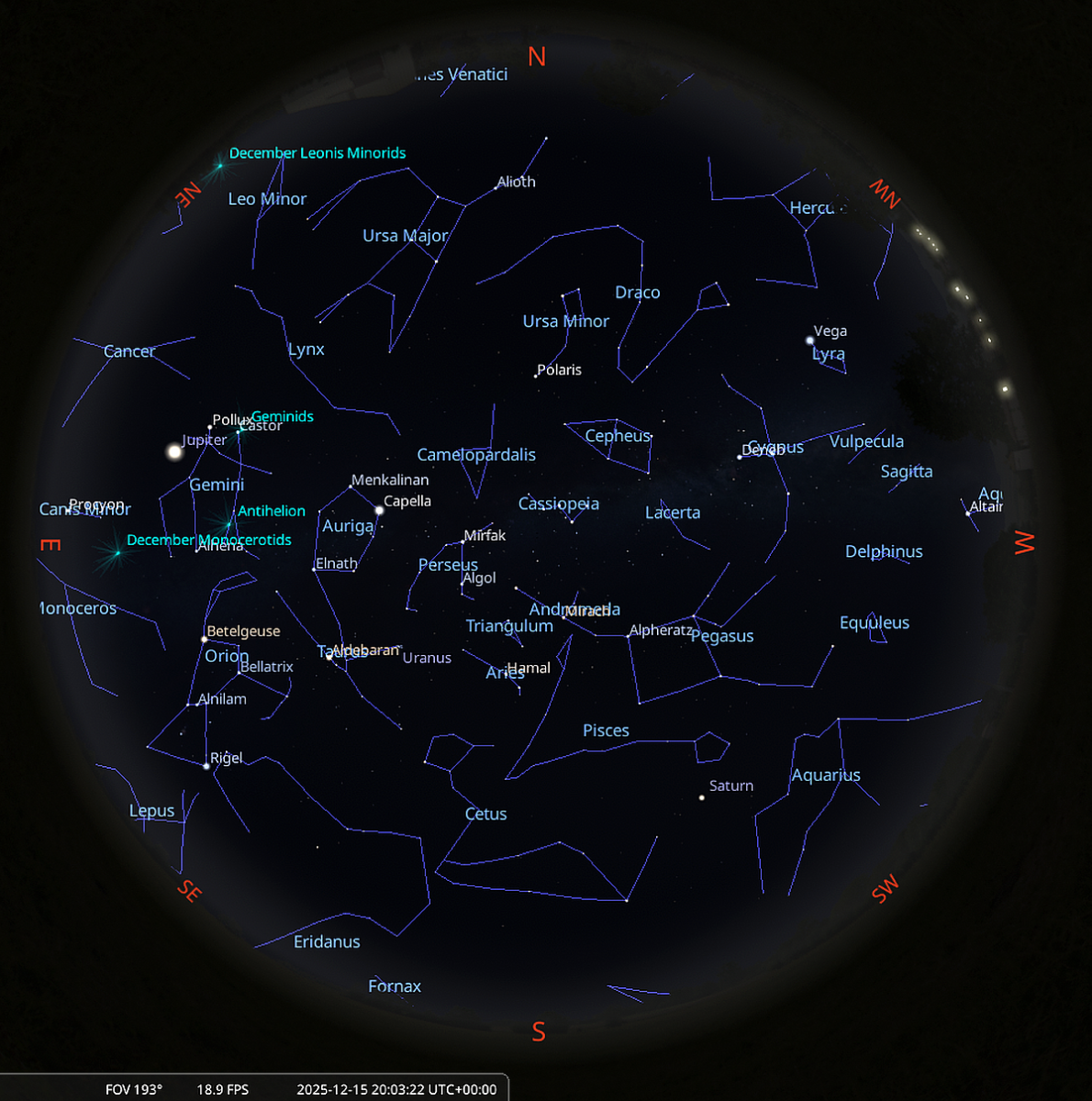
The December night sky. (Click for larger image)
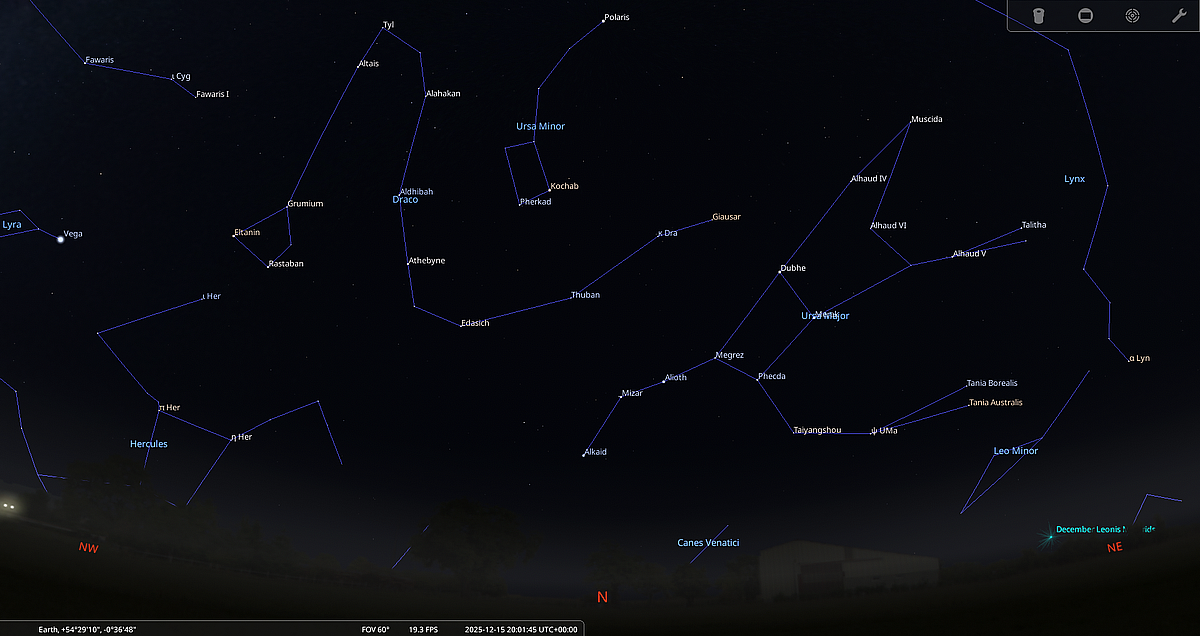
Here we find many of the circumpolar constellations - those that do not set from this latitude. Included amongst these are the two bears: Ursa Major and Minor. The Plough, the familiar ‘saucepan’ asterism, which is part of Ursa Major, prowls his territory low above the north horizon. Above the Plough during early evening stands Ursa Minor in which the Pole star, Polaris resides (the 'pointer stars' in the bowl of the Plough - Dubhe and Merak can be utilised to locate it). The celestial dragon – Draco winds its way between the bears towards the NNW where its head is marked by an irregular quadrilateral of stars.

The northeast aspect of the December night sky. (Click for full chart)
At the same altitude a little further west of this asterism, the sparkling steely blue lustre of Vega, chief star in Lyra, catches the eye. Nearby, the stars of Cygnus hang crucifix form below its chief star Deneb above the WNW horizon. Both Deneb and Vega form part of the summer triangle asterism, the third member, Altair in Aquila the Eagle, may be glimpsed just above the west horizon before departing our skies late evening, the only member to do so.
Throughout the early part of the evening, the zenith - the location directly overhead, is occupied in turn by the distinctive ‘W’ pattern of Queen Cassiopeia, then Perseus - the outline of which resemble a distorted figure Pi symbol, and later in the night the stars of Auriga the charioteer, highlighted by brilliant Capella.

The northwest aspect of the December night sky. (Click for full chart)
High to the south during early evening, another of the autumn skies more useful signpost asterism's; the great square of Pegasus, can be utilised to locate less conspicuous constellations ranged above the southern horizon including Pisces and Aquarius. Cetus the Whale churns along the south horizon below Pisces; use the front two stars in the square to locate its brightest star, Diphda. The most famed object in Cetus however is the variable star omicron Ceti - otherwise known as Mira 'the wonderful', an extraordinary pulsating red super giant over 300 million miles in diameter with a period of 332 days.
The faint stars of Capricornus - the Sea Goat, slip below the SSW horizon early evening by mid-month, but try to spot conspicuous Fomalhaut in Pisces Austrinus. It is visible until around 20:00hrs just above the SW horizon. It is the most southerly of first magnitude stars to rise over UK shores. Scheat and Markab in the square of Pegasus point down to its location during the first week in December.
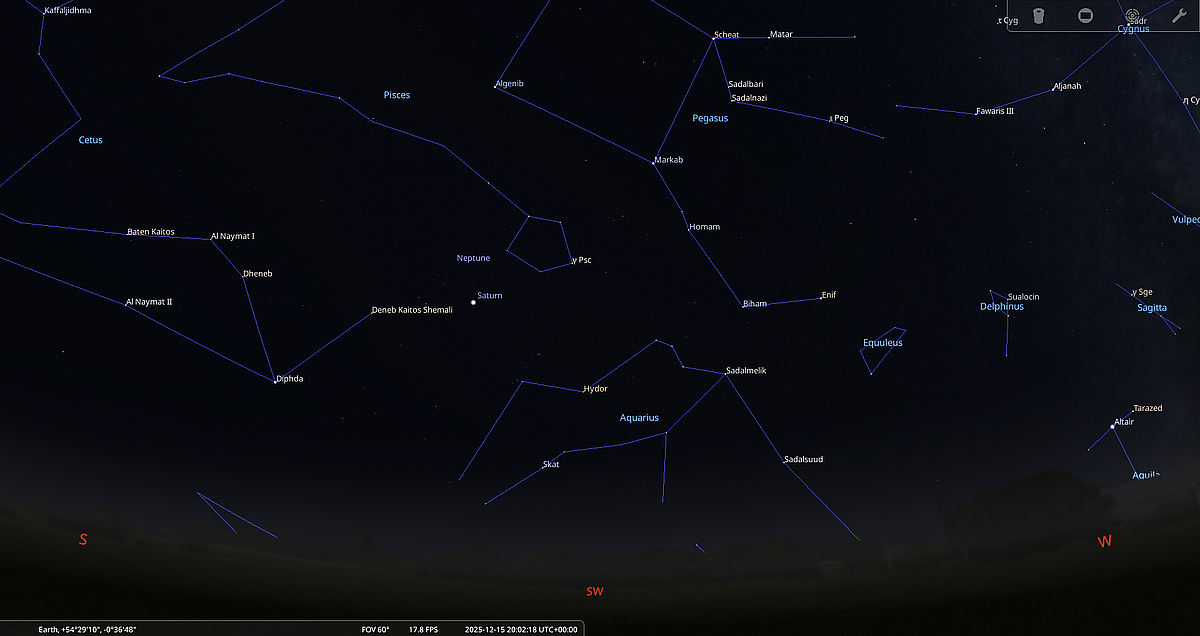
The southwest aspect of the December night sky. (Click for full chart)
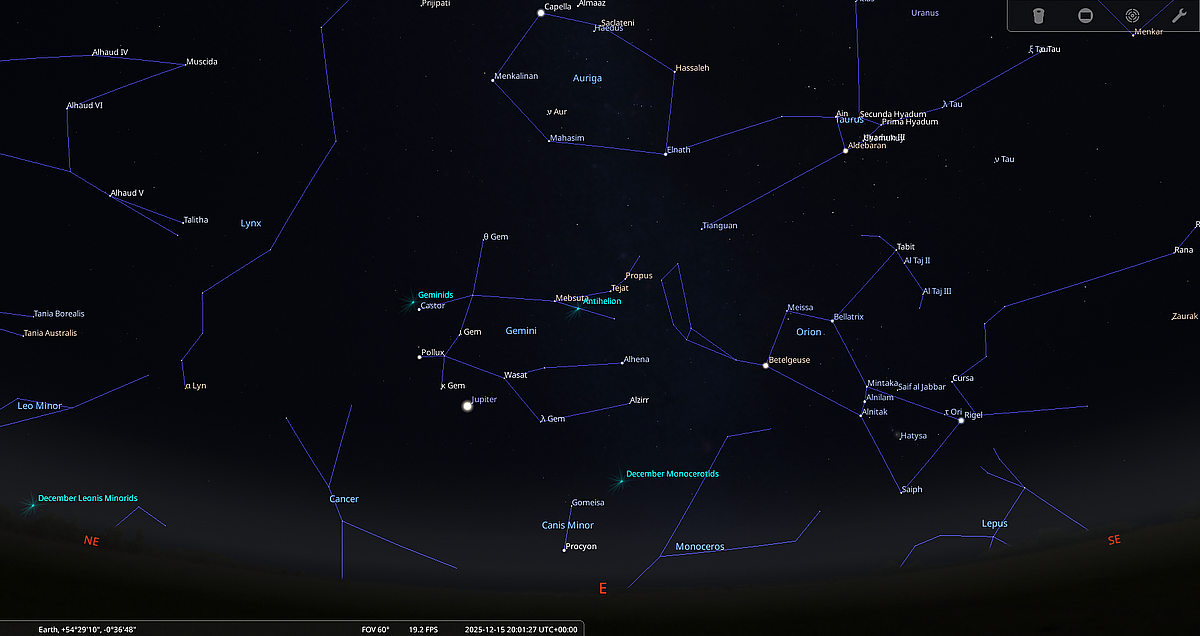
Time to focus our attention on the SE aspect of night sky, where the most majestic of all constellations, the mighty hunter of Orion, starts to dominate. The outline of Orion is recognised the world over, identified by the 3 bright 'belt' stars, together with the brilliant luminaries Betelgeuse and Rigel set diagonally opposed each other either side of the belt. As we shall see in the coming months, Orion and his retinue is a mecca for deep sky object aficionado’s and imagers, a region where the story of stellar evolution is writ large across the heavens.

Orion and company. (Click for full image)
Bearing down on Orion's right shoulder, Taurus the Bull contains the open star clusters the Pleiades and the Hyades. The prominent fiery hue of Aldebaran, 'the eye of the bull’ is the most conspicuous presence in the Hyades cluster - an open ‘V’ or arrowhead arrangement of star. It is not a genuine member however, lying at half the distance of true members. Upper right of the Hyades, the Pleiades star cluster (Seven Sisters) is an exquisite sight in binoculars or at very low telescopic powers and one of the most youthful star clusters visible. Keen sighted observers can make out more than seven stars with the naked eye, although most people see five or six. Optical aid reveals dozens, the entire cluster containing at least 380 members approximately 400 light years away.
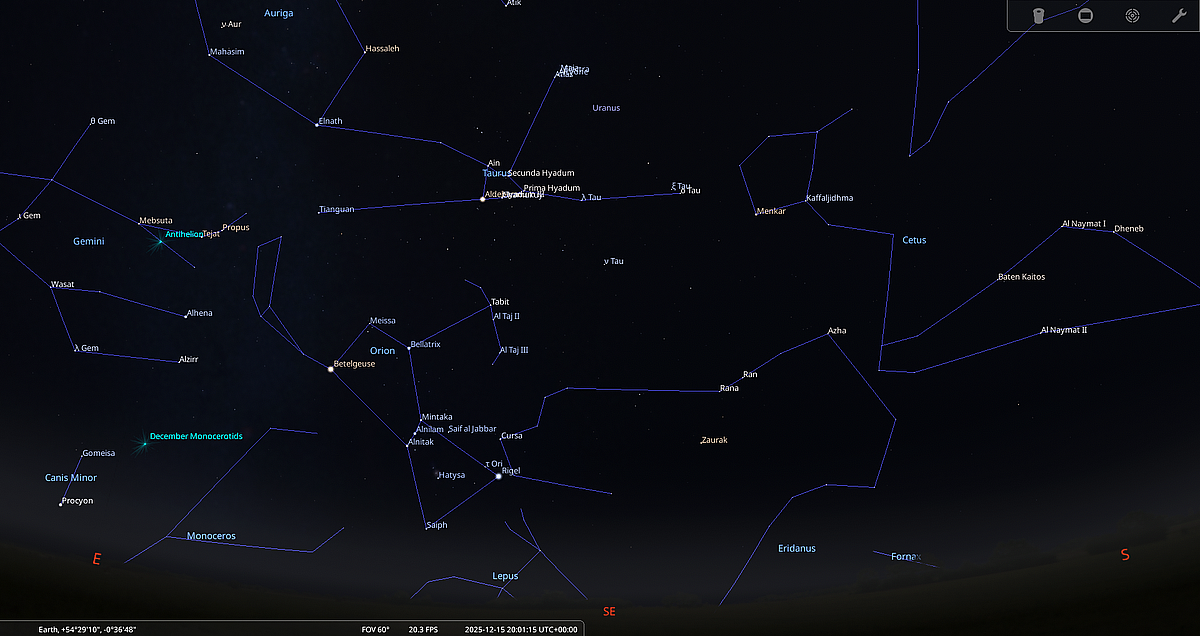
The southeast aspect of the December night sky. (Click for full chart)
Upper left of Orion stand the Twins of Gemini, marked by the two stars, Castor, and Pollux. Castor, the most northerly of the pair, is slightly fainter than twin brother Pollux which shines with a pale amber lustre. Although Castor appears solitary to the naked eye, it is a sextuplet system, the two brightest components of which may be separated in a modest telescope, given stable atmospheric conditions.
During the second half of December the two hunting dogs that dutifully accompany Orion across the heavens, Canis Major and Canis Minor, make their presence known by their lead stars. Sparkling Sirius (or, Dog star), in Canis Major is the most prominent of all night stars. The belt stars in Orion point down to its location low to the SE. The lesser dog of Canis Minor is highlighted by bright solitary Procyon, located well to the east of Orion's belt. The prominence of both stars is primarily due to proximity; 8.6 and 11 light years respectively.
The dog’s quarry, the timid celestial hare of Lepus, may be traced crouching below Orion just above the southern horizon. Look for the faint glow of the winter Milky Way which passes down to the left of Orion, separating the two dogs on opposing banks.
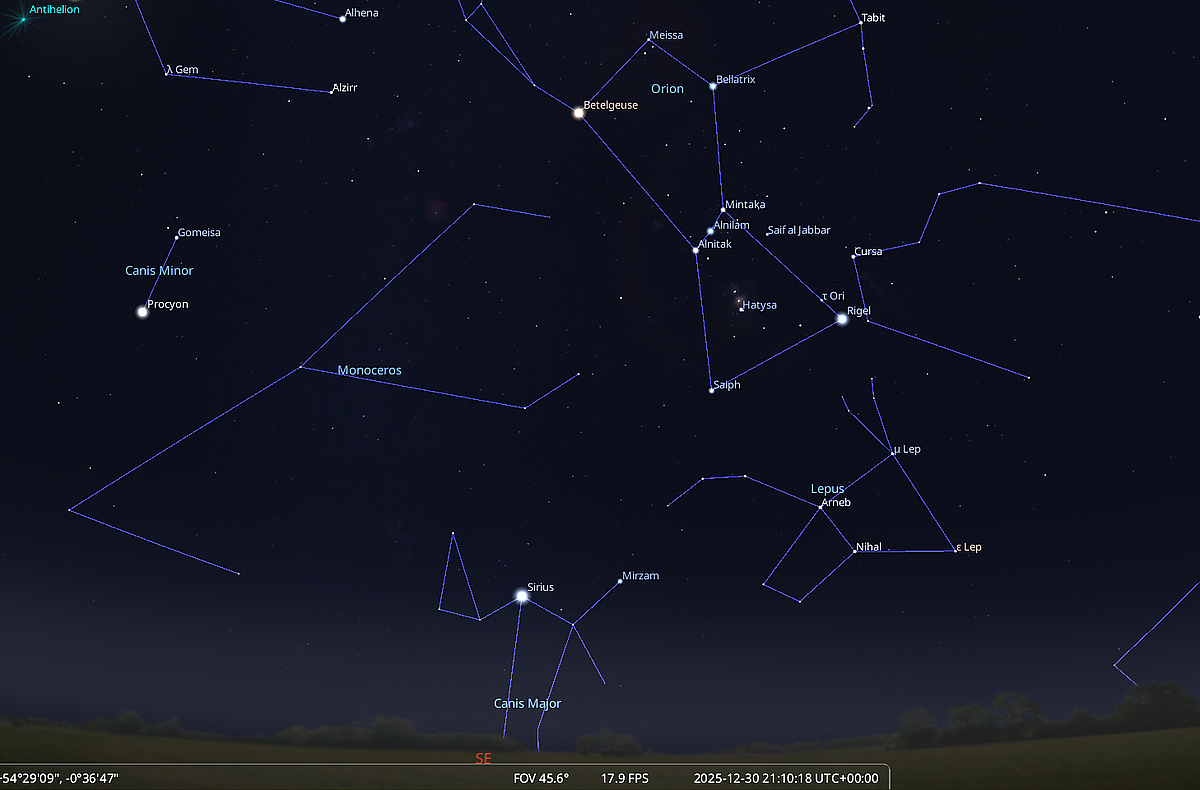
Orion's hunting dogs and their quarry, Lepus. Late December 21:00hrs. (Click for full image)
Finally, although astronomical winter may have only just commenced, the first celestial shoots of spring are already sprouting from the eastern horizon by the end of the month. The faint stars of Cancer - unnoticed in light polluted skies, lead the way scuttling after Gemini. Leo the lion - the signature group of spring follows, best identified by the ‘Sickle’ asterism at the foot of which shines bright Regulus. Some way below Procyon in Canis Minor, a faint, but distinctive stellar loop denotes the head of Hydra, the largest constellation in the heavens. Late spring will have bloomed before the entirety of Hydra will be visible above the horizon in our evening sky, but you can get a sneak peek by stepping outside and viewing south around 05:00hrs!

The first celestial shoots of spring - late December - east horizon - 22:30hrs.
(Click for full image)
No matter whether you are an experienced observer, or perhaps have just acquired a pair of binoculars or a telescope, the winter sky provides its own festive cheer, a magical vista worth exploring time and time again. Wrap up warm, find somewhere dark and enjoy!
December Sky Charts
 |
 |
|
Looking North
Dec 15th - 20:00hrs GMT |
Looking East |
 |
 |
|
Looking South
Dec 15th - 20:00hrs GMT |
Looking West
Dec 15th - 20:00hrs GMT |
 |
 |
|
Northern Aspect
Dec 15th - 20:00hrs GMT |
Southern Aspect
Dec 15th - 20:00hrs GMT |
 |
 |
| Northern Aspect (dawn) Dec 15th - 06:30hrs GMT |
Southern Aspect (dawn) Dec 15th - 06:30hrs GMT |
Additional Image Credits:
- Planets and Comets where not otherwise mentioned: NASA
- Sky Charts: Stellarium Software and Starry Night Pro Plus 8
- Log in to post comments

