
In this month's Sky Notes:
- Planetary Skylights
- Eclipses - Solar & Lunar
- August Meteors - Perseids, T Corona Borealis
- August Night Sky
- August 2026 Sky Charts
Planetary Skylights: A Brief Guide to the August Night Sky
Venus will lie very low in the western twilight throughout August. Saturn gains a place in the late-evening sky, though it is best viewed after midnight. Neptune lies 10 degrees to the right of Saturn but requires a telescope to identify. Mars, Mercury and Uranus are all morning objects, while Jupiter returns to the morning sky and meets Mercury in conjunction mid-month.
 Venus remains in the evening sky throughout August, but only just. It grows harder to spot as the month passes, sinking towards the western horizon. At magnitude -4.2 Venus will remain bright but, in all likelihood - unless purposely sought for, may be hidden to many, visible just a few degrees above the west horizon by late August.
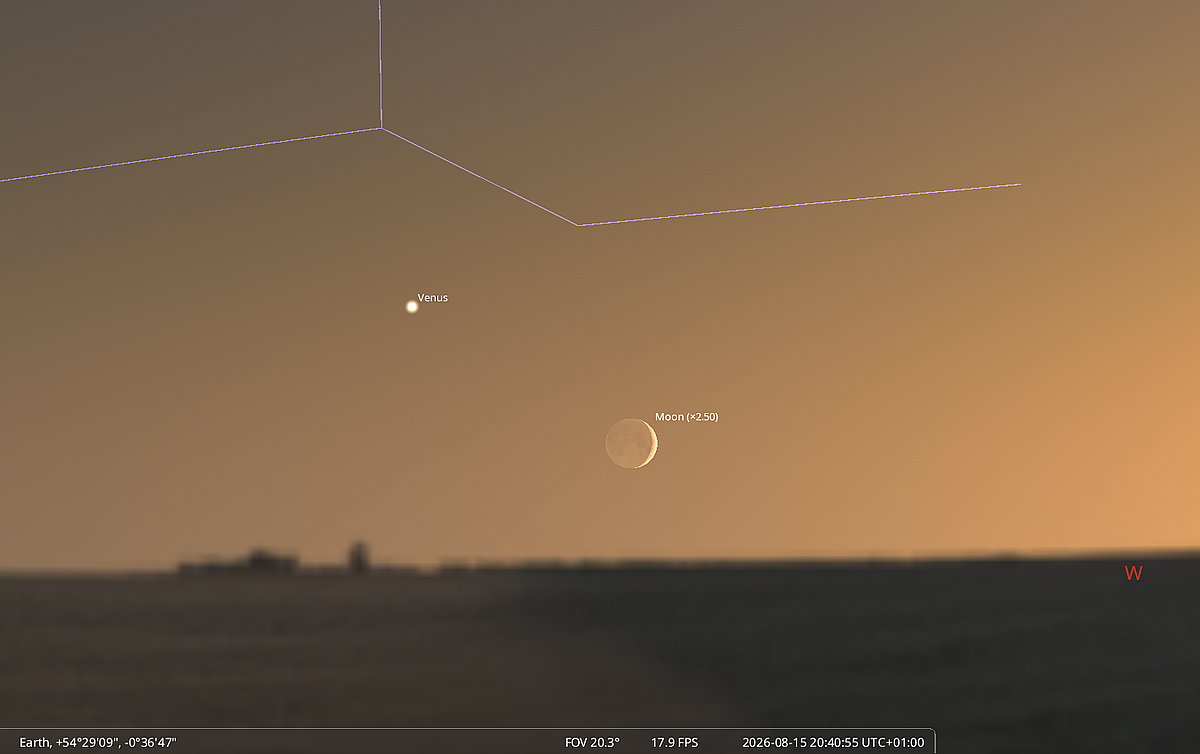
Aug 15th @ 20:40hrs, Venus with crescent Moon. (Click for full image)
Venus’s permanent cloud cover prevents any surface detail from being seen, but its phase is apparent, shrinking from 55% at the start of August to 39% by month’s end. Unlike most planets, Venus is best observed in brighter twilight, which helps reduce its glare. On August 15th and 16th, a slender crescent Moon lies close to Venus, although a clear, flat western horizon will be needed to see the pairing at 20:40hrs BST.
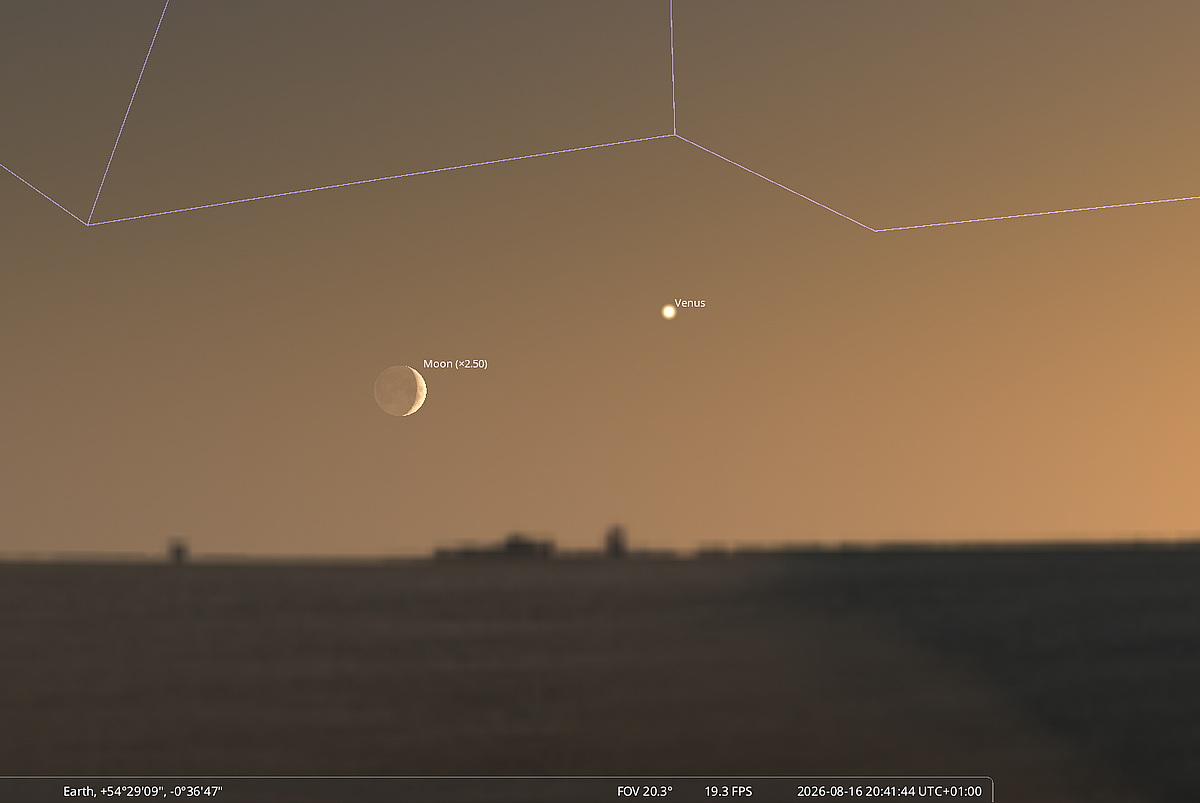
Aug 16th @ 20:40hrs, Venus with crescent Moon. (Click for full image)
By the end of August, Venus will only be visible for less than 20 minutes in bright twilight approximately 30 minutes after sunset. It will vacate the evening sky altogether in the first few days of September.
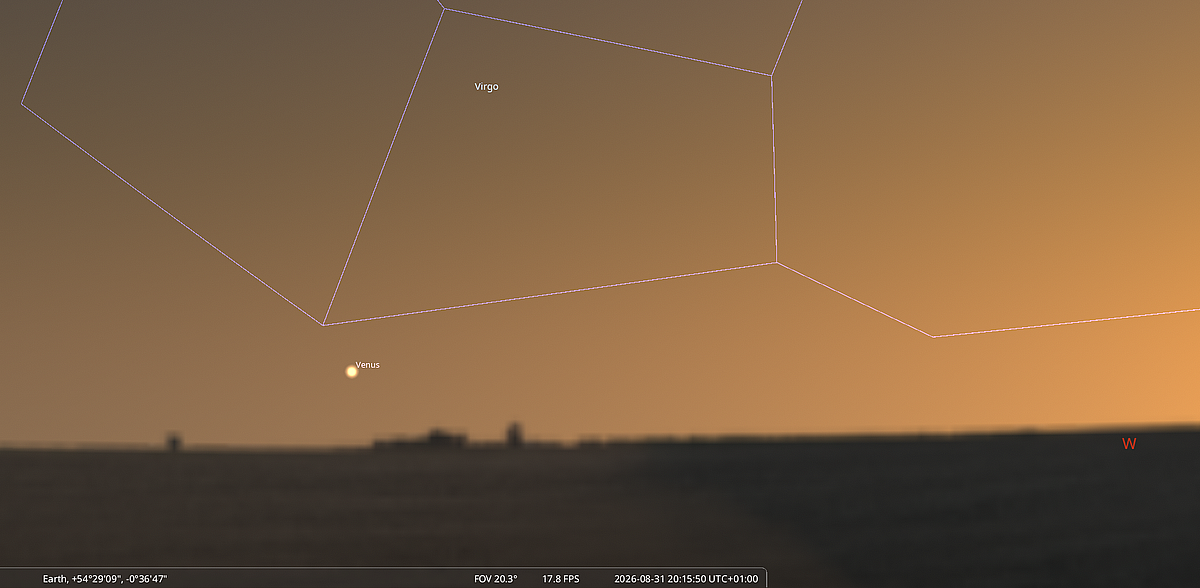
Venus at the end of August @ 20:15hrs. (Click for full image)
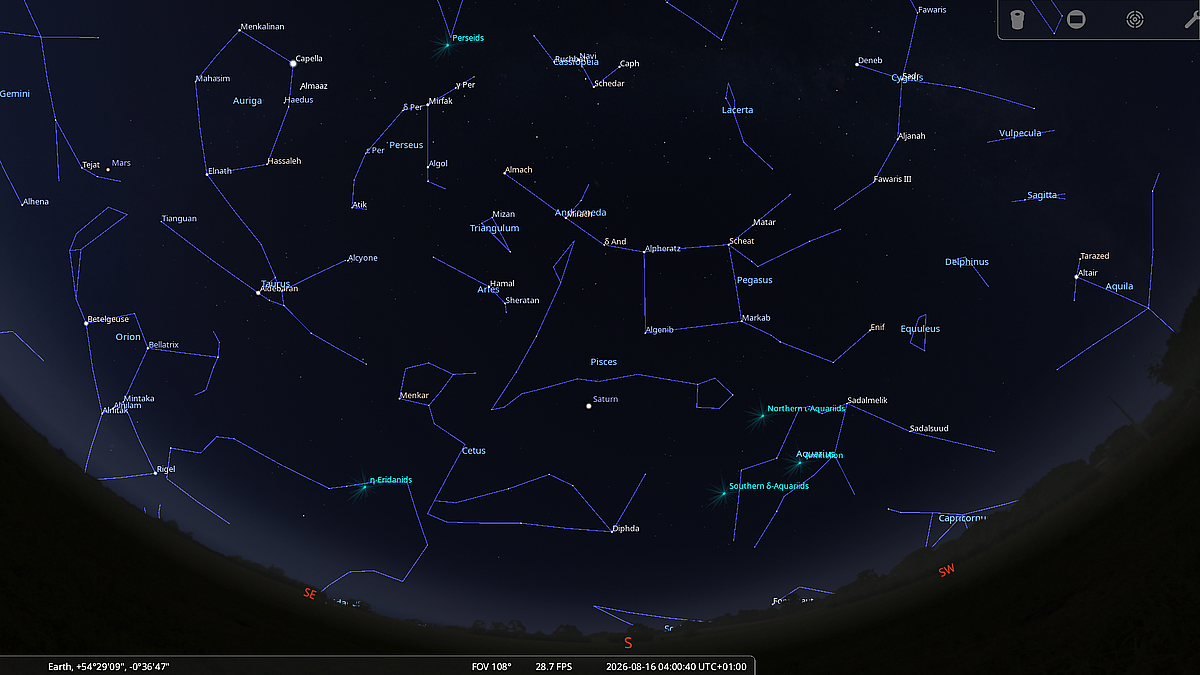
 Saturn now rises in the late evening, appearing shortly after 23:15hrs BST at the start of August and by around 21:00hrs by month’s end. At magnitude +0.6, it stands out against the faint stars of Pisces, below the Square of Pegasus in the eastern sky. Viewing conditions improve through the month as Saturn climbs higher, reaching a respectable 37 degrees above the southern horizon in the early morning hours.
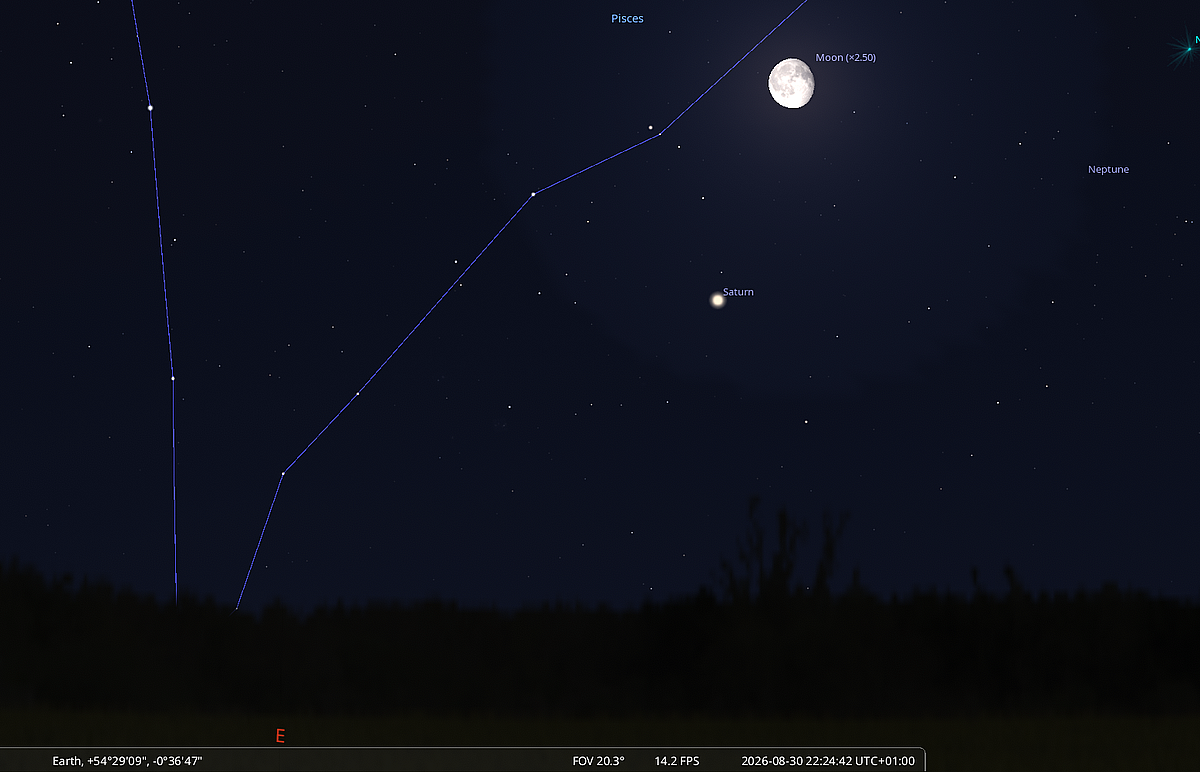
Aug 30th @ 22:24hrs BST - Saturn and Moon rising. (Click for larger image)
Through a telescope, Saturn’s rings should be evident, with their tilt increasing to more than 6 degrees—enough to reveal the Cassini Division under steady seeing. Titan, Saturn’s largest moon, should appear as a small point of light near the planet’s disc, while larger instruments under dark, steady skies may show several more moons. The Moon will lie near Saturn on 30th and 31st August.
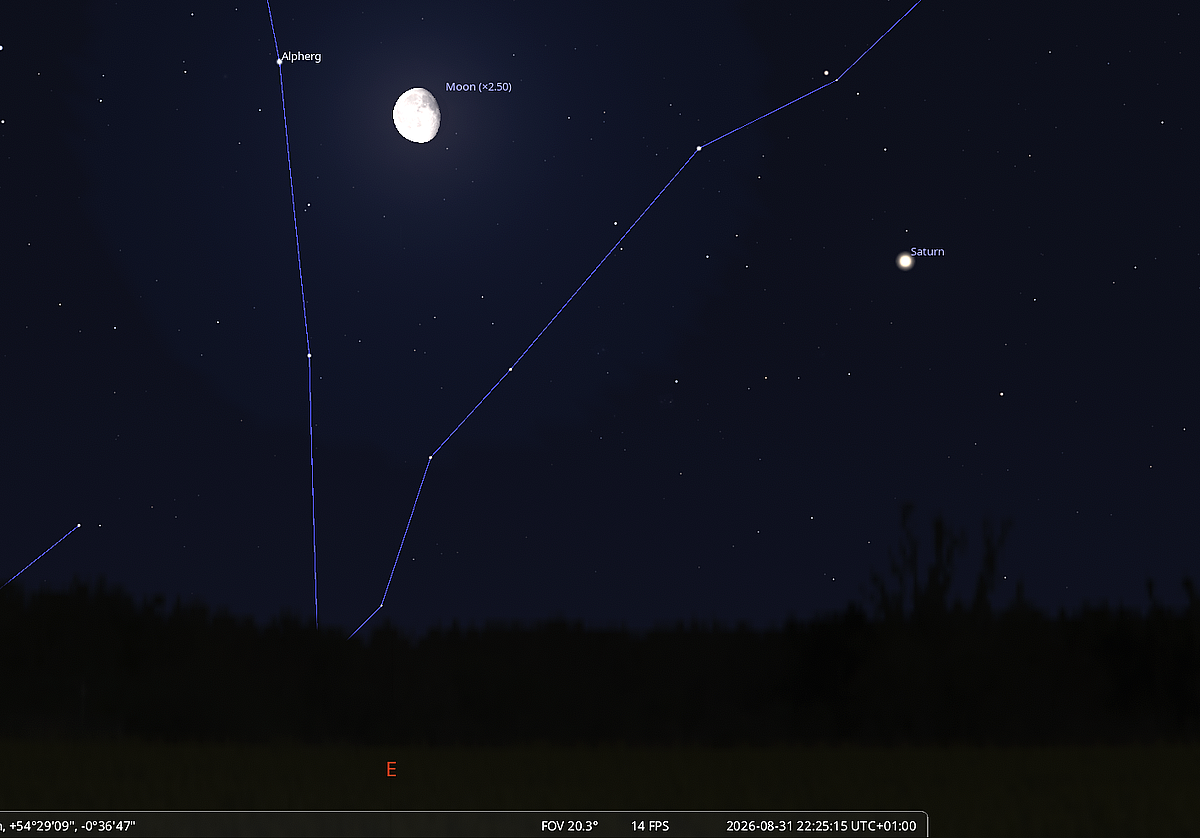
Aug 31st @ 22:30hrs BST - Saturn and Moon. (Click for larger image)
 Neptune also rises in the late evening, located 10 degrees ahead of Saturn still within the borders of Pisces. At a faint magnitude of +7.8, it requires a telescope to identify. Observers with GOTO instruments should find it readily, while others will need a sky app or planetarium program, along with some patience. Binoculars may show Neptune as a tiny speck, but resolving its 2.3 arcsecond blue-grey disc requires at least a 100mm (4-inch) aperture at around f/10 with medium to high magnification. The nearest named stars are 10 Cet and 44 Psc, both about 2.5 degrees east of Neptune.
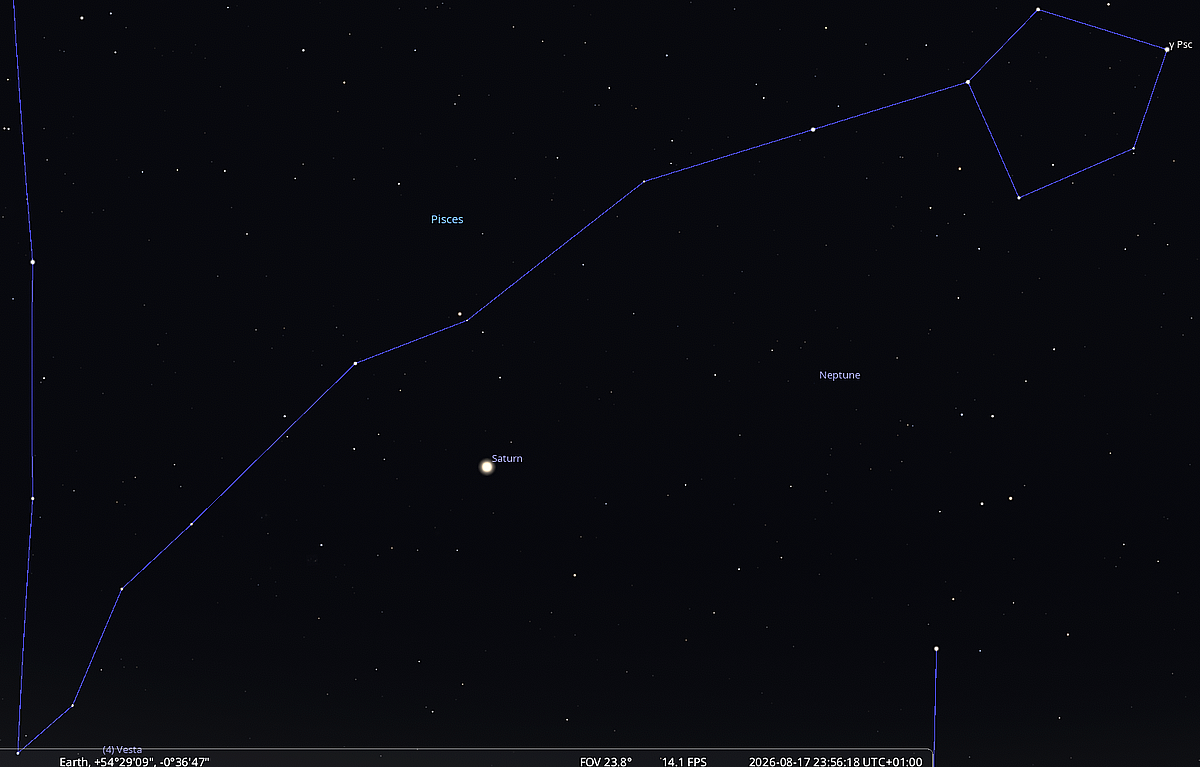
Neptune to right of Saturn - mid-August 23:55hrs BST. (Click for larger image)
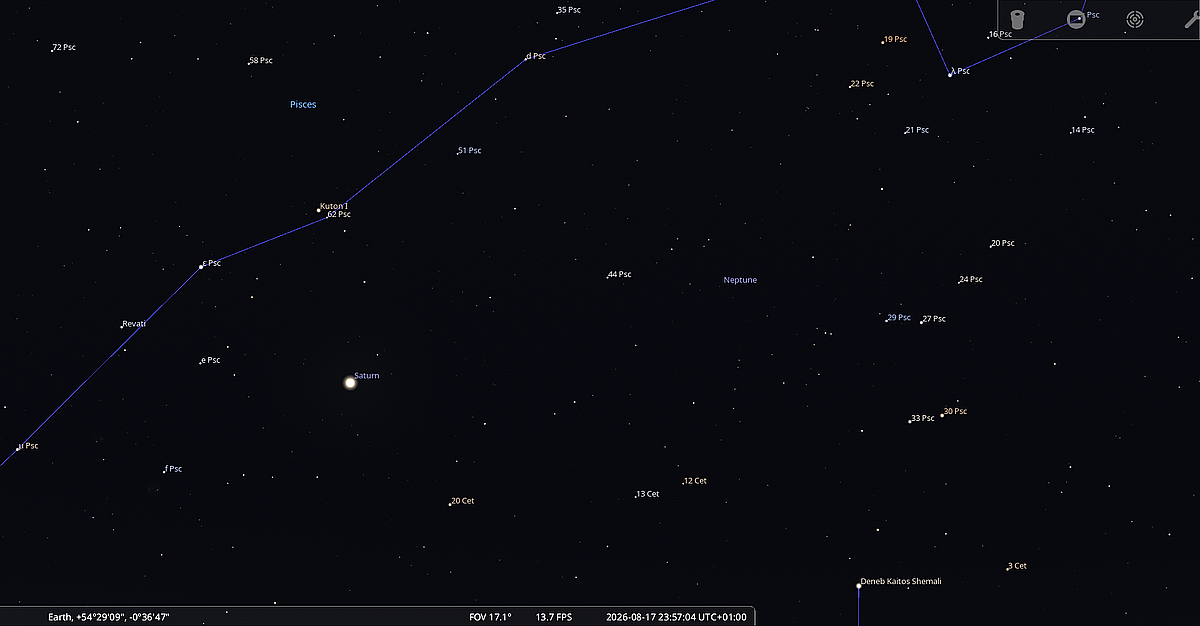
General location of Neptune with named stars, mid-August, 23:55hrs BST.
(Click for full image)
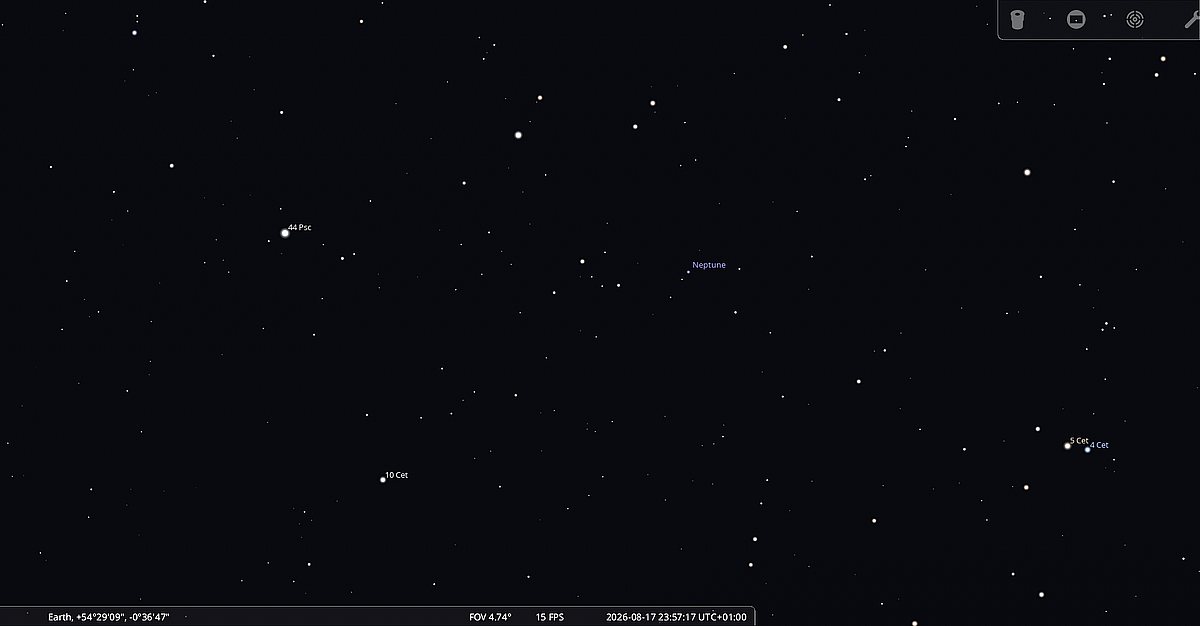
Detailed location of Neptune with named stars, mid-August, 23:55hrs BST.
(Click for full image)
 Uranus also enters the late-evening sky, but only late in the month and after 23:00hrs BST, so it is best regarded as an early-morning object for observation. At magnitude +5.7, it should be visible in binoculars as a tiny speck, lying not far above the Hyades star cluster, the head of Taurus. A telescope will make it easier to locate; an 80mm (3-inch) aperture should reveal its small 3.7-arcsecond grey-green disc, while instruments over 125mm (5 inches) will show it more clearly.
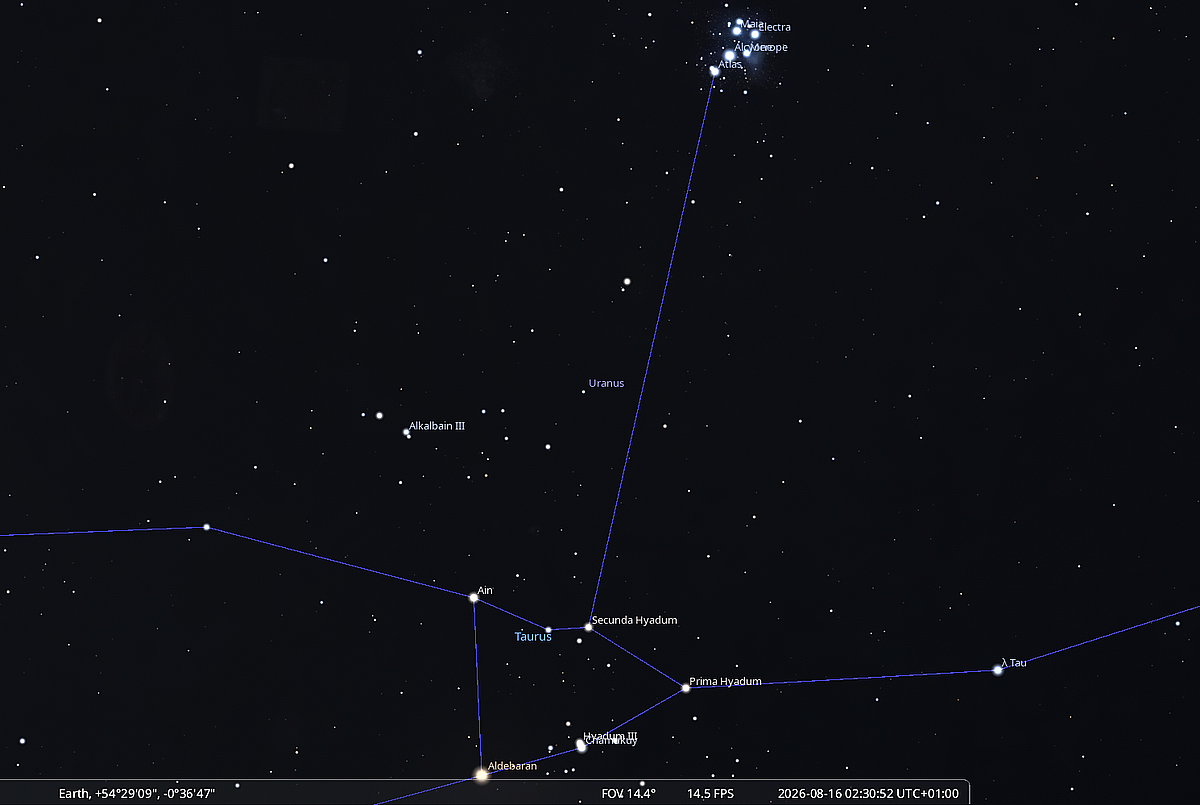
General location of Uranus with named stars, mid-August, 02:30hrs BST.
(Click for full image)
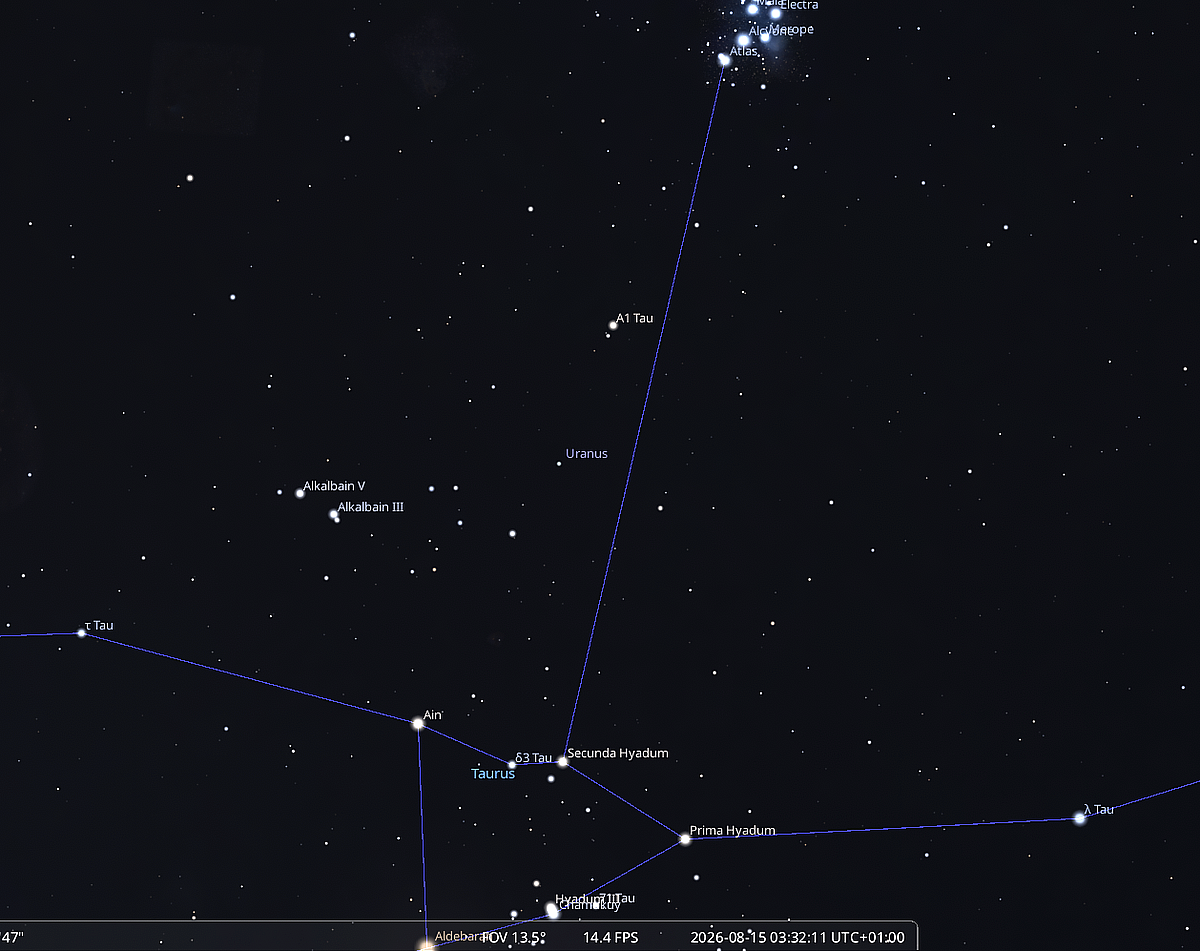
Detailed location of Uranus with named stars, mid-August, 02:30hrs BST.
(Click for full image)
 Mars is visible in the early morning sky, rising well after midnight and becoming easier to observe as August progresses. At the start of the month, it lies between Taurus’s “horn stars”, then moves steadily eastwards into the heart of Gemini. Shining at a modest magnitude +1.38, the red planet brightens slightly to +1.25 by month’s end.
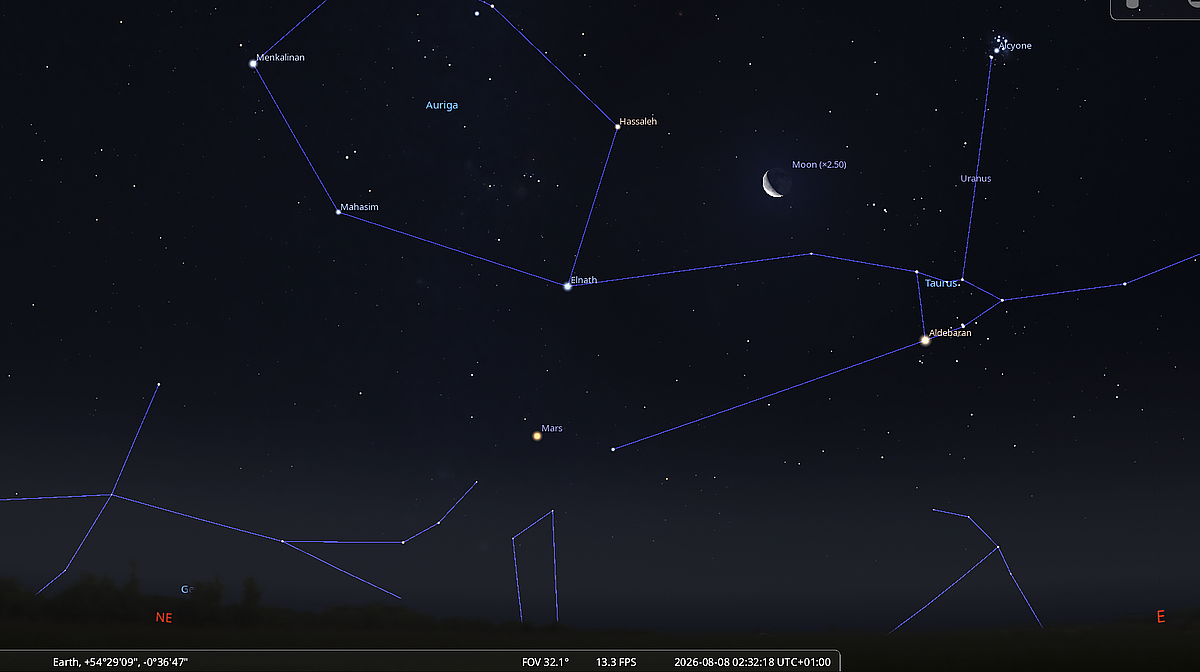
Mars and Moon on Aug 8th, viewing around 02:30hrs. (Click for full image)
Initially low in the north-east, Mars steadily gains altitude during August, reaching 34 degrees above the eastern horizon by 05:00hrs at month’s end. On Aug 15th Mars lies just 38 arcminutes south of the open cluster M35 in Gemini. Through a telescope Mars remains very small, with a disc only 5 arcseconds across, making surface detail very difficult to resolve except in the largest amateur instruments. Mars sits 4 degrees south of the Moon on Aug 9th.
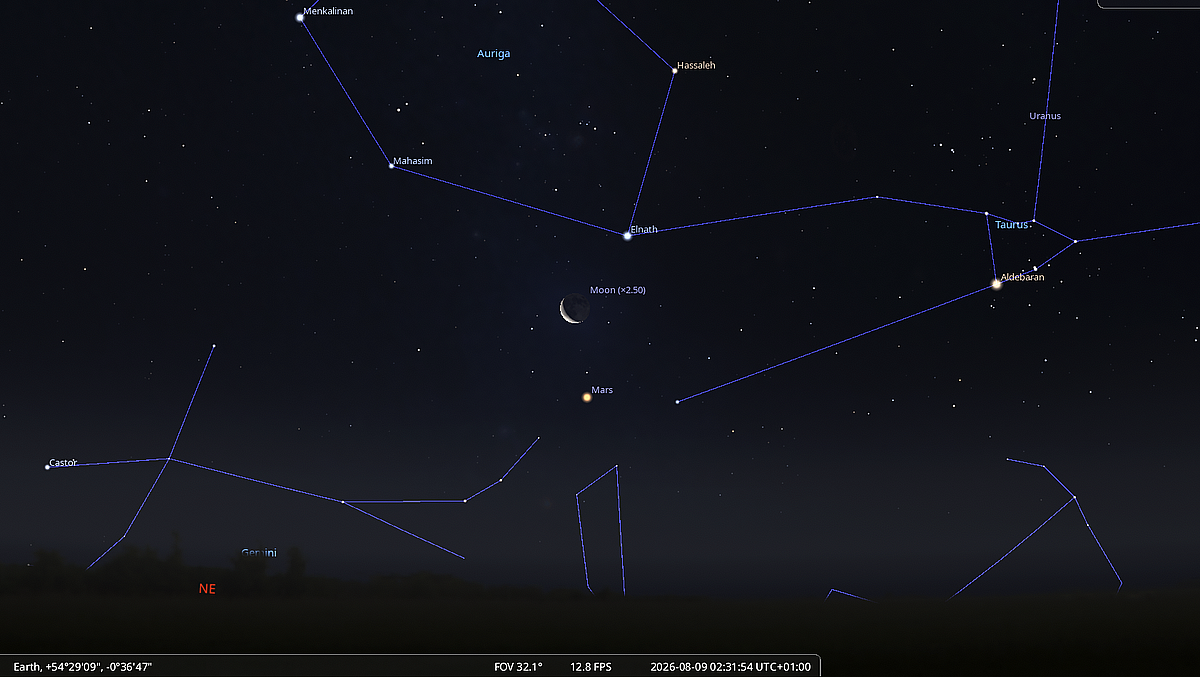
Mars and Moon on Aug 9th, viewing around 02:30hrs. (Click for full image)
 Jupiter returns to the morning sky by mid-August, though it will be difficult to spot without a clear north-eastern horizon. On 15th and 16th August, look for Jupiter and Mercury in conjunction just above the north-north-eastern horizon around 04:45hrs. On the 15th, Jupiter lies directly below Mercury, separated by just 43 arcminutes. It will appear slightly brighter at magnitude -1.65, compared with Mercury at -1.18, although their very low altitude will dim both by more than one magnitude. The next morning, Jupiter will sit just over one degree to Mercury’s right.
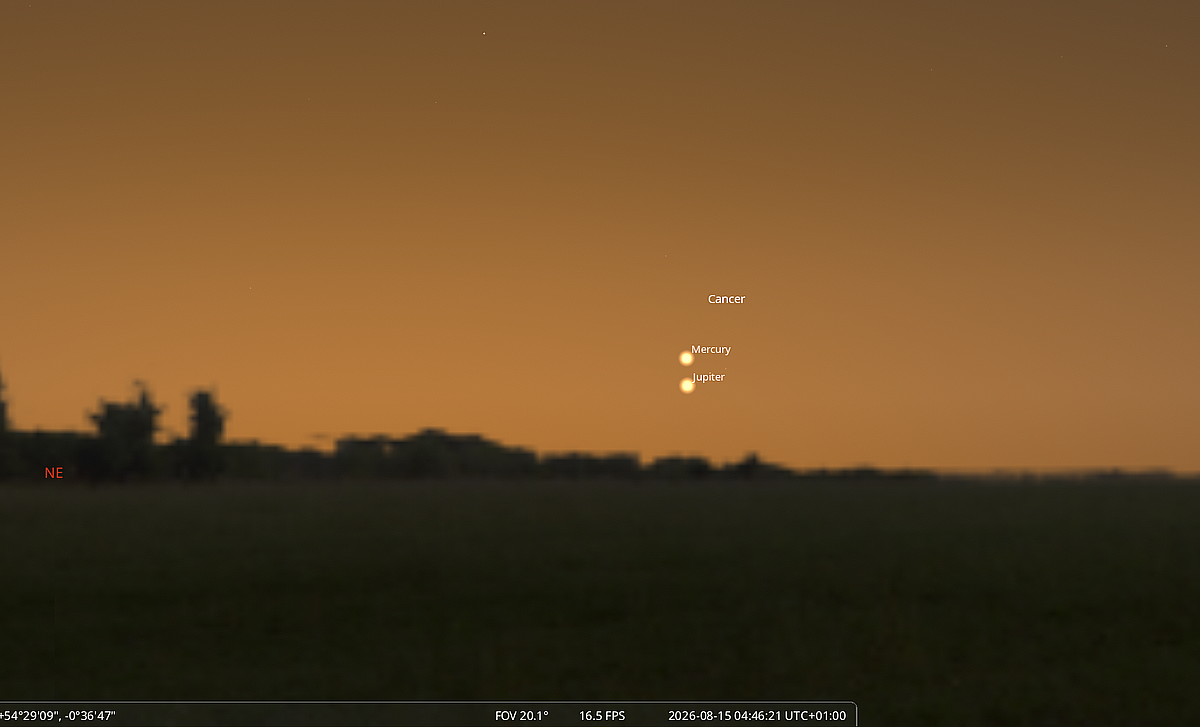
Jupiter and Mercury on Aug 15th @ 04:45hrs. (Click for full view)
Through a telescope, Jupiter is usually a fine sight, but this month its low altitude will severely limit the view, reaching only 13 degrees by 05:15hrs at month’s end. If seeing conditions are steady, its noticeably flattened, banded disc should be visible, along with any accompanying Galilean moons.
 Mercury continues a quite favourable morning apparition for UK observers, appearing low to the east-north-eastern horizon around 04:15hrs at the start of August. Mercury will gain some altitude before disappearing again by August 23rd. Look 35–45 minutes before sunrise from a site with a flat eastern horizon. On the morning of 11th August, a very slender waning Moon lies above Mercury around 04:30hrs. This will be a difficult observation—enough to make the Mercury-Jupiter conjunction a few days later seem easy by comparison.
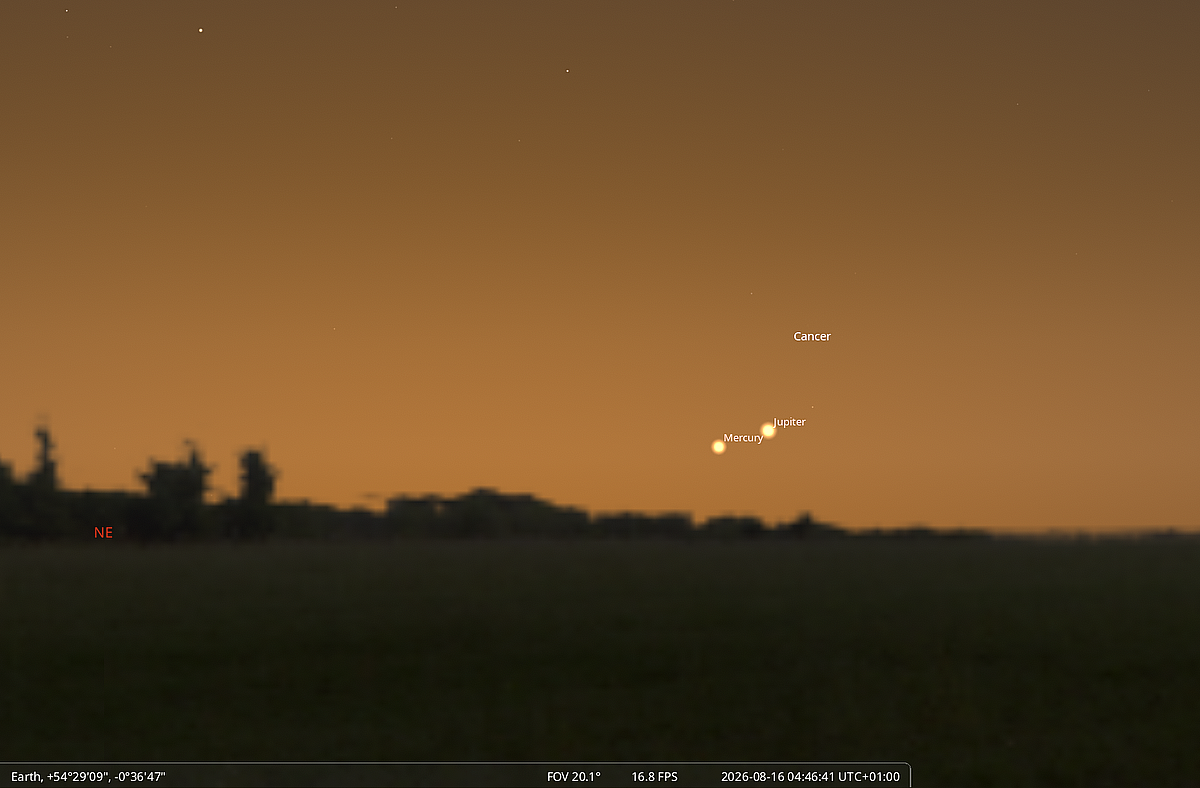
Mercury and Jupiter Aug 16th @ 04:45hrs. (Click for full image)
As noted earlier, Mercury has a close but challenging conjunction with Jupiter on Aug 15th and 16th, the pair separated by only 0.6 of a degree appearing just 4 degrees above the east-north-eastern horizon shortly before 04:45hrs. On the 15th, Mercury lies directly below Jupiter, then slightly to its left the next morning. Although Mercury is marginally fainter, both planets will shine at around magnitude -1.1 and should be visible despite their very low altitude.
After that, for a few more days Mercury continues to brighten, gaining a little in elevation, before dropping back to the horizon. Binoculars will help pick out Mercury in the dawn twilight should haze be an issue.
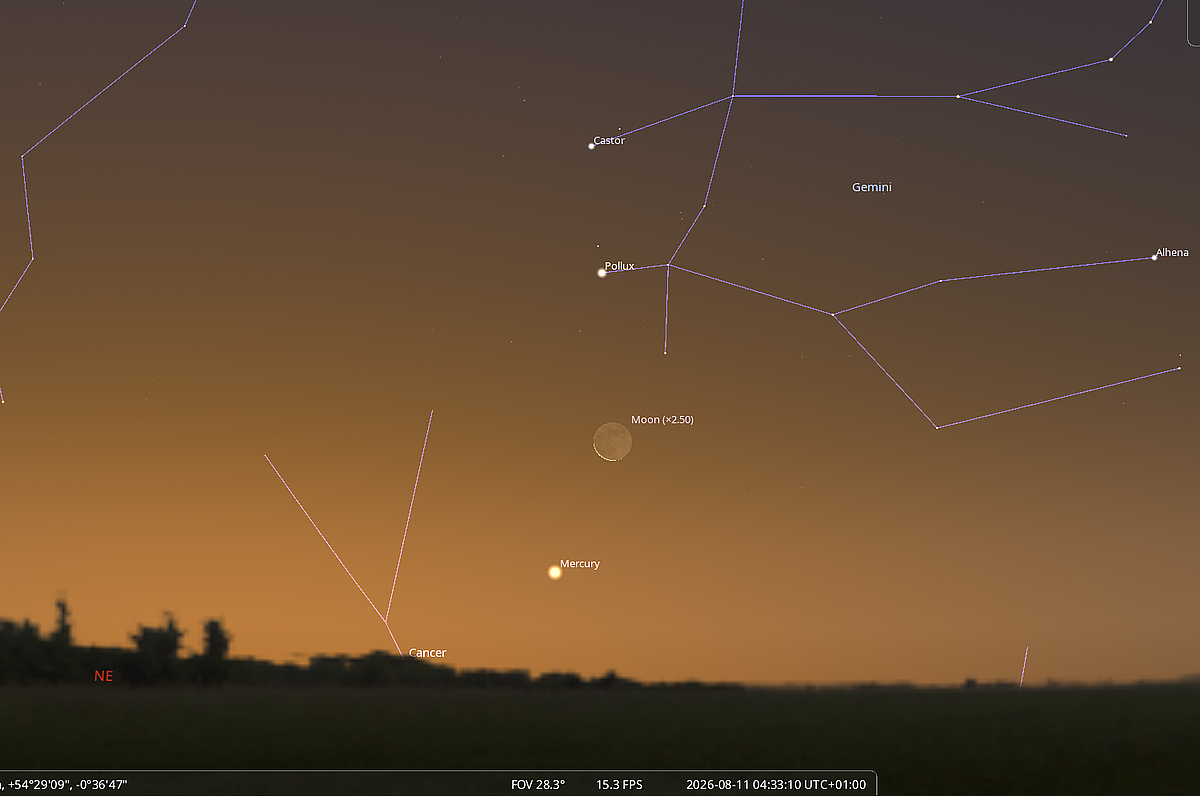
An observing challenge! Mercury and very slender crescent Moon - Aug 11th @ 04:30hrs.
(Click for larger image)
August Eclipses - Partial Solar
August brings two eclipses: a solar eclipse on the evening of the 12th and a lunar eclipse in the early hours of the 28th. From the UK, both will appear as deep partial eclipses.
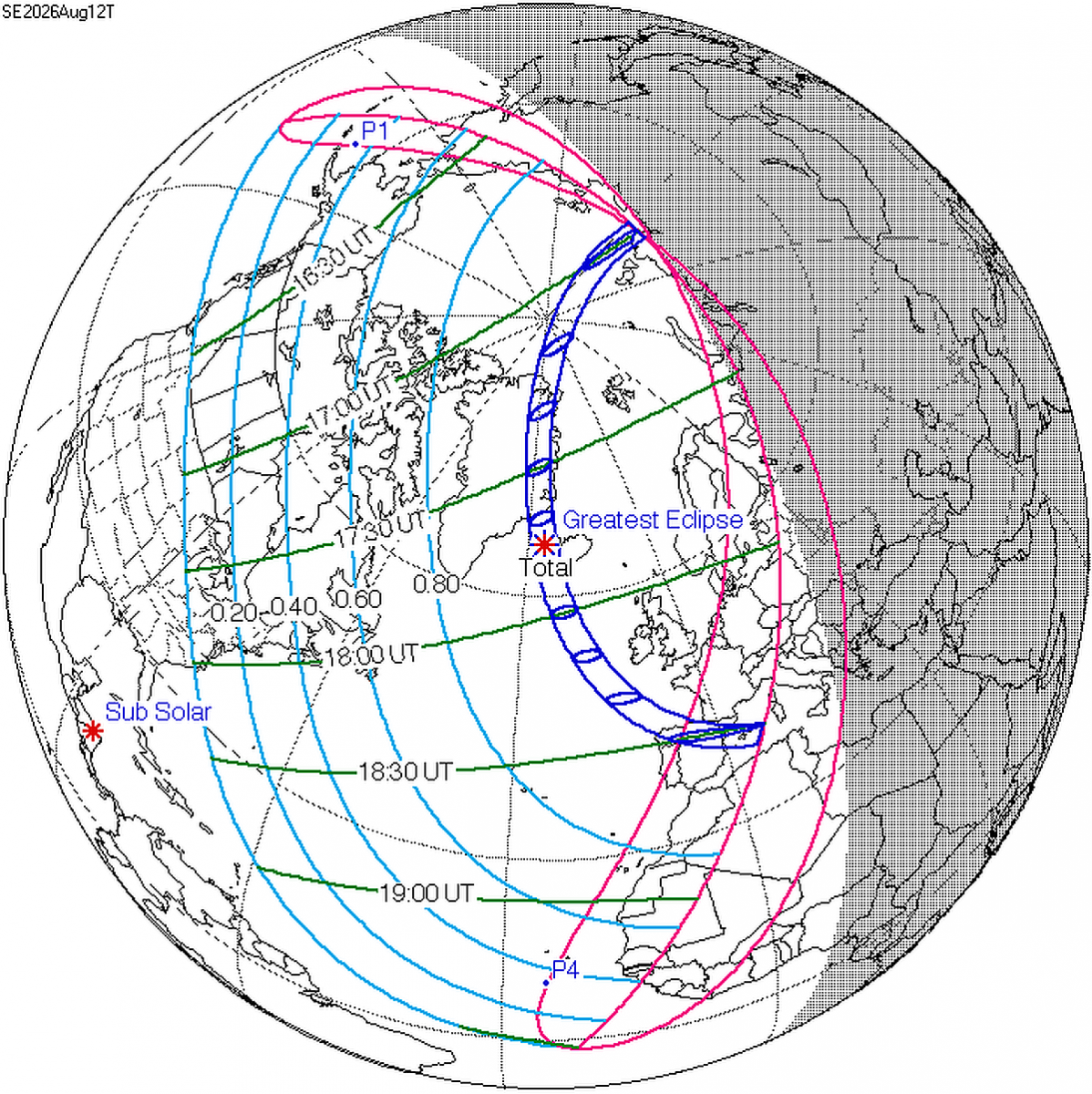
Path of totality for solar eclipse on Aug 12th. (Click for full image)
The celestial highlight of the year arrives on Wednesday 12 August: not the Perseids, good though they should be, but a very large partial solar eclipse visible from our shores. If the UK had lay a few hundred miles farther west, we would have witnessed a total eclipse in the path of totality! Even so, around 90% of the Sun will be eclipsed across much of the UK—the greatest coverage here since the solar eclipse of August 1999.
For those fortunate enough to witness totality—including several WDAS members—the path will cross the Arctic, Greenland, Iceland, the western Atlantic, parts of Spain and the Mediterranean. Greatest eclipse and longest duration occur off Iceland’s west coast, where totality will last 2 minutes 18.21 seconds. At least five WDAS members will be located somewhere along this path, hopefully under clear skies.

August 12th - 18:15hrs BST. Moon 'bite' as seen from Whitby.
From Whitby, the eclipse begins at 18:12hrs BST (first contact), with the Sun already low in the west at about 20 degrees. By 18:15hrs, the Moon’s “bite” should be clearly visible. The images below show the eclipse’s progress towards maximum at around 19:07hrs, when more than 90% of the Sun will be obscured and it will stand 12 degrees above the horizon. It will be interesting to note how much the sky darkens and how the quality of the light changes.
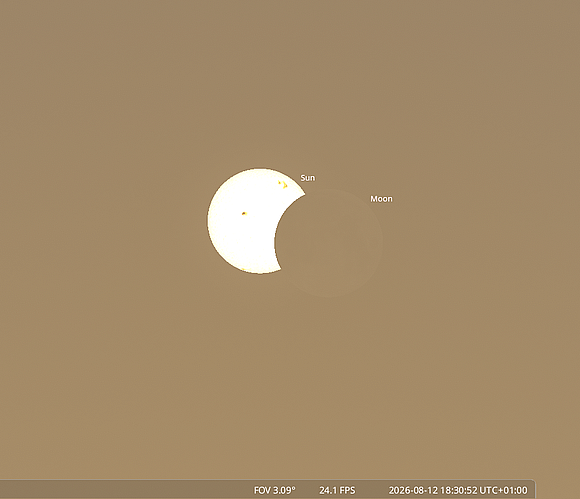
August 12th - 18:30hrs BST Moon will become more noticeable as seen from Whitby.
As the Moon covers more of the Sun, temperatures may fall and light levels will drop. At maximum eclipse, the Sun should resemble a striking, downturned crescent in the western sky. Atmospheric conditions will influence the view, but safety is essential when observing any solar eclipse. Use only approved solar filters, such as Mylar, Baader film or other certified solar-viewing filters.
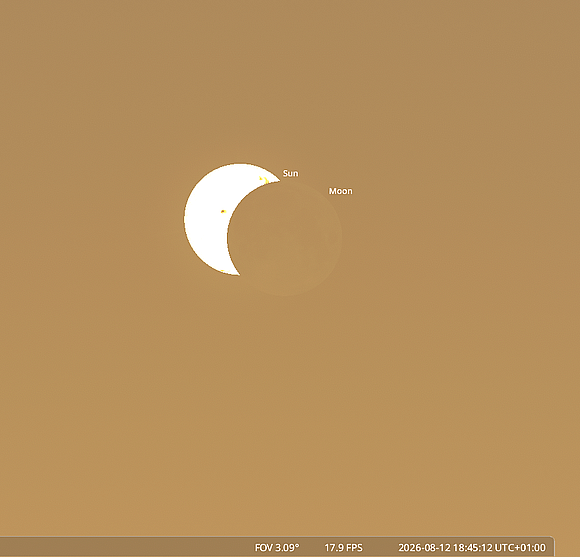
August 12th - 18:45hrs BST, eclipse progresses.
Do not look directly at the eclipsed Sun unless atmospheric conditions make it clearly safe to do so. Mist, thin cloud or horizon haze as the Sun sinks lower may allow brief naked-eye viewing, but this relies on judgement and experience. Conditions can change suddenly, so it is always better to be safe than sorry.
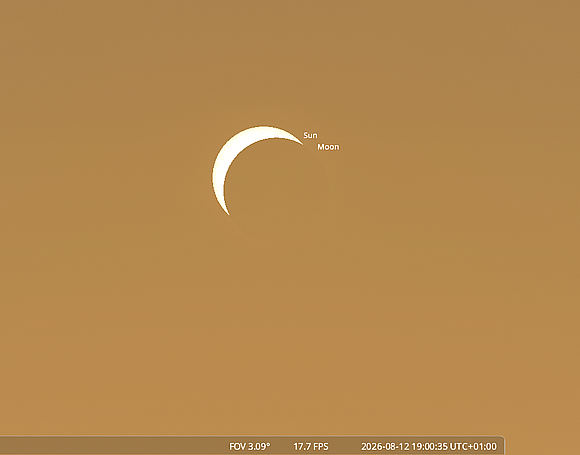
The Eclipse @ 19:00hrs BST.
If viewing the eclipse through a telescope, employing a correct solar filter fitted on the aperture end and look for any visible sunspots. Also study the Moon’s limb; careful observation should reveal its rugged edge, shaped by mountains and crater rims.
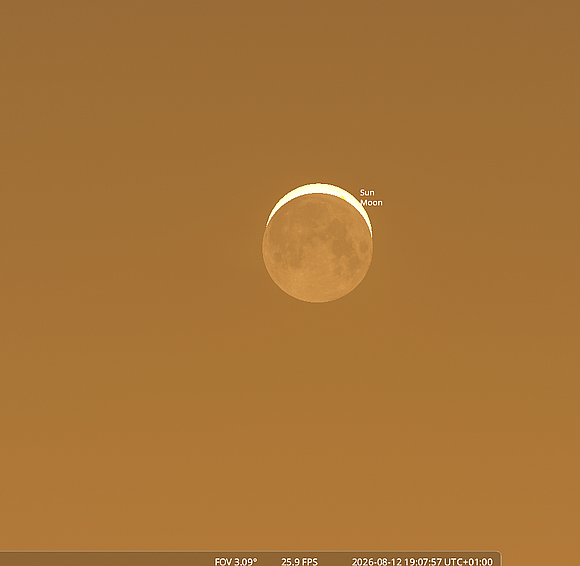
Maximum eclipse around 19:07hrs BST.
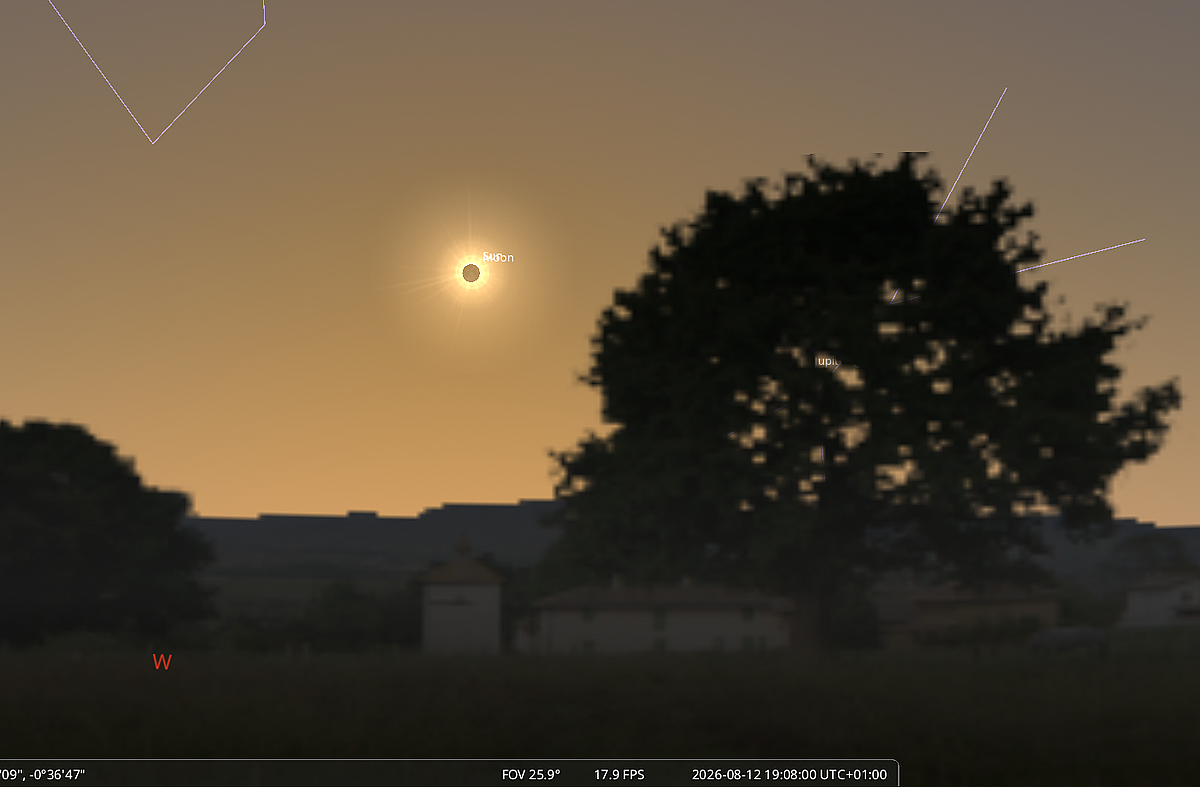
Location of Sun in the sky relative to horizon around maximum eclipse. (Click for full image)
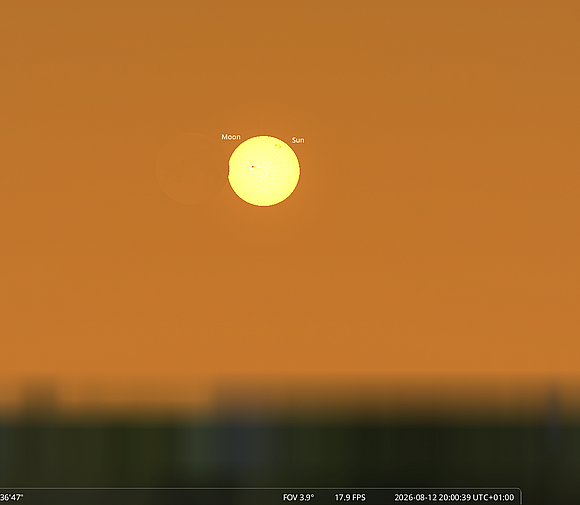
As the Moon moves across the Sun, the remaining visible portion will appear to rotate around the lunar limb before, during and after greatest obscuration, then gradually slide away. The image sequence below shows the eclipse after maximum. Keep an eye out for Venus to the left of the Sun. It should emerge as skies darken when deepest partiality is reached, before fading again after.
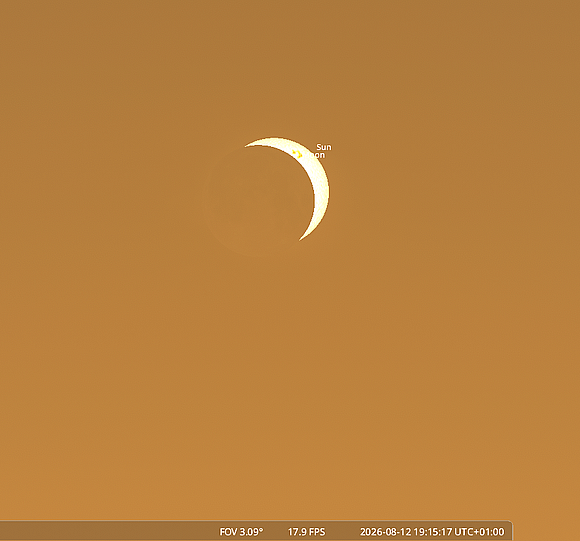
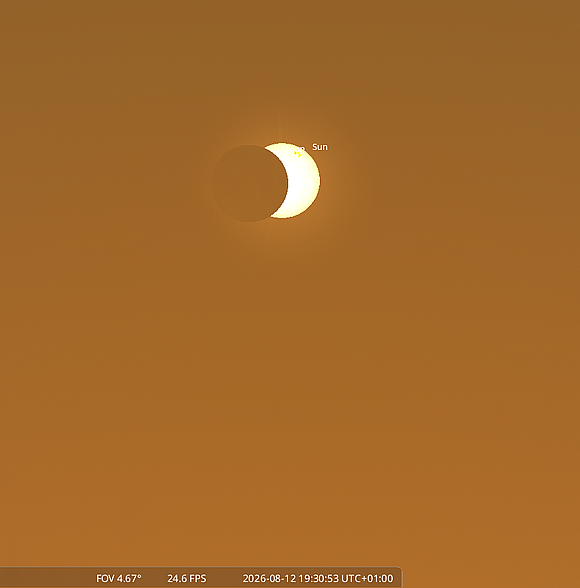
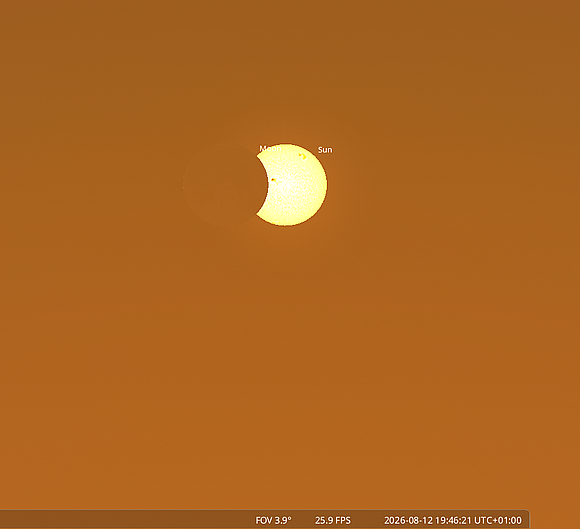
The Moon will finally clear the Sun’s disc just after 20:00hrs, when the Sun will be only a few degrees above the western horizon.
The biggest uncertainty, of course, is the weather. We can only hope that at least part of the eclipse will be visible, making 12 August a truly memorable day. WDAS members will be stationed at Danby Lodge. See details in WDAS events schedule.
Partial Lunar Eclipse.
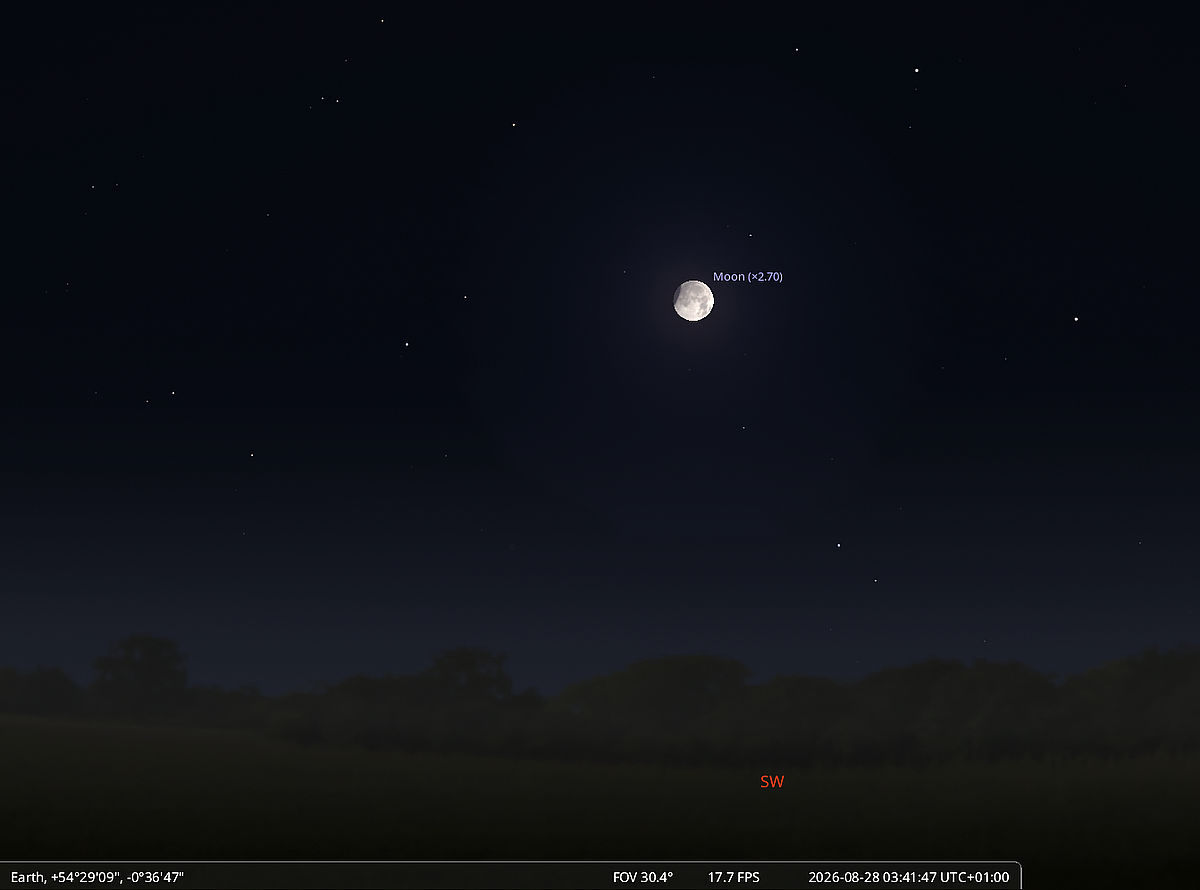
The view to the SW shortly after umbral shadow becomes noticeable.

Closer view of umbral shadow creeping across lunar disk.
The subtle penumbral shading, often hard to detect, begins around 03:26hrs BST. Earth’s darker umbral shadow starts to cover the Moon at about 04:35hrs BST. Greatest eclipse occurs around 05:12hrs BST, when up to 97% of the Moon will be within Earth’s shadow. The latter stages will not be visible from the UK, as the Moon sets at around 05:45hrs BST, well before the eclipse ends.
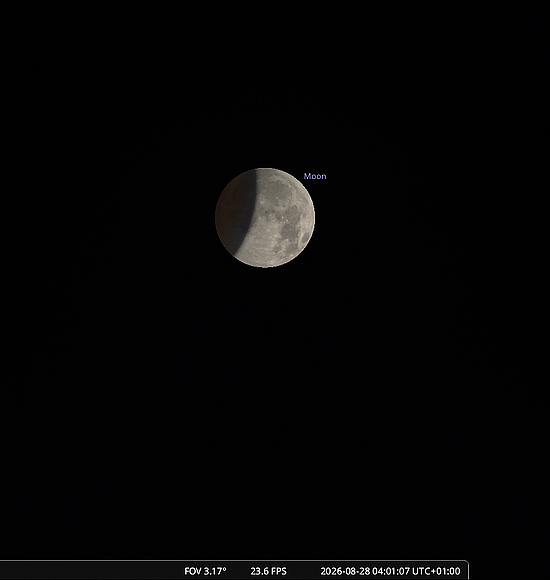
Lunar eclipse at 04:00hrs
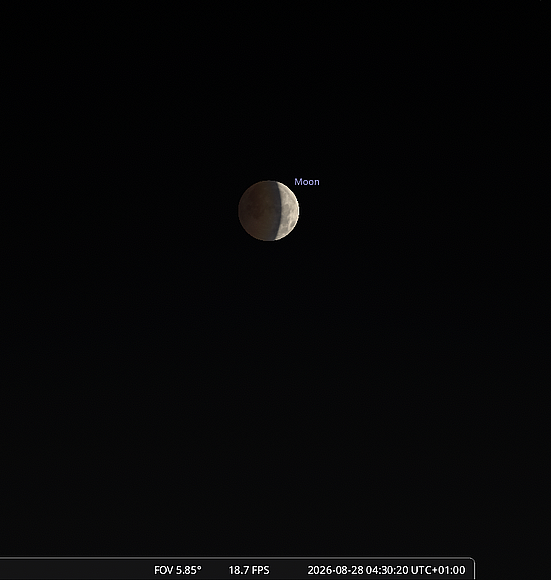
...and at 04:30hrs BST.
Observers will need a good western aspect to see as much of the eclipse as possible, with the Moon low on the horizon by 05:12hrs BST. Binoculars or a small telescope will greatly enhance the view of Earth’s shadow crossing the Moon, though it should still be dramatic to the naked eye and camera lens in the early morning twilight. No eclipse event is scheduled, but Whitby East Cliff should offer a good viewing spot if skies are clear—and your alarm clock has done its job!
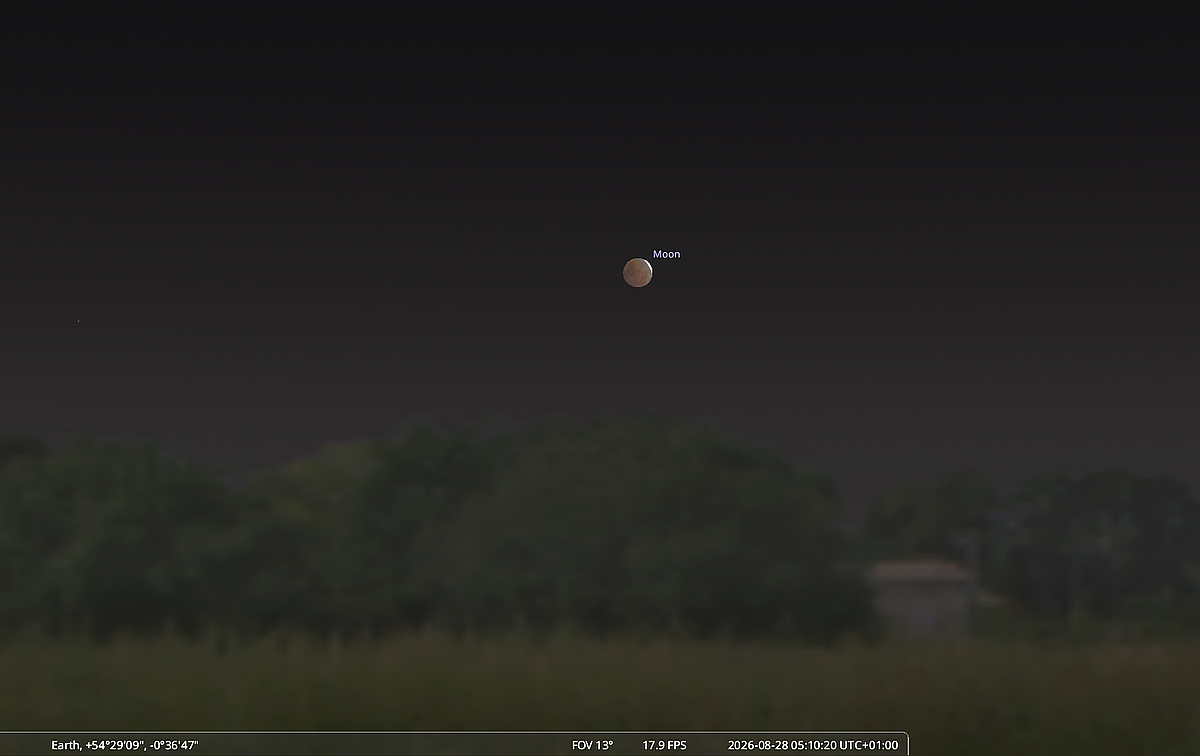
Maximum eclipse amount at 05:10hrs BST not far above west horizon. (Click for full image)
August Meteors - The Perseids
Meteor activity is rather low during summer, with one, glorious exception; the Perseids, one of the more prolific meteor showers and without doubt the most widely observed by the public. The Perseids are active from just after mid-July until into the fourth week of August with activity highest from Aug 8th-15th. The shower normally reaches a peak overnight of Aug 11-12th or 12-13th.
Sometimes known as "The tears of St. Lawrence"; the martyred Christian deacon whose feast day falls on Aug 10th, just before the Perseids peak, these particular ‘tears’, like most meteor showers, are composed of debris deposited over many thousands of years by periodic comets.
Perseids are associated with the periodic comet Swift Tuttle which has an orbital period of around 133 years. It appeared last in 1992 when enhanced rates were seen, the next pass being in 2126 when the comet could be as bright as Comet Hale-Bopp was back in 1997, providing that predictions are correct of course!
It is widely perceived amongst the public that meteors are quite substantial in size, but this is not so, Perseid meteoroids are not dissimilar in size to that of instant coffee granules with the occasional pea or marble sized fragment. Every August, Earth encounters various strands of the Swift-Tuttle debris stream giving rise to the eagerly anticipated shooting stars.
Penetrating the upper atmosphere some 60miles (100km) up, Perseid 'meteoroids' reach speeds of 43miles/second, interacting with atoms as they push through the air, a process known as ablation, before becoming ionised and releasing a packet of light. It is this brief luminous flash we call a meteor. Particularly bright examples often leave behind persistent ionisation trails in their wake, the classic shooting star.
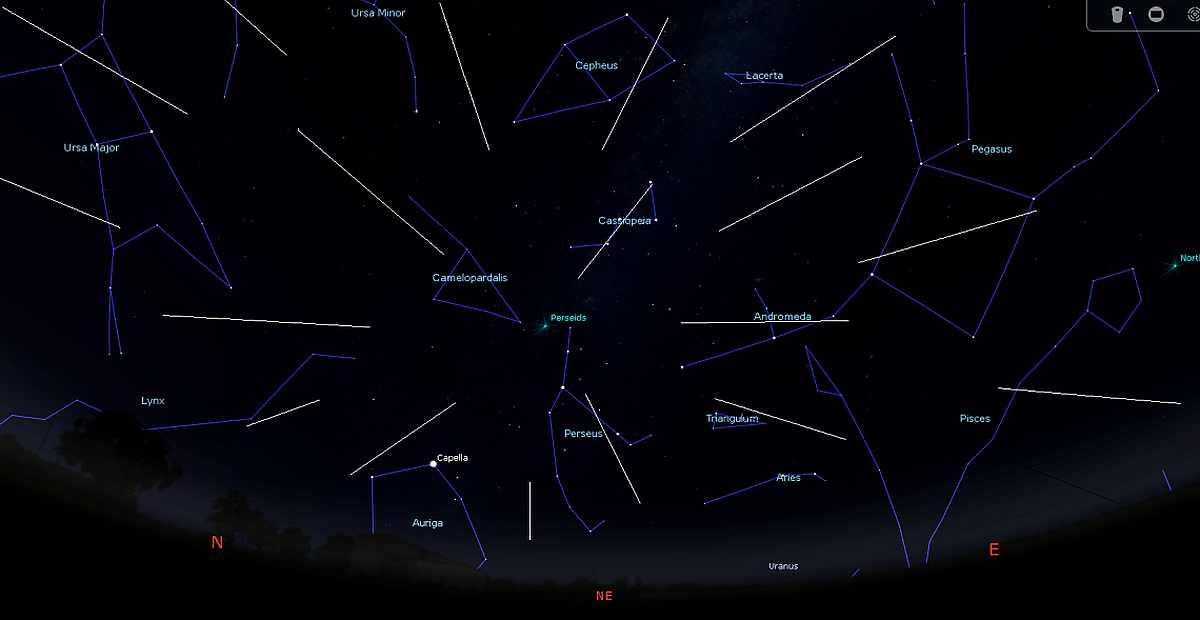
The Perseid Meteor shower radiant - pre-midnight Aug 12th. (Click for full image)
The shower’s radiant—the point in the sky from which the meteors appear to originate—lies in Perseus. In August, Perseus rises in the north-east during the evening and is best placed before dawn.
In 2026, the shower is expected to peak from the UK overnight on 12/13 August, as Earth passes through the densest part of Comet Swift-Tuttle’s debris stream. Activity is most likely to be enhanced for about 16 hours around the peak, especially when the radiant is high in the sky.
The best observing window is likely to be the early hours of 13th August, from about 01:00hrs to 04:00hrs. Observers should also watch in the early hours of the 12th, late evening of the 12th, and again late on the 13th. Hopefully, clear skies will coincide with at least one of these periods.
Under ideal conditions, the Perseids typically have a zenith hourly rate (ZHR) of 80–120, though a single observer usually spots about 40% of that number.
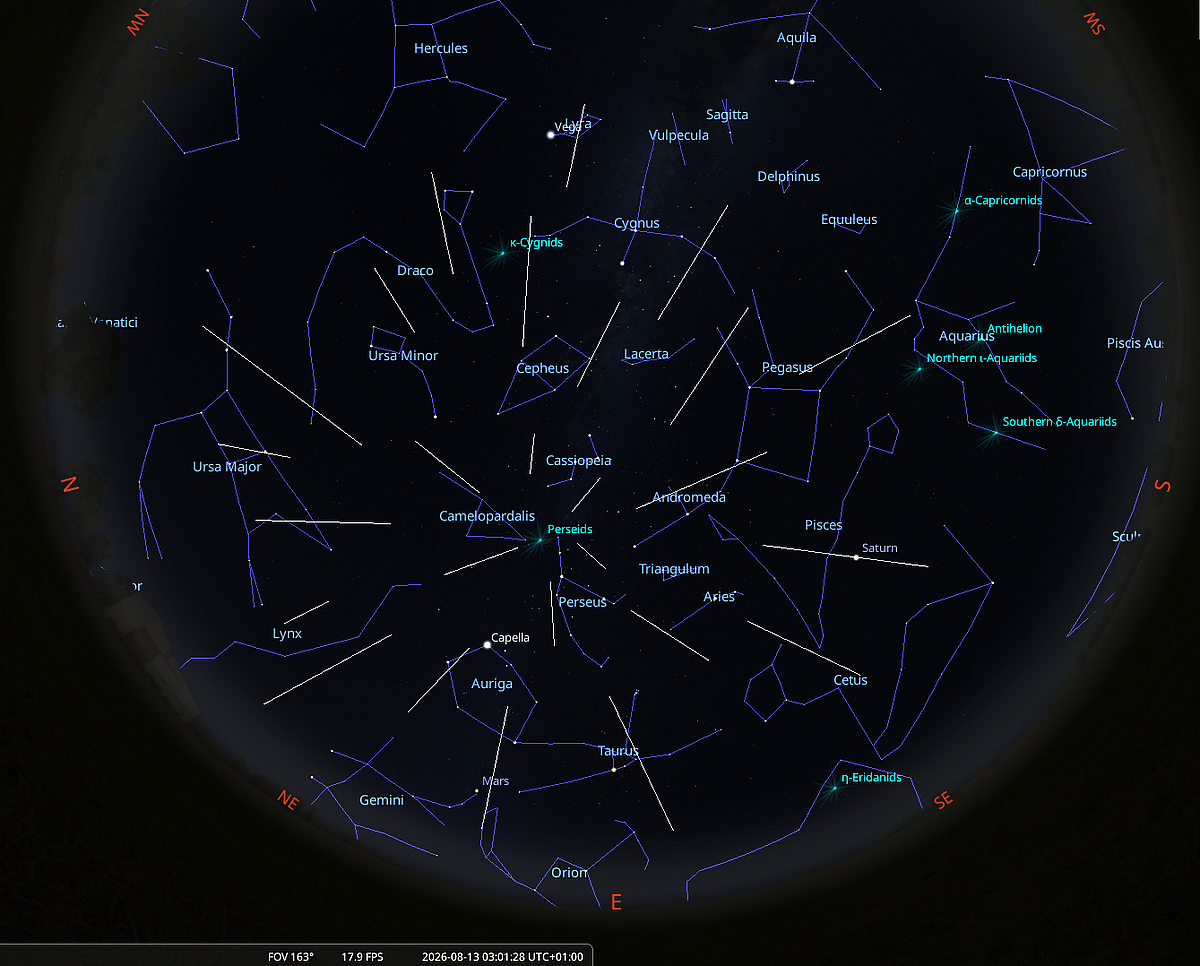
Perseid activity early morning hours of Aug 13th. (Click for full image)
Weather permitting, conditions should be excellent this year, with the Moon new after eclipsing the Sun on the evening of the 12th. Observers out in the early hours of the 13th could see 30–50 meteors per hour, while those watching after 22:00hrs on the 12th are more likely to see 10–15 per hour.
Anyone planning a long observing session on 11/12 or 12/13 August should watch an area of sky at least a hand span from Perseus and 40–70 degrees above the horizon. Fingers crossed for clear skies—wrap up warm, and hopefully you’ll wish upon a few “Tears”.
T Corona Borealis
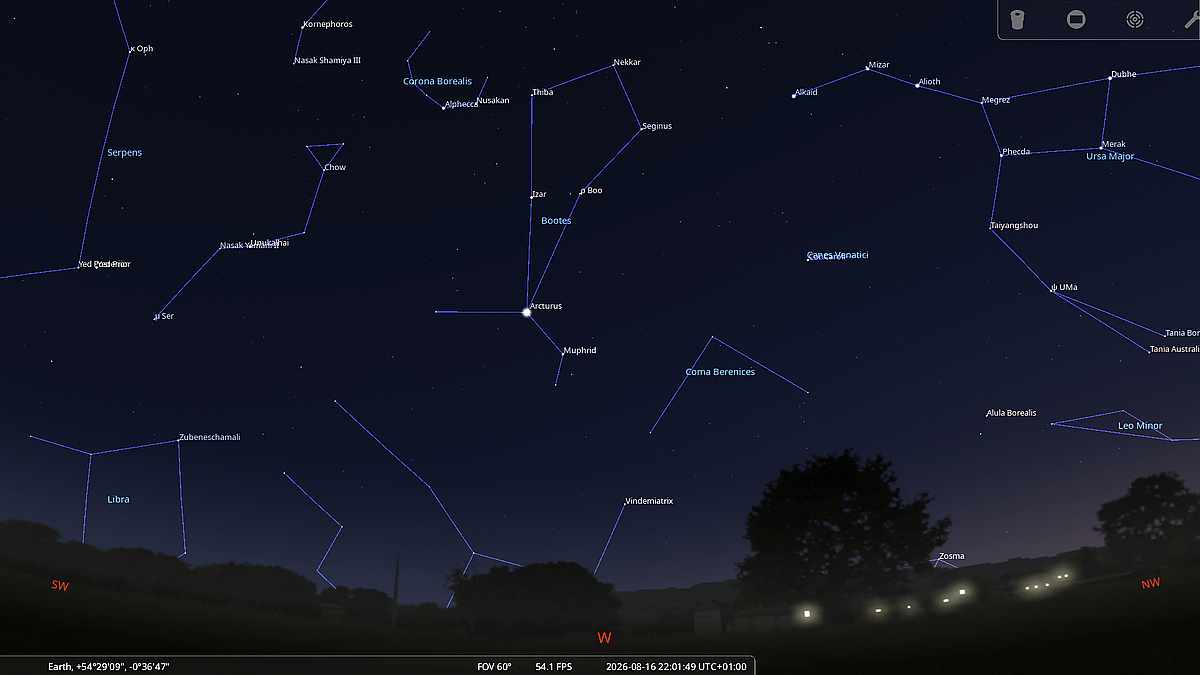
And yes, the recurrent nova T Coronae Borealis continues to keep observers waiting, with astronomers across the northern hemisphere watching closely. T Cor Bor remains inconspicuous at around magnitude +10, as speculative eruption dates come and go. Fortunately, Corona Borealis is currently well placed for UK observers, high in the south-west as twilight deepens, with the small constellation’s stars visible by about 22:30hrs in mid-August. Keep checking regularly and watch for reliable updates in the media. See January Sky Notes.
August Night Sky 2026
After 82 consecutive light nights, astronomical twilight—the deepest twilight stage, bringing true darkness—returns in August for the first time since May. The change will take a few weeks to become obvious, but by mid-month observers should have longer spells beneath a darker stellar canopy, ideal for exploring deep-sky objects.
At the start of August, the brightest stars still do not appear until around 22:00hrs, with Arcturus in the west and Vega overhead usually first to emerge. Within about ten minutes, Altair midway up in the south, Deneb high in the east and Capella low in the north complete this first group of stellar beacons. Antares in Scorpius may just be visible low in the south-west, provided the horizon is flat and seeing conditions are good.
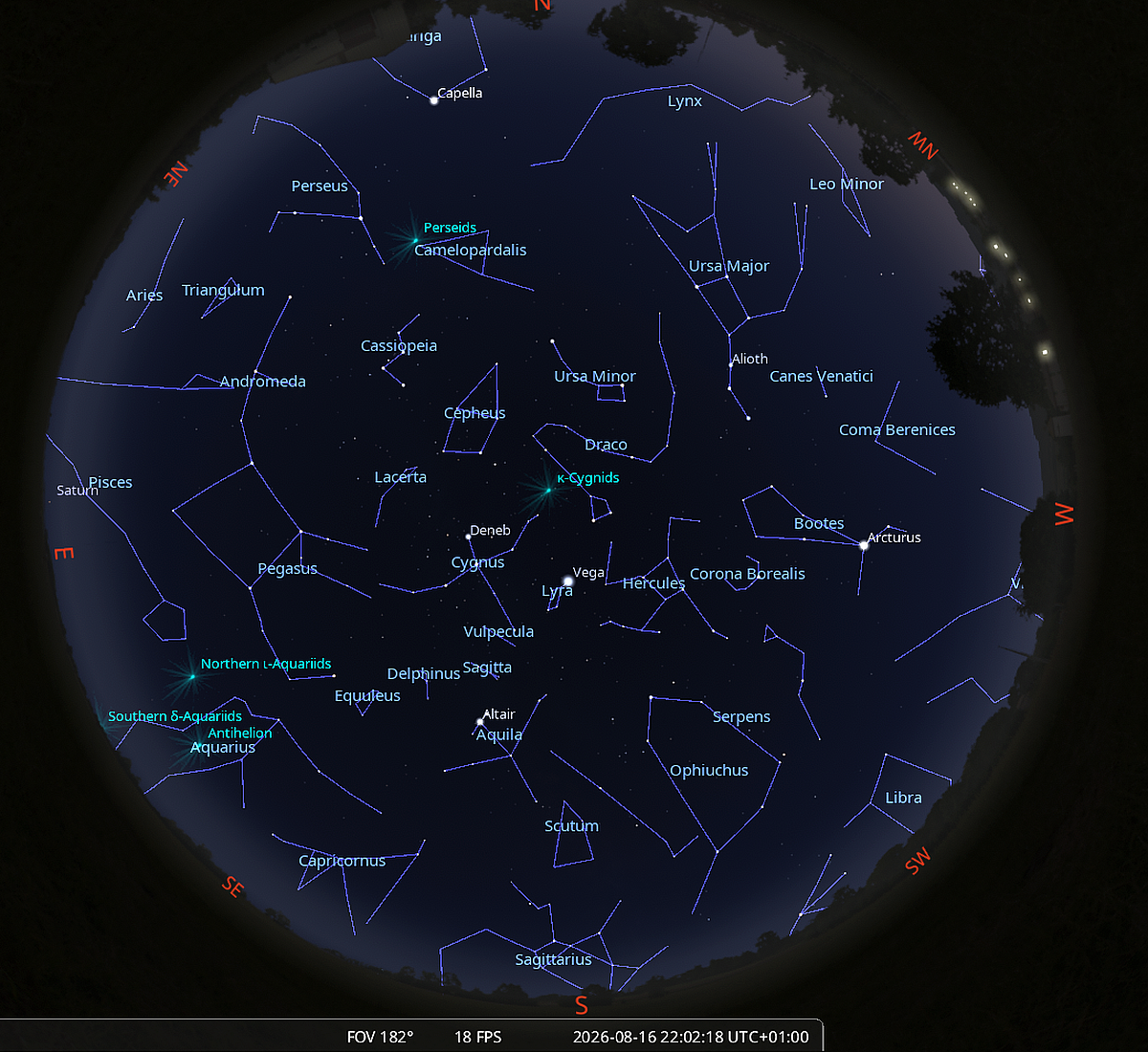
August 'night' sky - mid-month 22:00hrs. (Click to enlarge)
By 22:30hrs, most stars should be visible to the naked eye, making the constellations easier to recognise. Look for the familiar saucepan shape of the Plough, part of Ursa Major, high in the north-west. Following the natural arc of its handle leads to bright Arcturus, the chief star of Boötes the Herdsman. Upper left of Arcturus lies the delicate circlet of Corona Borealis, the Northern Crown, with Alphecca as the central jewel of this celestial tiara. When the recurrent nova T Cor Bor finally erupts, it should appear just below and to the left of the crown.
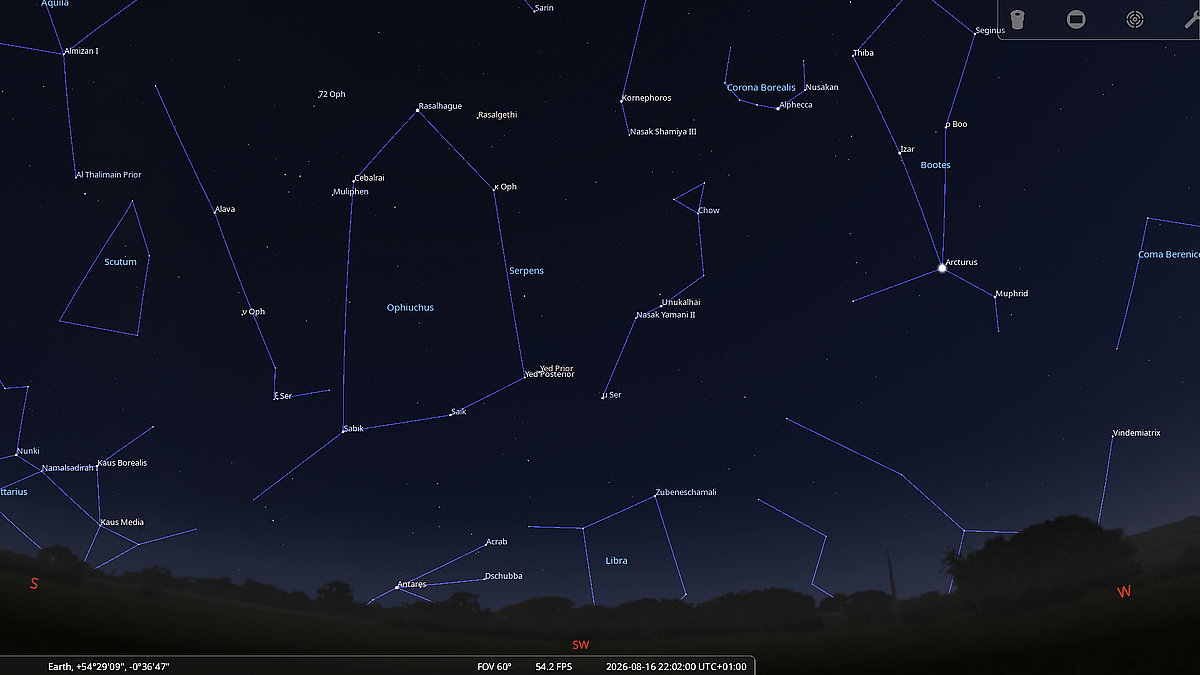
The SW aspect, mid-August - 22:00hrs BST. (Click to enlarge)
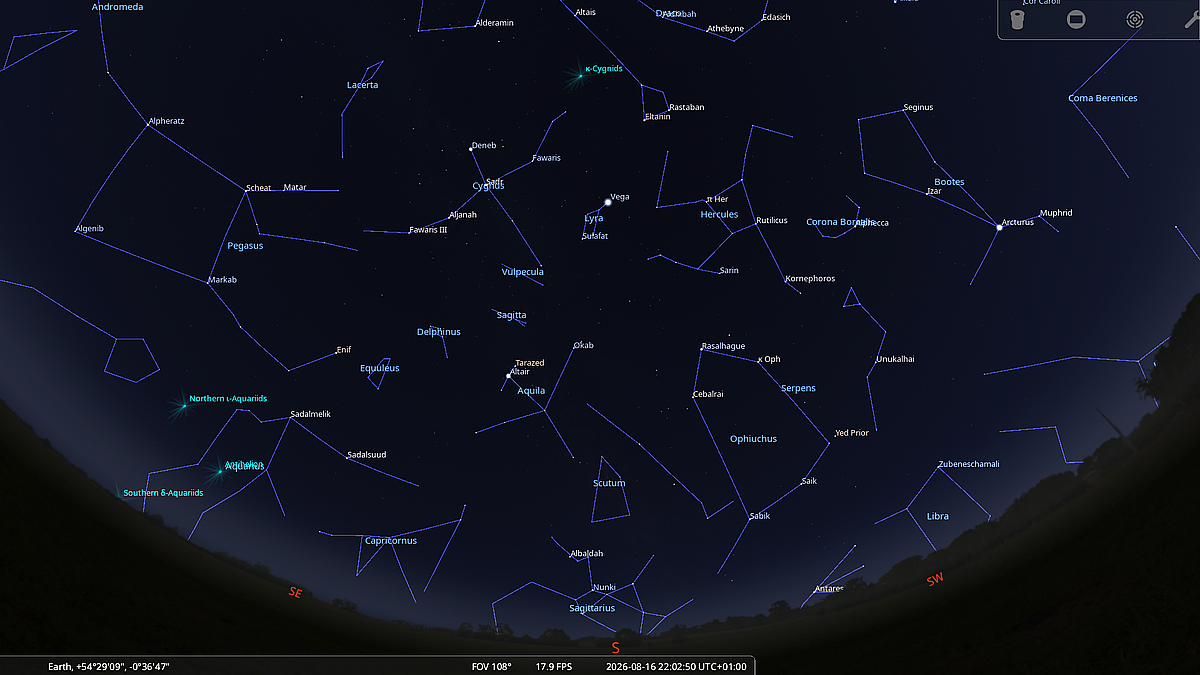
Much of the south-western sky is taken up by two large constellations: Hercules and Ophiuchus. Hercules lies higher in the south-west and is easiest to recognise by its “Keystone” asterism. Below it, stretching down towards the west-south-western horizon, is the large but rather indistinct figure of Ophiuchus, the Serpent Bearer. As twilight deepens, you may also glimpse the orange glow of Antares in Scorpius just above the south-western horizon.
Due south, the “Teapot” asterism—the visible part of Sagittarius from the UK—sits on the horizon and can be traced in clear, transparent skies. In this same direction, among the celebrated star clouds of the Milky Way near the border of Sagittarius and Scorpius, lies the centre of our galaxy, about 27,000 light years away.
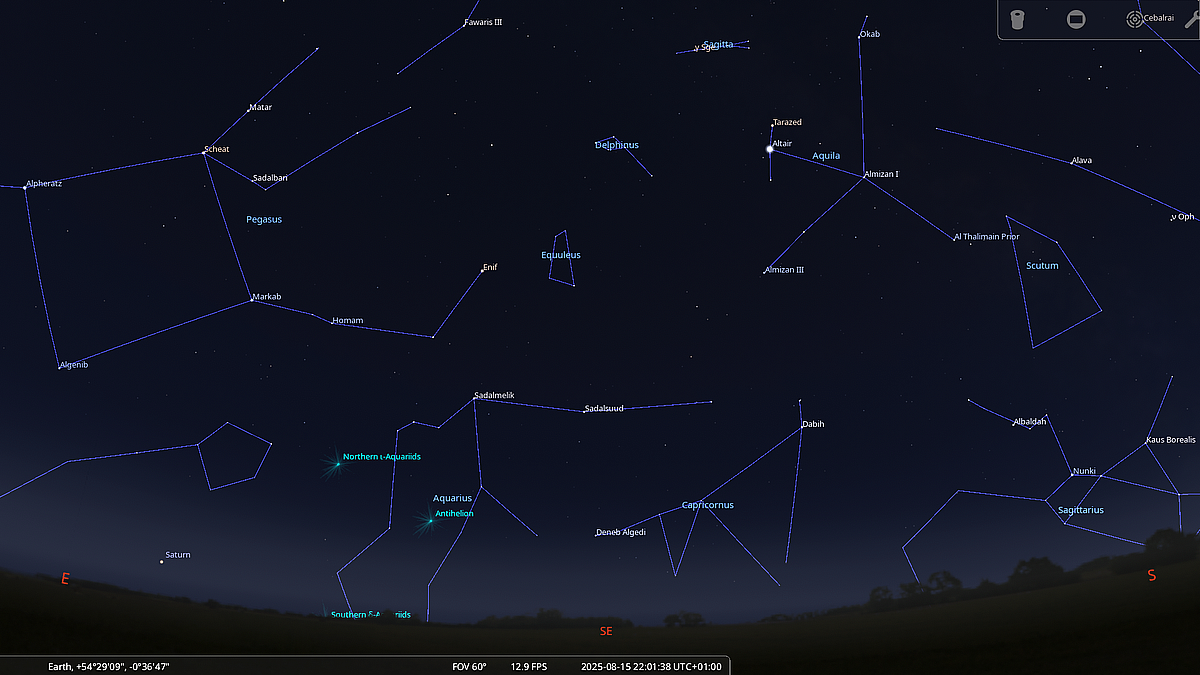
The SE aspect - mid-August - 22:00hrs BST. (Click to enlarge)
More zodiac constellations occupy the south-eastern and eastern horizons, where the ecliptic lies low at this time of year. These include Capricornus, the Sea Goat, in the south-south-east; Aquarius, the Water Bearer, in the east-south-east; and Pisces, the Fish, in the east. None is easy to trace from light-polluted skies or under strong moonlight, so choose a dark site for the best view. The bright “star” low in the south-east later in the month is Saturn, marking the southern reaches of Pisces.
 Constellations bounded by the Summer Triangle, mid-August - 22:30hrs BST. (Click to enlarge)
The Summer Triangle rides high overhead in August. Formed by brilliant, steel-blue Vega in the small lozenge of Lyra, Deneb at the head of the cross-shaped Cygnus, and Altair in Aquila as the southernmost point, this prominent asterism remains visible well into autumn.
Near the Deneb–Altair side of the triangle, look for the small but distinctive patterns of Sagitta and Delphinus. Sagitta, made up of just five main stars, is linked in one legend with Cupid’s arrow. With a little imagination, compact Delphinus resembles a dolphin leaping from the water; it is also oddly known as Job’s Coffin. The fainter constellations Vulpecula and Equuleus lie in the same region. Vulpecula contains M27, the Dumbbell Nebula, while Lyra hosts M57, the Ring Nebula; both are visible in small telescopes.
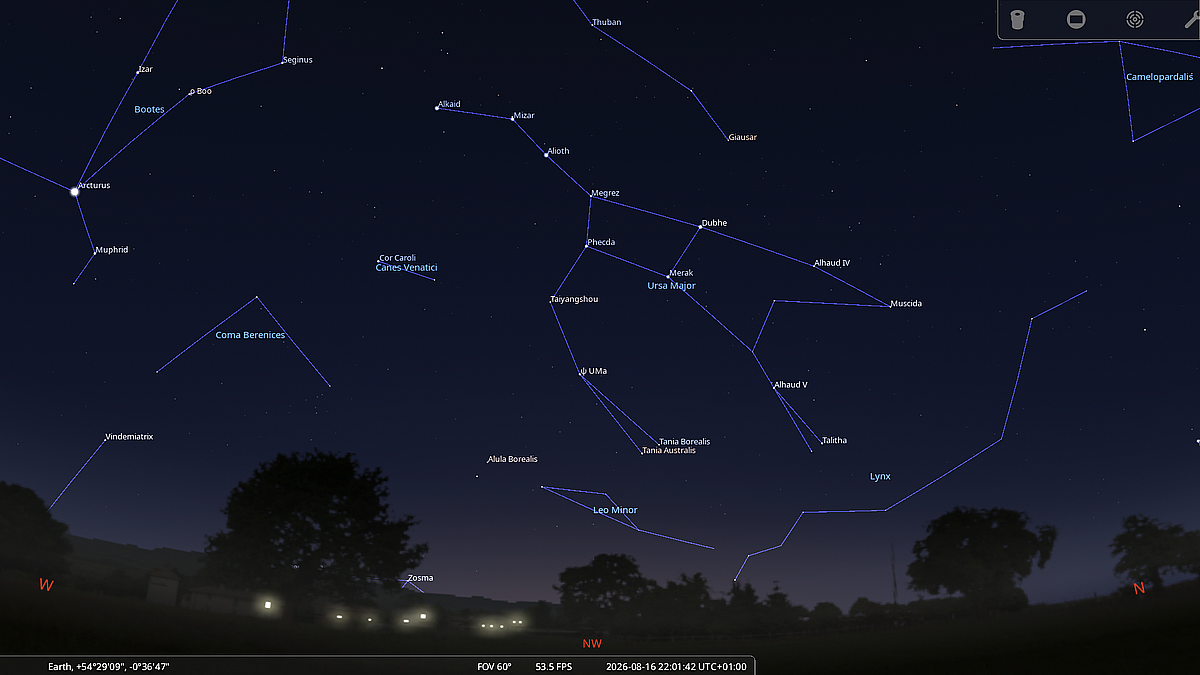
The NW aspect, mid-August - 22:00hrs BST. (Click to enlarge)
Facing north, use the pointer stars in the Plough’s bowl to locate Polaris, the Pole Star, in Ursa Minor. Overhead lies the head of Draco, whose body winds between Ursa Major and Ursa Minor. Perseus rises above the north-north-eastern horizon, with Cassiopeia’s familiar “W” above his right shoulder and Cepheus higher still. Lower right lies Andromeda, recognised by a chain of stars stretching towards Pegasus in the mid-eastern sky. Within Andromeda is the Andromeda Galaxy, visible on clear, moonless nights and the most distant object visible to the naked eye, about 2.65 million light years away.
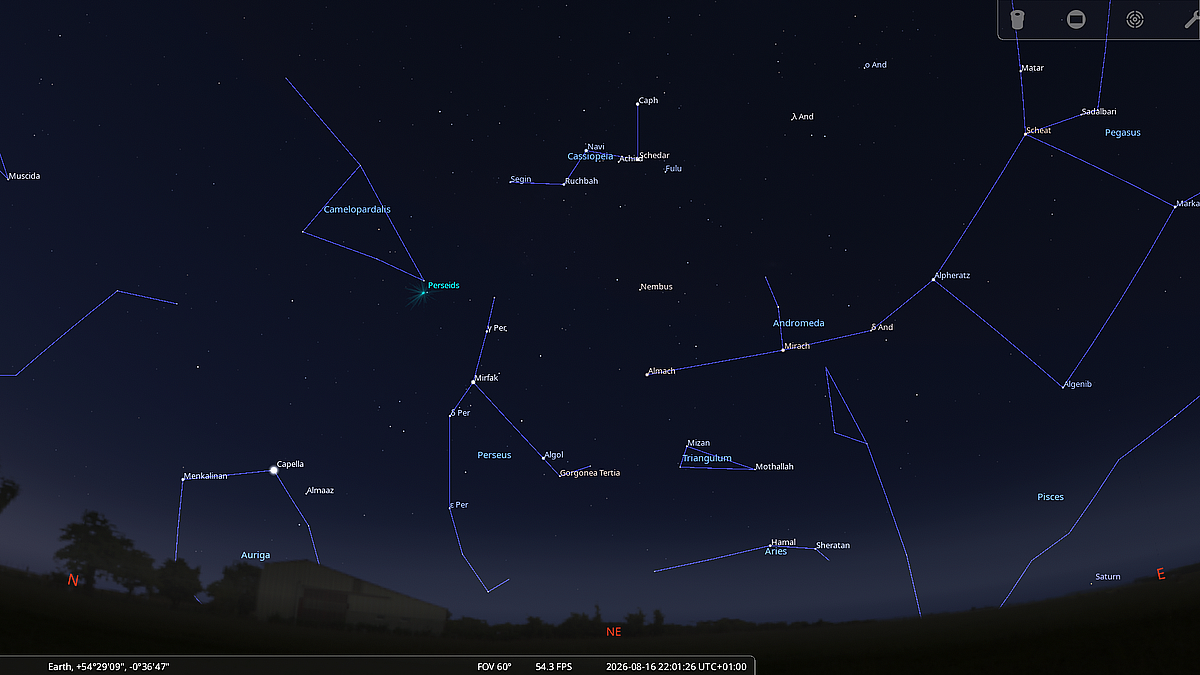
The NE aspect - mid-August - 22:30hrs BST. (Click to enlarge)
Below Andromeda lie two small constellations. Triangulum contains M33, the Pinwheel Galaxy, one of the Local Group’s three major galaxies alongside Andromeda and the Milky Way. Beneath Triangulum is Aries, marked by a crooked line of stars. Farther east, Taurus rises over the horizon, with the exquisite Pleiades open cluster marking the Bull’s tail—a sure sign to astronomers that autumn is approaching.
With good conditions the latter half of August beckons all to venture outside and view the glorious late summer sky.
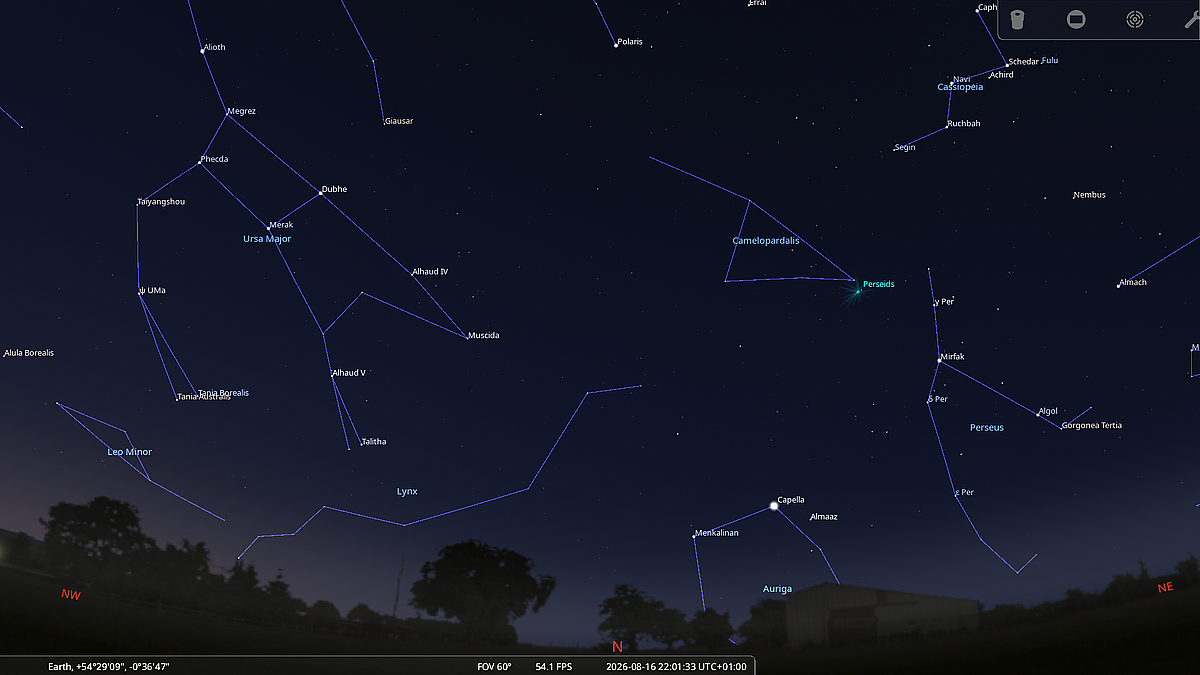 |
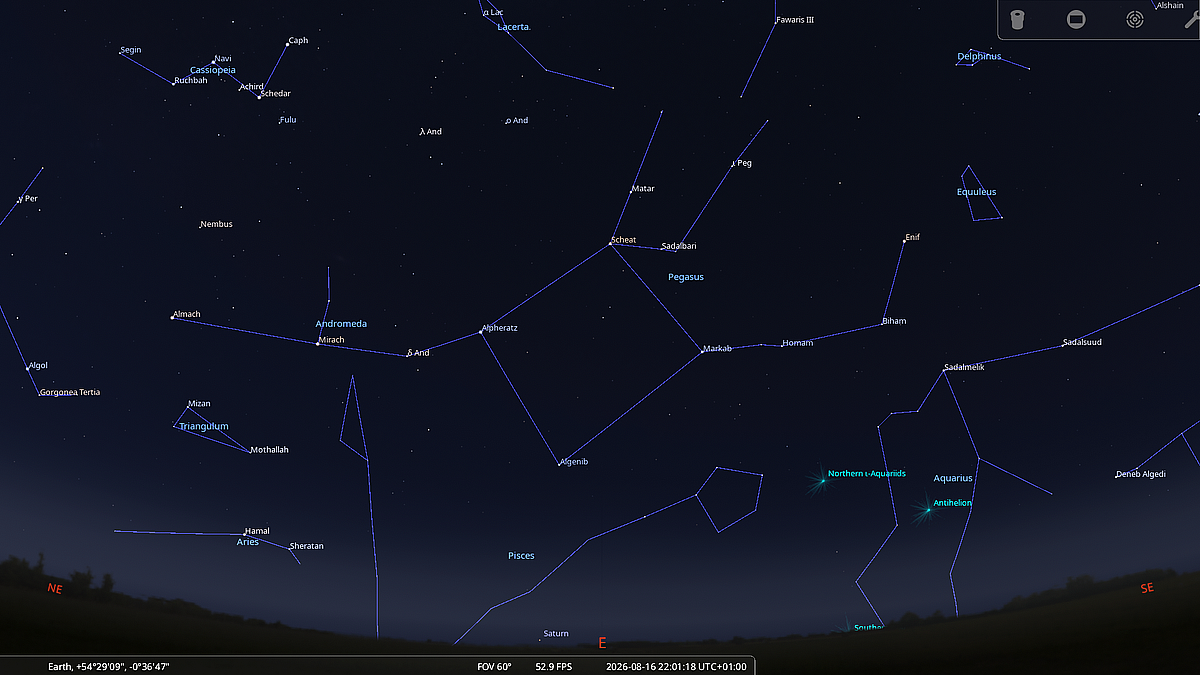 |
|
Looking North
Aug 16th - 22:00hrs BST |
Looking East |
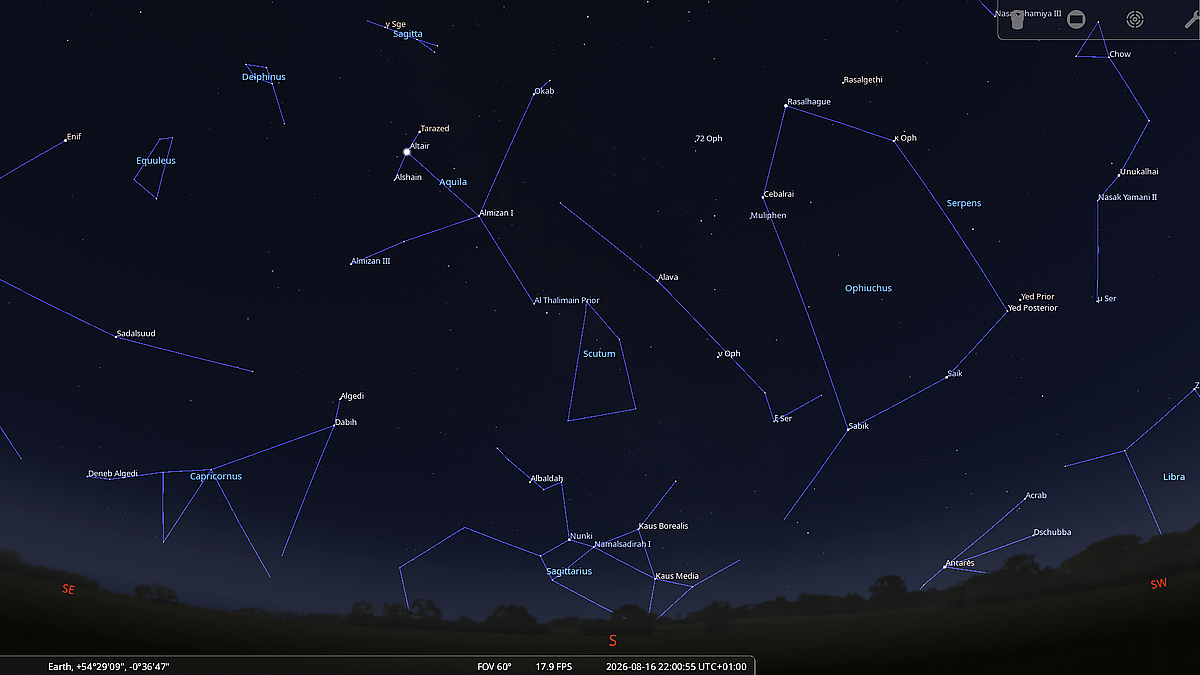 |
 |
|
Looking South
Aug 16th - 22:00hrs BST |
Looking West
Aug 16th - 22:00hrs BST |
 |
 |
|
Northern Aspect
Aug 16th - 22:00hrs BST |
Southern Aspect
Aug 16th - 22:00hrs BST |
 |
 |
| Northern Aspect (dawn) Aug 16th - 04:00hrs BST |
Southern Aspect (dawn) Aug 16th - 04:00hrs BST |
Additional Image Credits:
- Planets and Comets where not otherwise mentioned: NASA
- Sky Charts: Stellarium Software and Starry Night Pro Plus 8
- Log in to post comments

