
In this month's Sky Notes:
Planetary Skylights: A Brief Guide to April's Night Sky
Saturn and Neptune have departed the evening sky. Jupiter remains a dominant presence, though it is gradually heading westwards. Venus slowly gains altitude in the western evening twilight, passing Uranus later in the month.
 Jupiter remains a prominent object (magnitude -2.1), well placed for observation high in the southwest as darkness falls. Regular observers should note that its viable observing window will diminish markedly this month - from around five and a half hours to barely three by the end of April - setting at approximately 02:00 hrs BST. A waxing Moon lies closest to Jupiter on April 22.
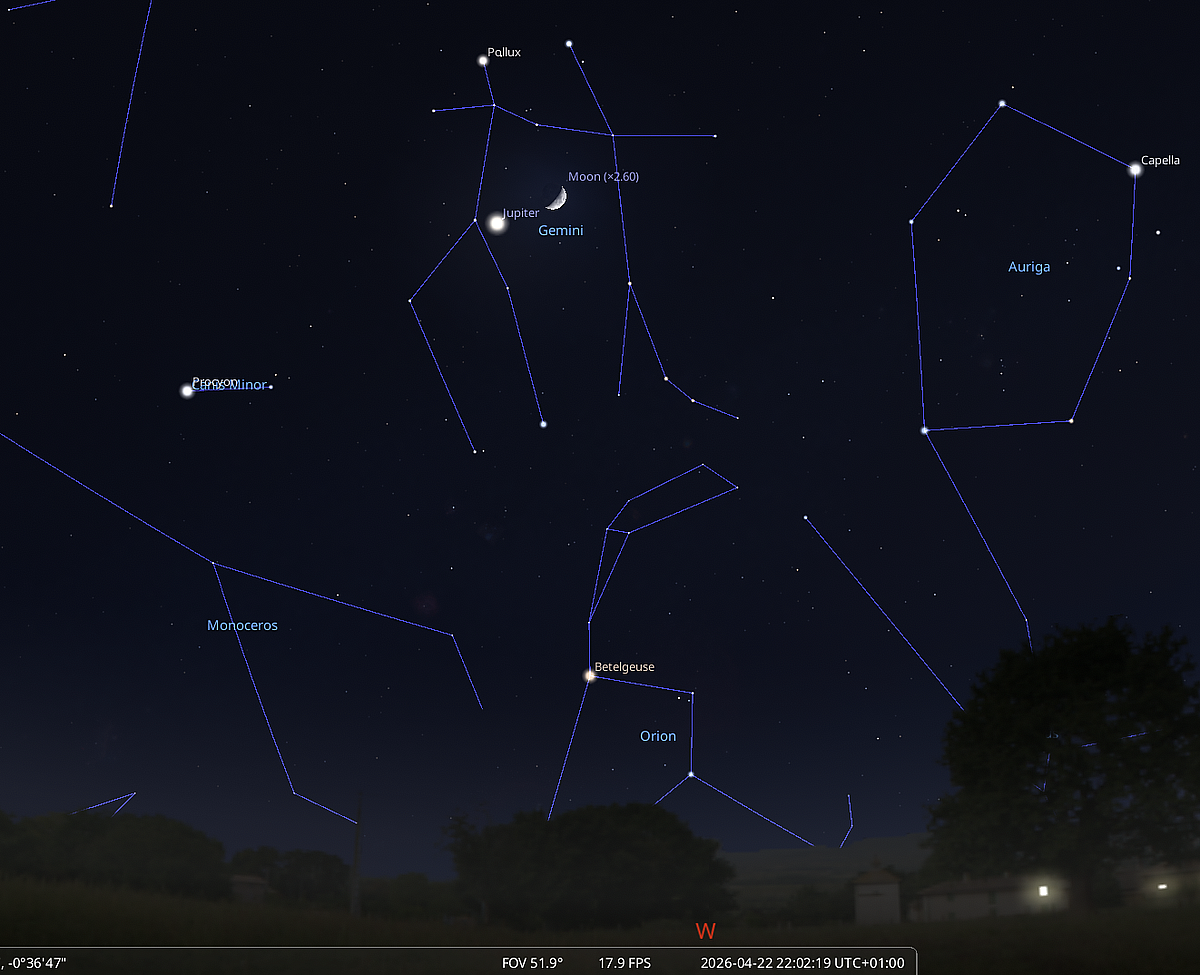
April 22nd - 22:00hrs BST. Jupiter and crescent Moon. (Click for full image)
Through the eyepiece Jupiter is a delight to observe, the dark equatorial belts across the noticeable oblate disk, along with the Galilean moons - appearing as small specks of light, in line with the plane of Jupiter’s equator, make for fascinating viewing. Apertures above 130mm (5") at medium magnification should also reveal the Great Red Spot, a colossal storm system that in recent decades has diminished in size and intensity, but still noticeable. The optimal dates for viewing the GRT are: April 2nd, 4th, 9th, 14th, 21st, 23rd and 28th between 20:45 and 22:15hrs BST.
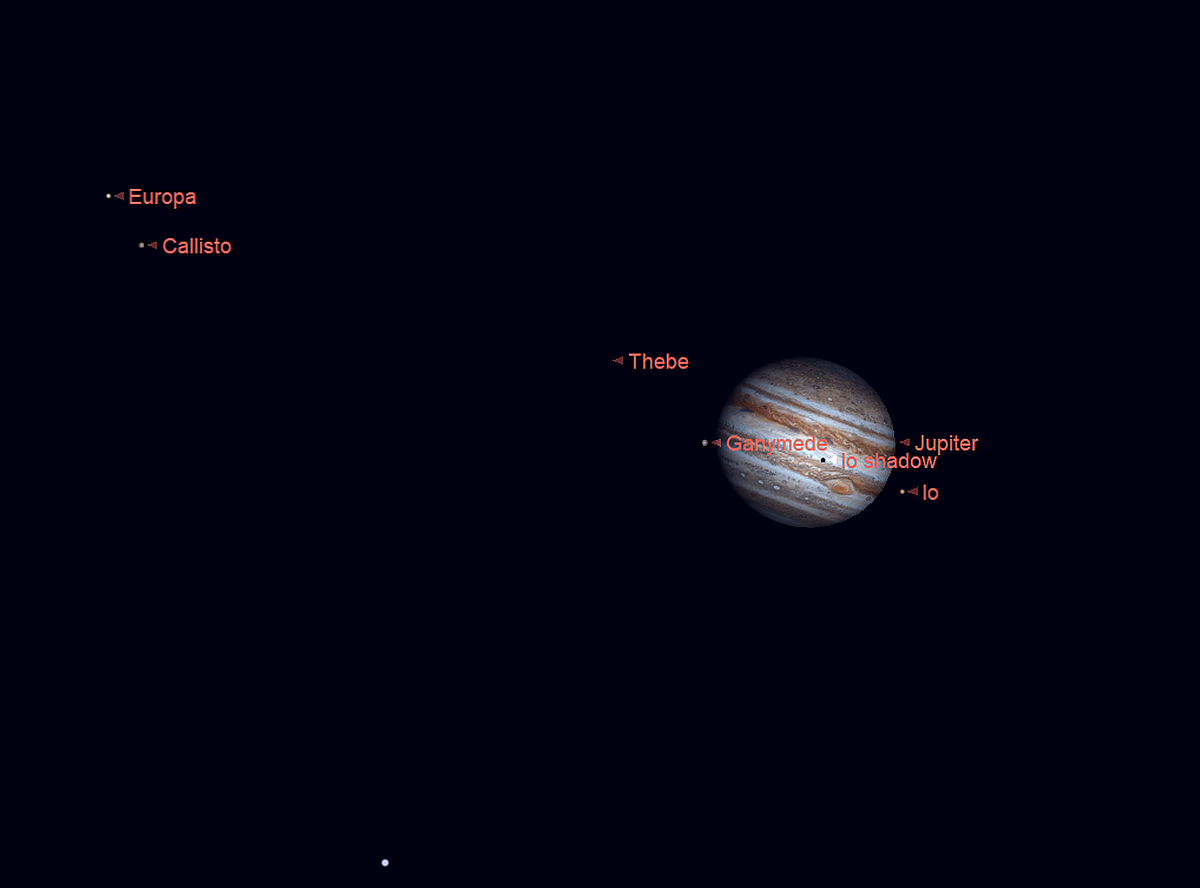
April 2nd - 21:00hrs, Io shadow transit. (Click for full image)
Jupiter's Galilean moons provide fascinating observation opportunities especially during shadow transits. Favourable transit events will be visible on April 2nd at 21:00 hours (Io), April 20th at 22:00 hours (Callisto), and April 24th at 22:00 hours (Europa). A quality 100mm (4") aperture with high magnification and decent seeing should suffice, although instruments of 150mm (6") plus are more preferable.
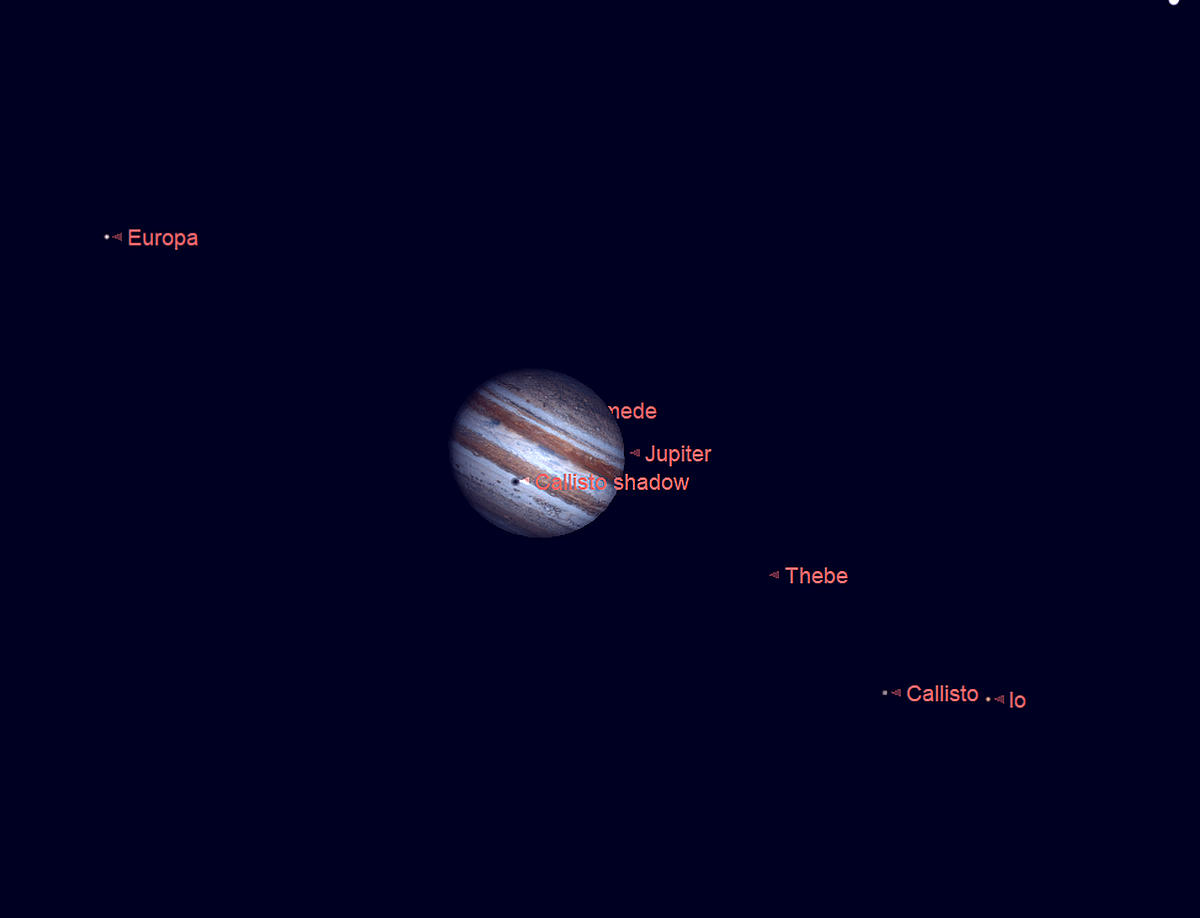
April 20th - 22:00hrs, Callisto shadow transit. (Click for larger image)
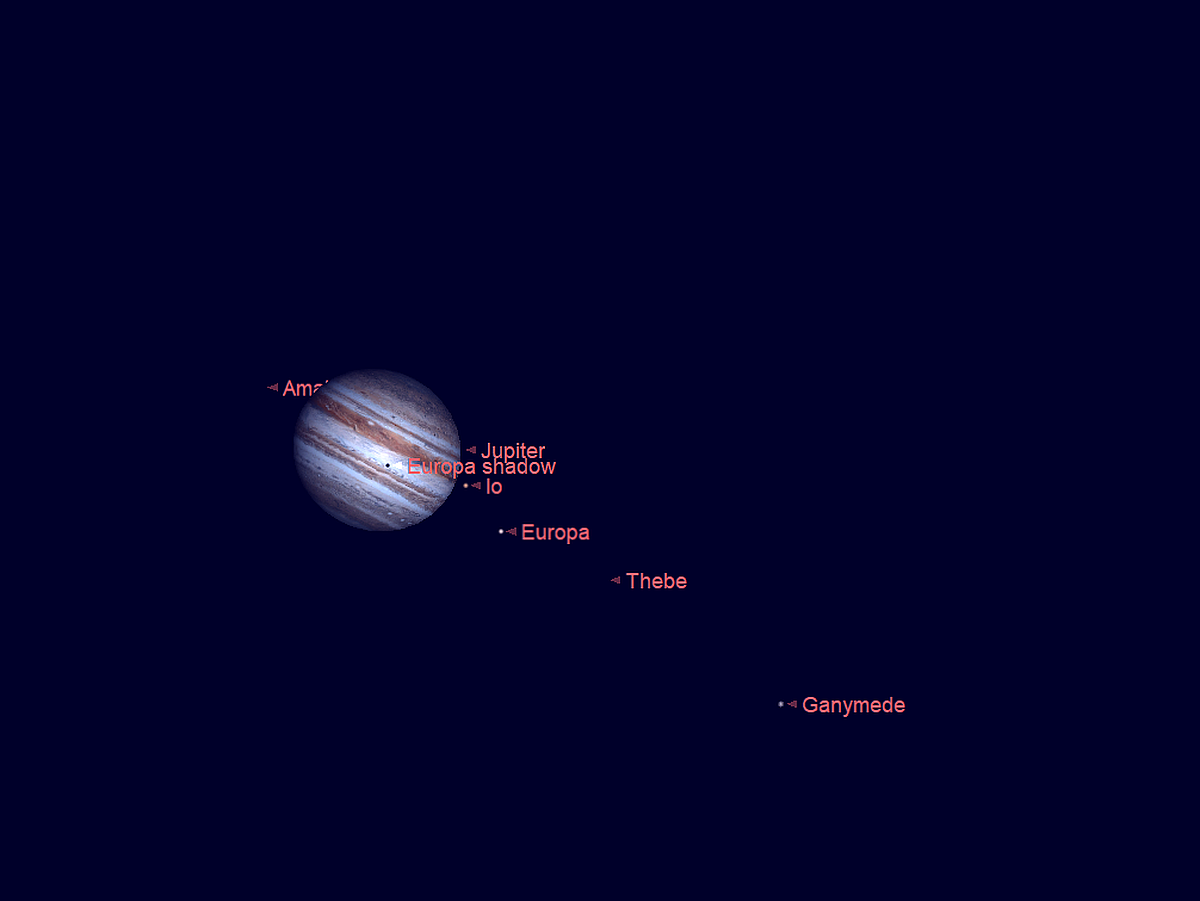
April 24th - 22:00hrs Europa shadow transit. (Click for larger image)
 Uranus will become increasingly difficult to track down in the evening sky as it drops closer to the west horizon, becoming too low for observation by the third week of April. It is located approximately 4 degrees lower left of the Pleiades star cluster in Taurus forming a chain with the 5th magnitude pairing of 13 and 14 Tau. At mag +5.6 Uranus is technically visible to the naked eye but requires binoculars just to show as a brighter speck. Instruments of 80mm plus (3"+) will hint at a planet and above 150mm (6") should clearly define the very small 3.7 arcsecond grey-green disk.
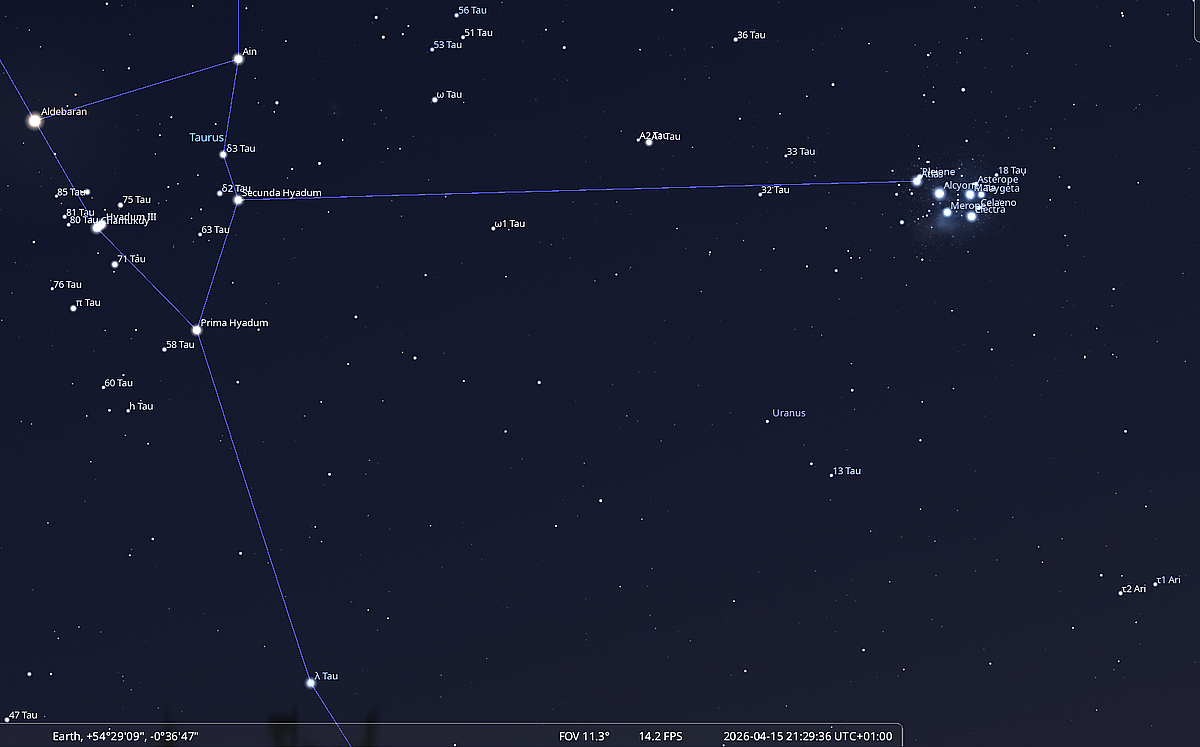
Uranus - general chart mid-April @ 21:30hrs BST. (Click for full image)
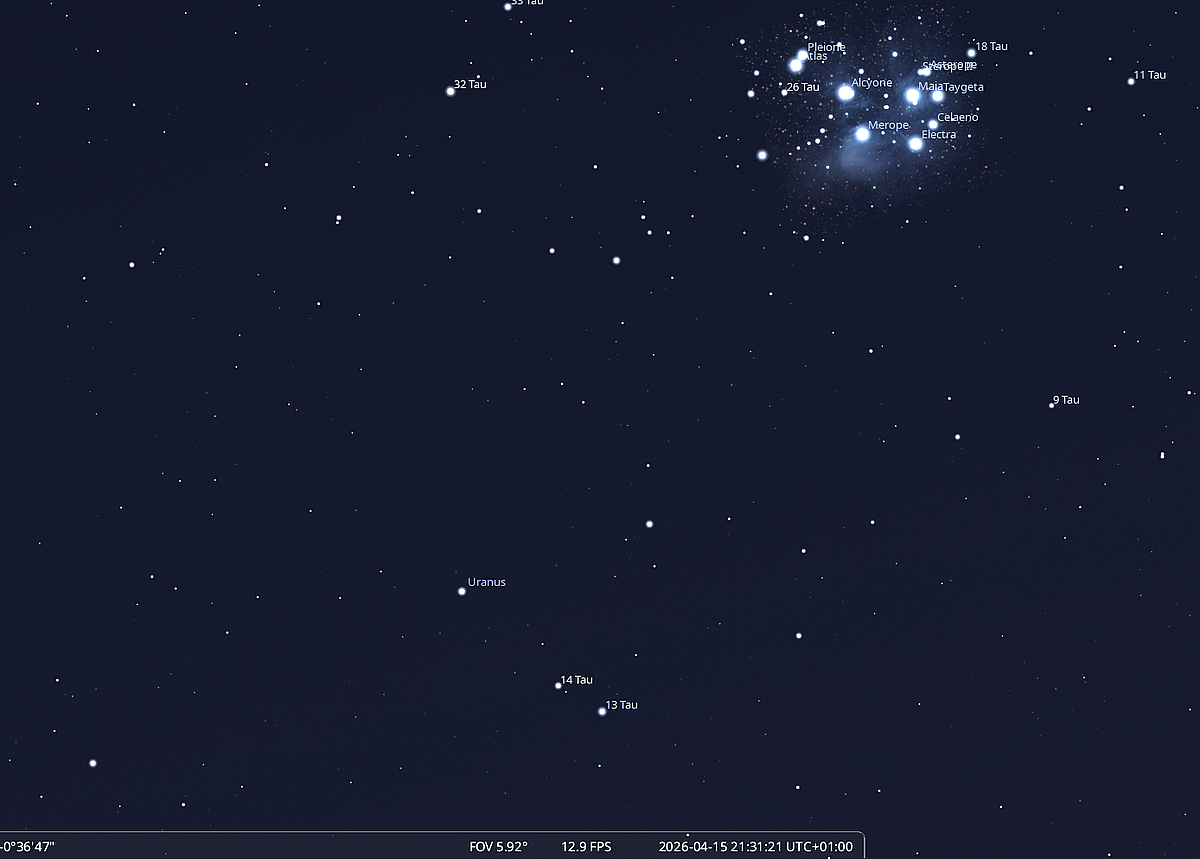
Detailed chart for Uranus - mid-April - 21:30hrs BST. (Click for full image)
 As April progresses, look for Venus above the west horizon as evening twilight falls, slowly gaining in altitude and hence prominence. At mag -3.9, Venus is certainly eye catching, although its brilliance is tempered somewhat by the low altitude and brighter twilight sky.
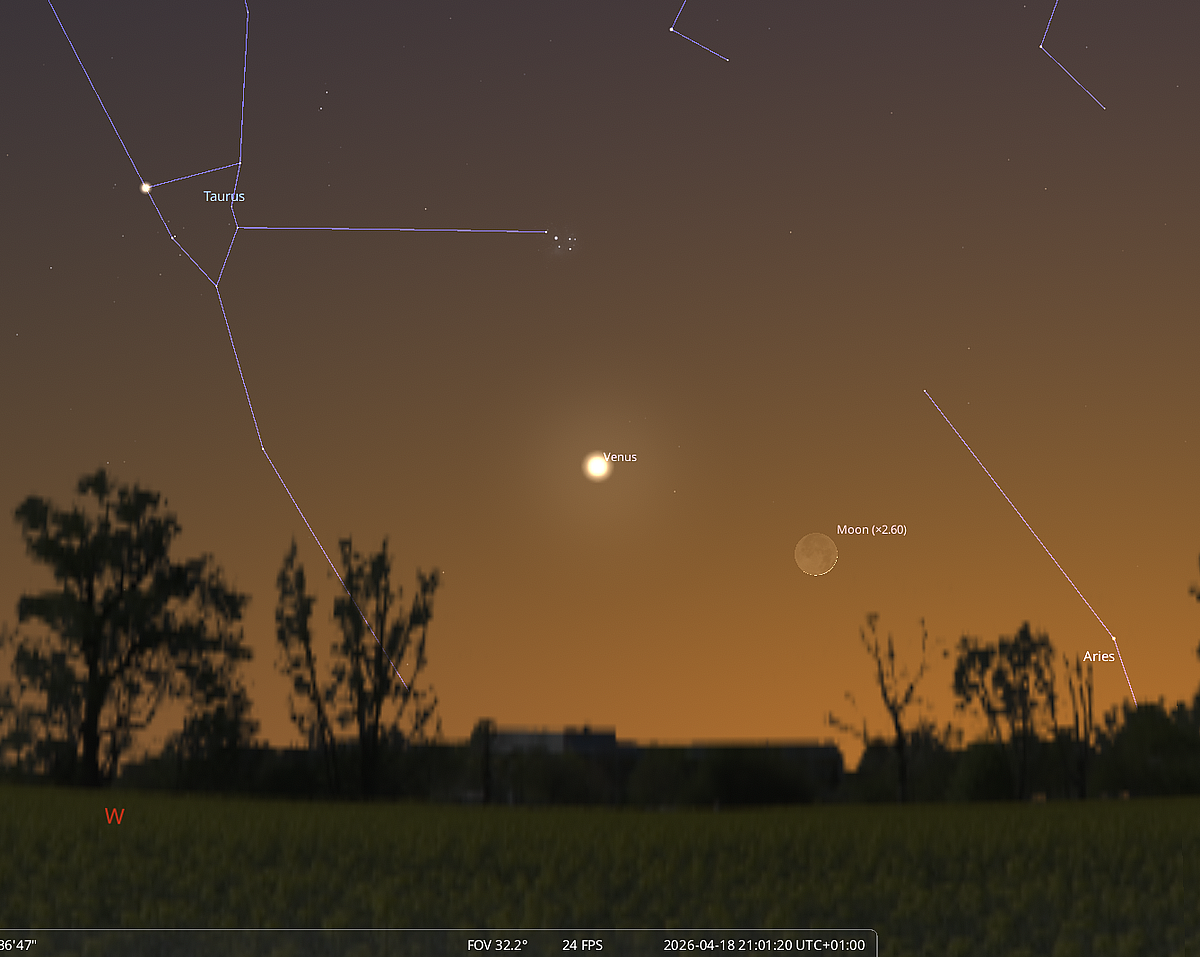
Venus and very slim Moon, April 18th @ 21:00hrs - due west.
(Click for full image)
An extremely thin crescent Moon will reside lower right of Venus on April 18th, view around 21:00hrs. The following evening, look for the slender Moon immediately above the Pleiades star cluster (which it partly occulted during daylight hours) with Venus located below them.
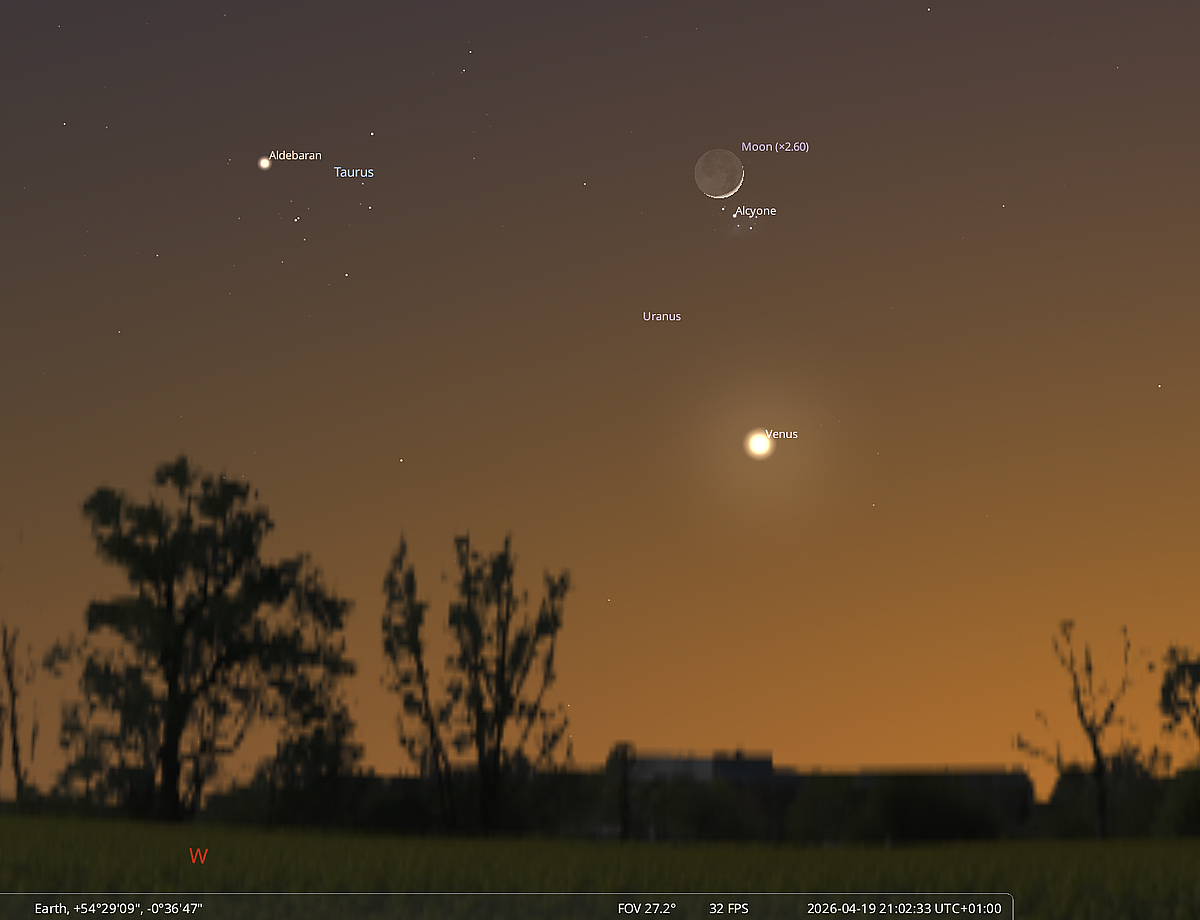
April 19th - 21:00hrs- crescent Moon and Pleiades above Venus. (Click for full image)
Telescopically, Venus is rather bland with little but a phase noticeable (currently 90%). It is often advantageous to view Venus in twilight, reducing glare and allowing any subtle detail to be observed on the duvet of cloud perpetually shrouding the surface of the planet.
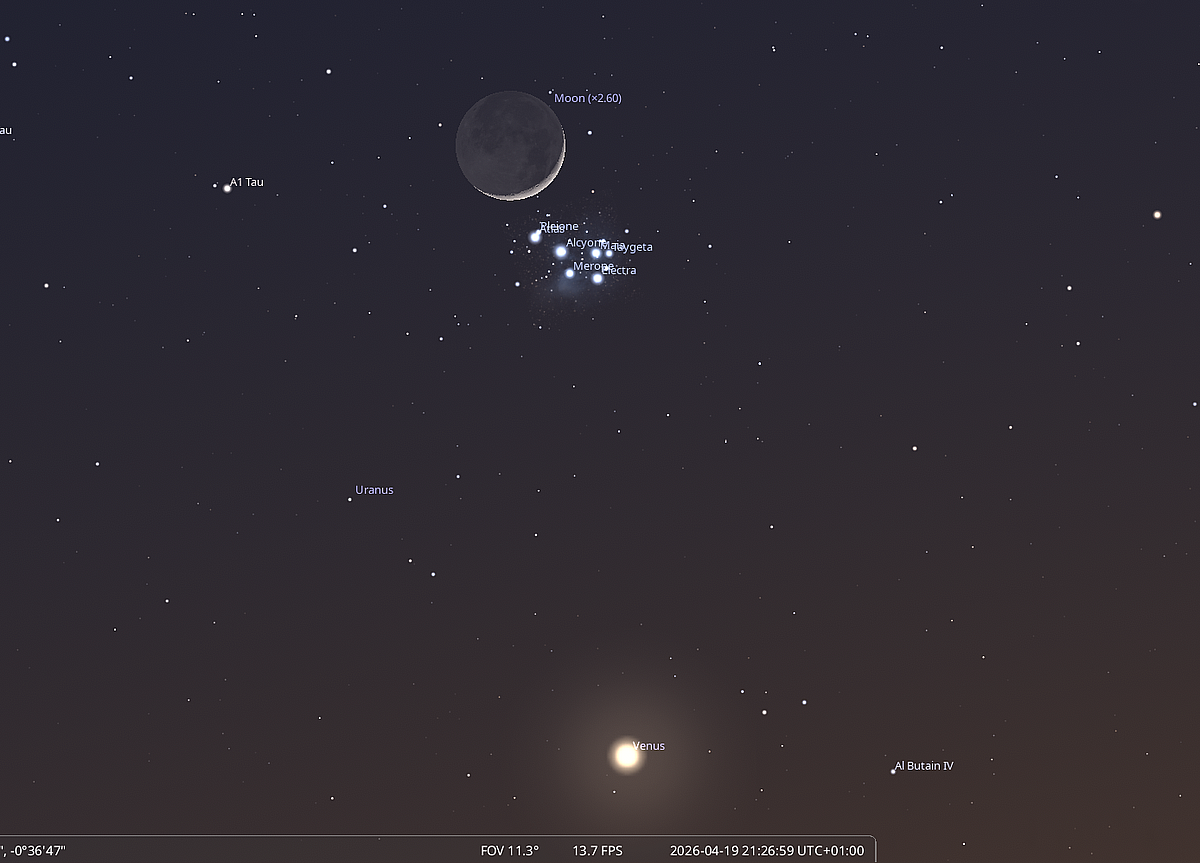
April 19th - 21:30hrs - crescent Moon, Pleiades, Uranus and Venus. (Click for larger image)
April Meteors
Following nearly three months of minimal meteor activity, April experiences a modest yet notable increase in meteor occurrences, with several showers active throughout the month. Of these, the most prominent shower is the Lyrids, recognised as the oldest documented meteor shower, with sightings recorded by Chinese observers dating back 2,700 years to 687 BC. The Lyrids are a medium strength meteor shower associated with the long-period comet Thatcher (C/1861 G1), which completes an orbit around the Sun once every 415 years and was last at perihelion in April 1861. Earth traverses the fine debris deposited over time by Comet Thatcher, resulting in meteor activity from April 15th to 29th each year.
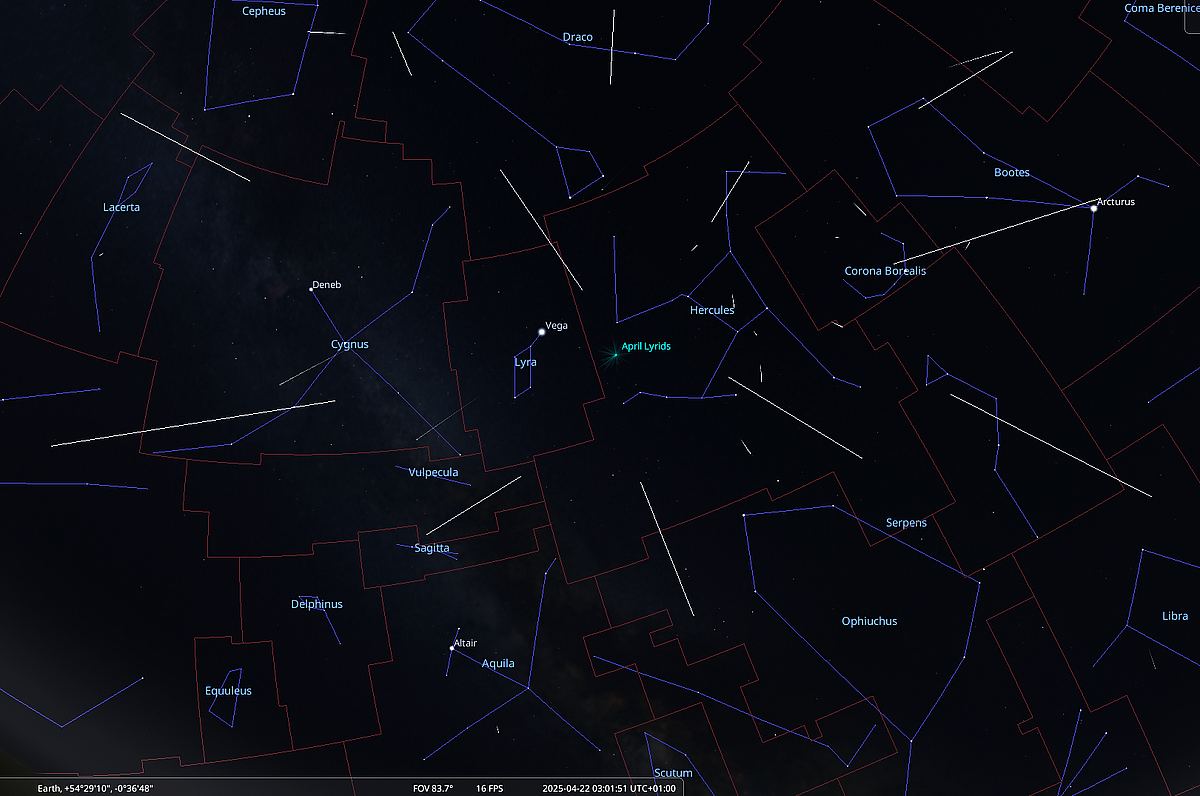
Location of Lyrid meteor shower radiant - early morning hours of April 22nd.
(Click for larger image)
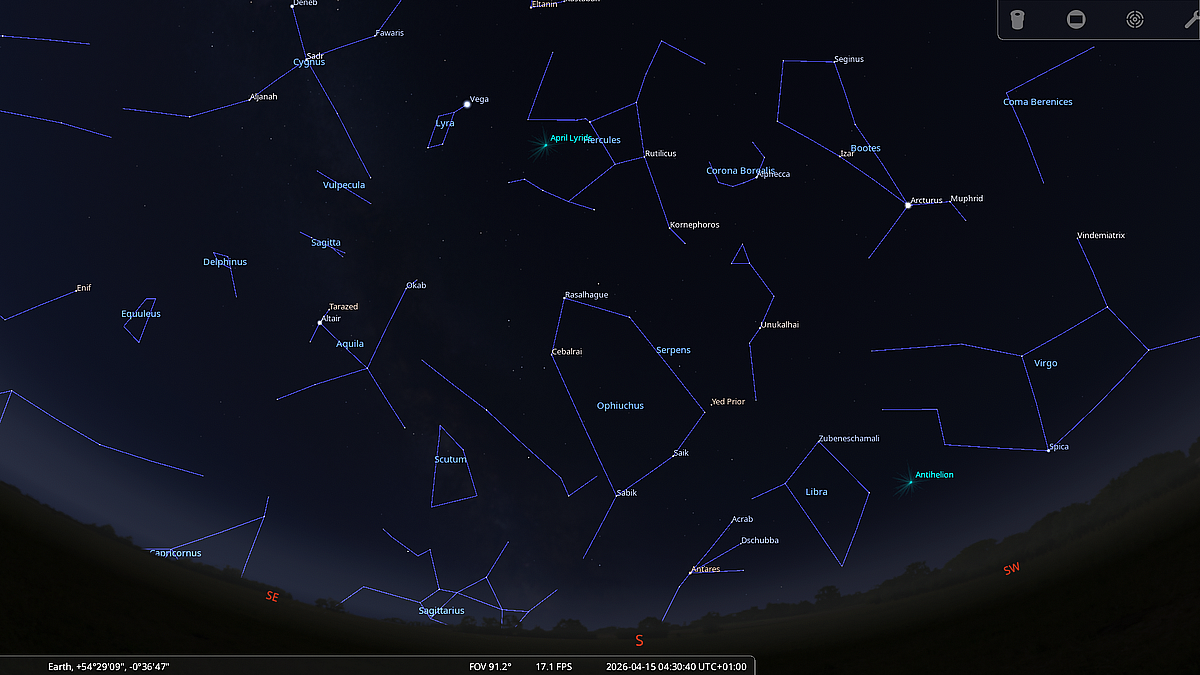
The shower peak is expected on April 22nd when under ideal conditions hourly rates can approach 25. The good news is there will be no moonlight this year, so observed rates of around 15 per hour in the early morning hours would not be unreasonable - should skies be clear that is! The shower radiant is located near the bright star Vega in Lyra, visible high to the east during the early morning hours, but the radiant sits just within the borders of Hercules, so perhaps the shower should be renamed the Herculids! Lyrids have the potential to produce bright fireballs. Given the timing of the predicted peak, viewing is recommended on the nights of April 21-22 and April 22-23.
Early April yields a few Virginid meteors, although numbers are scarcely above sporadic levels, with approximately 4 or 5 per hour. Various Virginid radiants can be observed throughout spring and summer, the one in April reportedly located near Gamma Virginis. Meteors from this shower typically exhibit slow movement, extended duration, and flared trails. Occasionally, this shower may produce sporadic outbursts with several tens of meteors per hour. The peak of this activity occurs around April 12th coinciding with little to no moonlight.
April Night Sky
April, a month often characterised by raw easterly winds bringing dull, rainy conditions, at least that was perception for many years. In recent years however, April showers aside, weather conditions have presented a genuine taste of late spring, very pleasant. It is this variability that makes accurate weather prediction challenging. One aspect of April that is predictable for northern temperate latitudes are the rapidly lengthening evenings and diminishing hours of darkness as twilight periods increase. By the end of the month, fully darkened skies associated with astronomical twilight amount to a few hours and will be lost altogether a week or so into May. For those who can manage late-night observing sessions, April provides suitable conditions for doing so but do take advantage of clear skies early in the month.
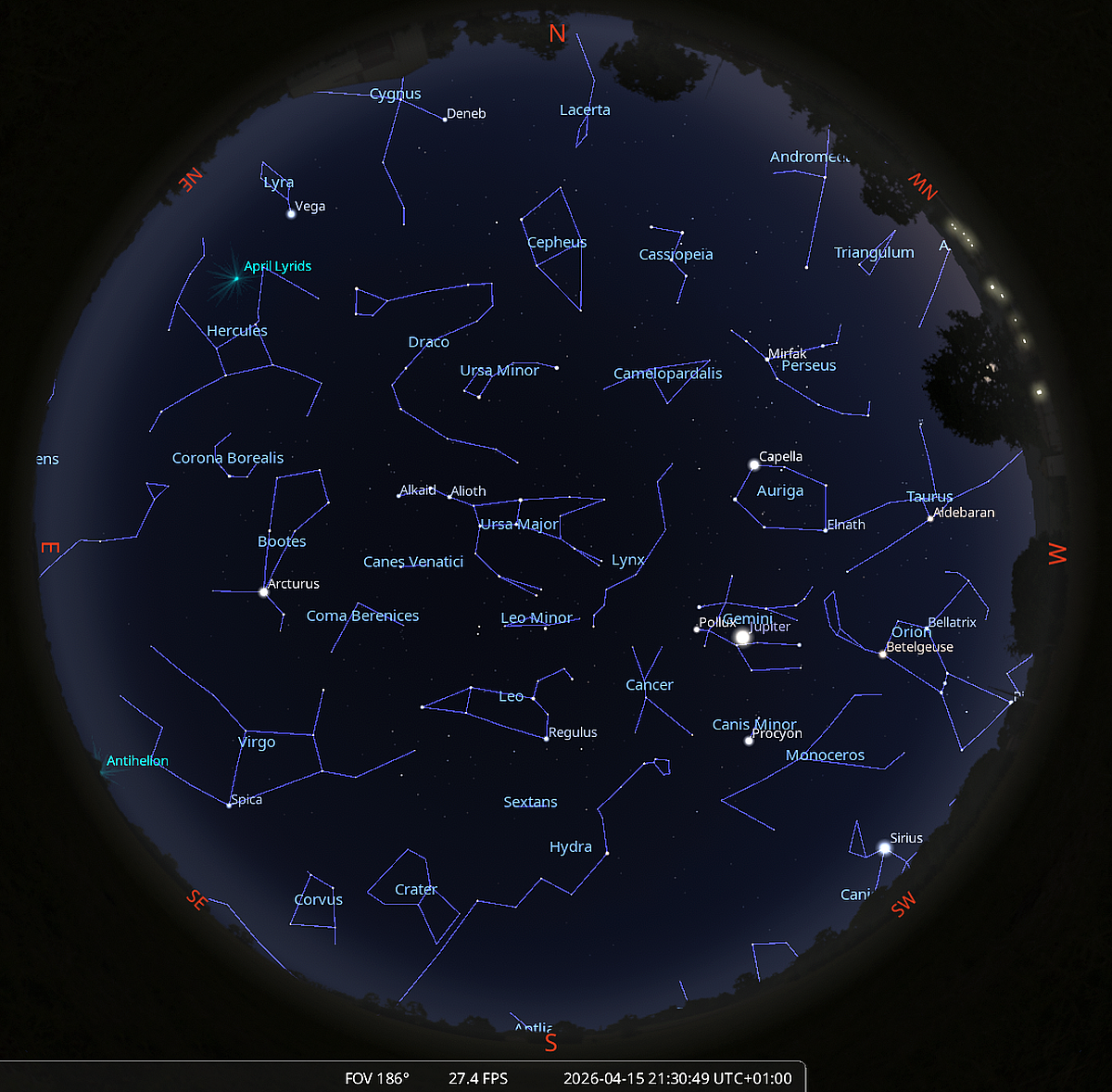
Mid-April night sky 2026 - 21:30hrs. (Click for full image)
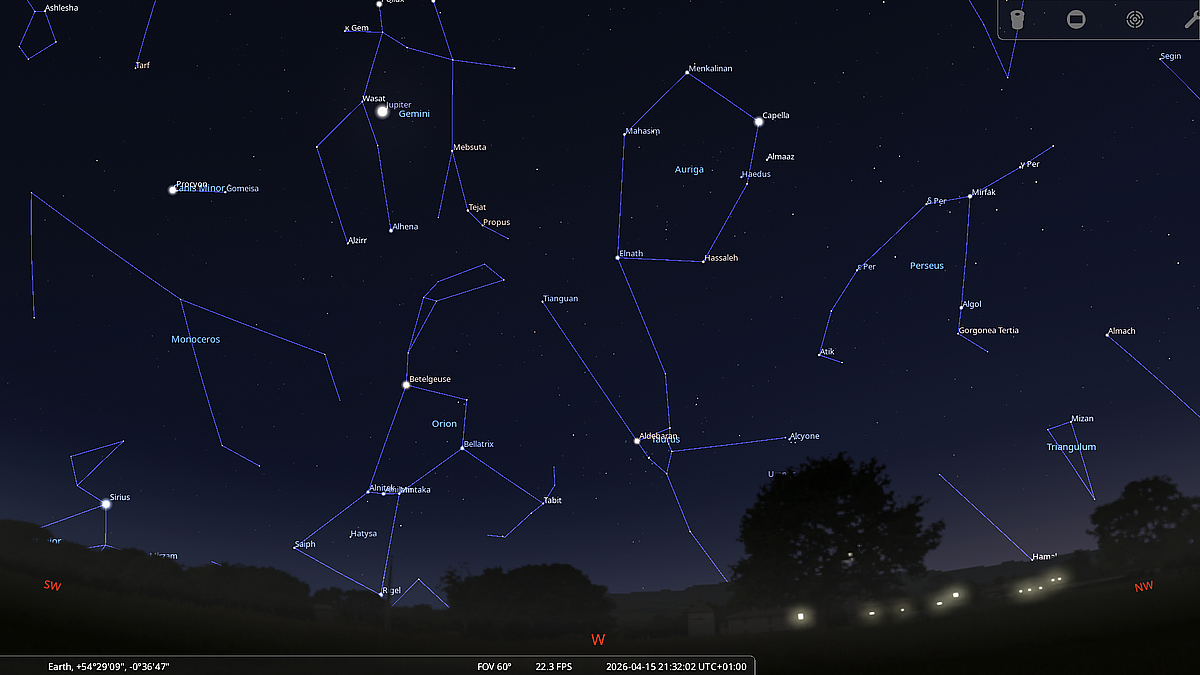
In the night sky, winter constellations inexorably edge westwards, preparing to depart. Leading the celestial procession, the constellation of Taurus identified by the 'V' shaped Hyades star cluster highlighted by bright, fiery, Aldebaran, points the way towards the northwest horizon. However, it is mighty Orion that first starts to set, initially bright Rigel disappearing, followed by the three belt stars and finally, the orange hue of Betelgeuse.
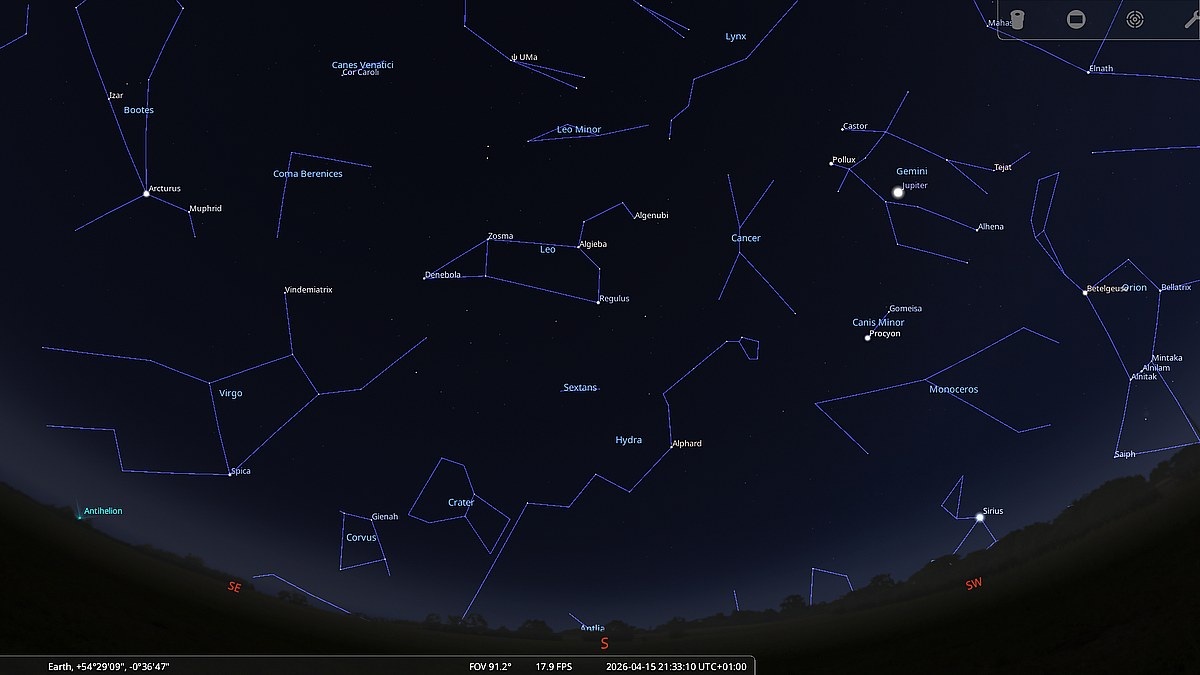
The brightest star in the entire night sky, Sirius the ‘dog star’ in Canes Major, catches the eye sparkling just above the SSW horizon, its alarming scintillation purely down to our turbulent atmosphere. Somewhat higher in the SSW, look for solitary Procyon, chief star in the Lesser Dog of Canis Minor. Higher still in the west, the twins of Gemini descend feet first above Taurus, their heads marked by the stars, Castor and Pollux respectively, although the constellation is currently dominated by Jupiter.
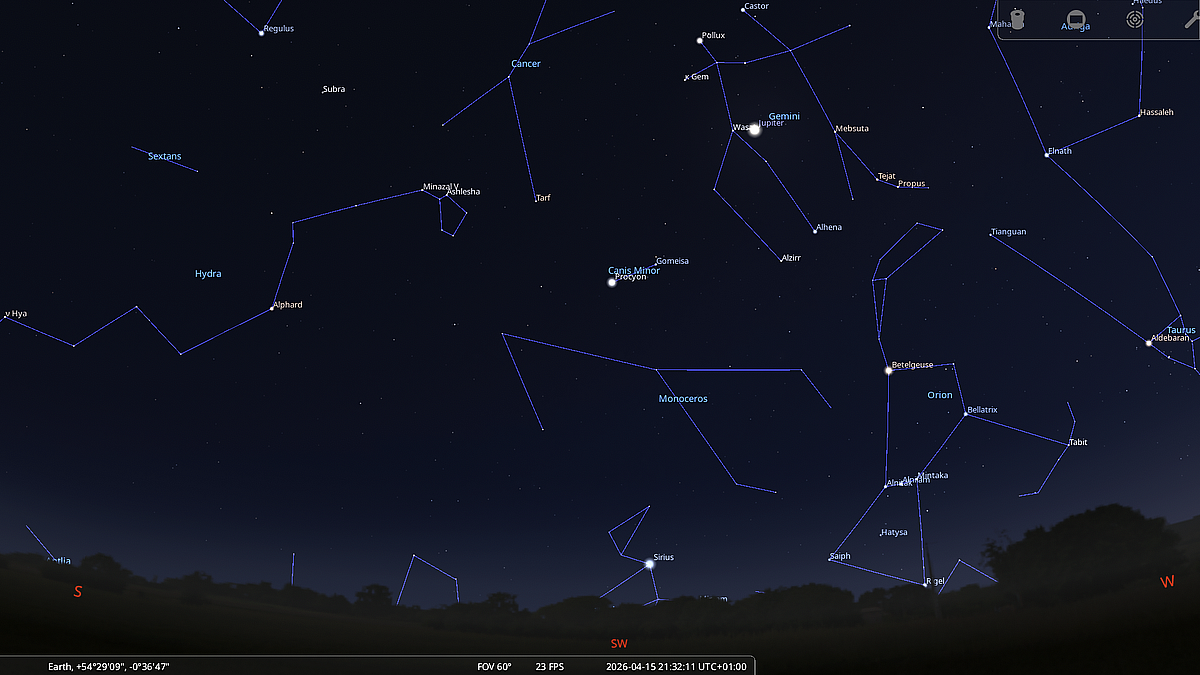
Winter constellations depart from the SW aspect. Mid-April - 21:30hrs. (Click for full image)
Of the bright stars associated with winter, only circumpolar Capella in Auriga the charioteer located high to the NW will remain, spending summer months skirting above the north horizon.
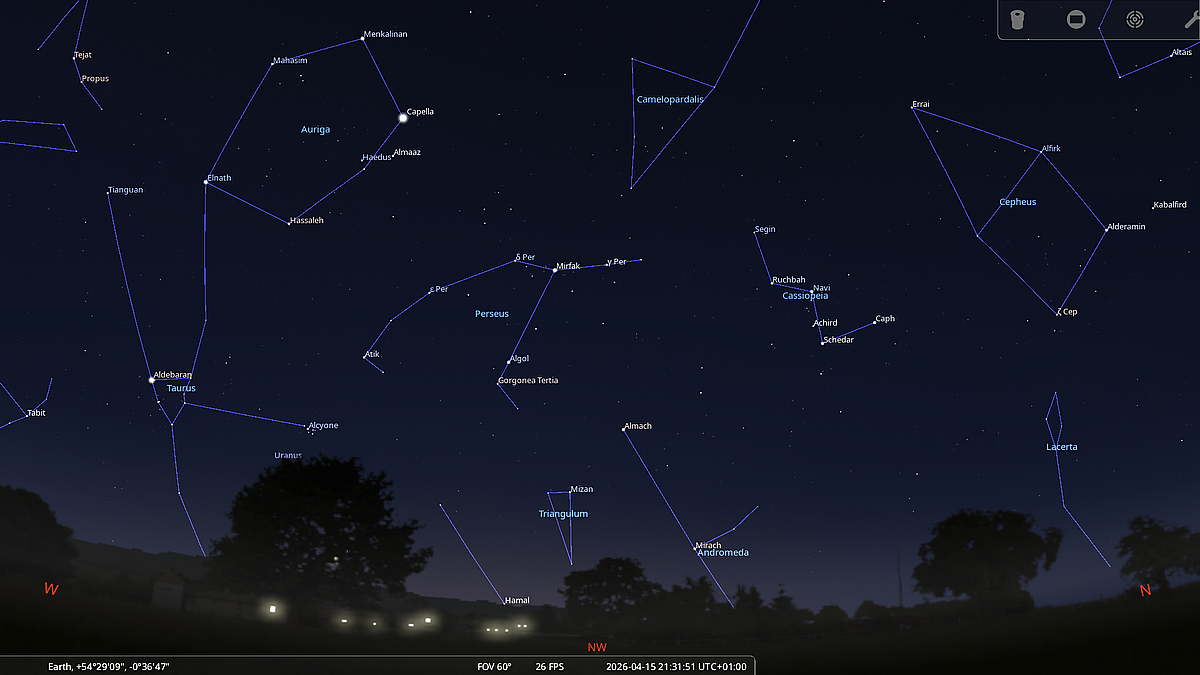
Northwest aspect of the mid-April night sky, 21:30hrs. (Click for full image)
It is time for the ensemble of spring constellations to take centre stage. As evening twilight falls, the sky to the south and east may appear somewhat sparse when compared to the majestic winter canopy disappearing into twilight afterglow in the west. If seasonal winter night skies may be likened musically to a dramatic overture, the spring sky portrays a quieter musical interlude. It is perhaps true to say for UK amateur astronomers the spring night sky is the least studied, partly due to lengthening twilight hours and shorter periods of darkness, as well as a perceived lack of celestial interest. Perhaps a lack of object variation would be a better description. Instead of star clusters and nebulae abundant in the winter sky, the spring sky offers up many, many, galaxies, though not exclusively.
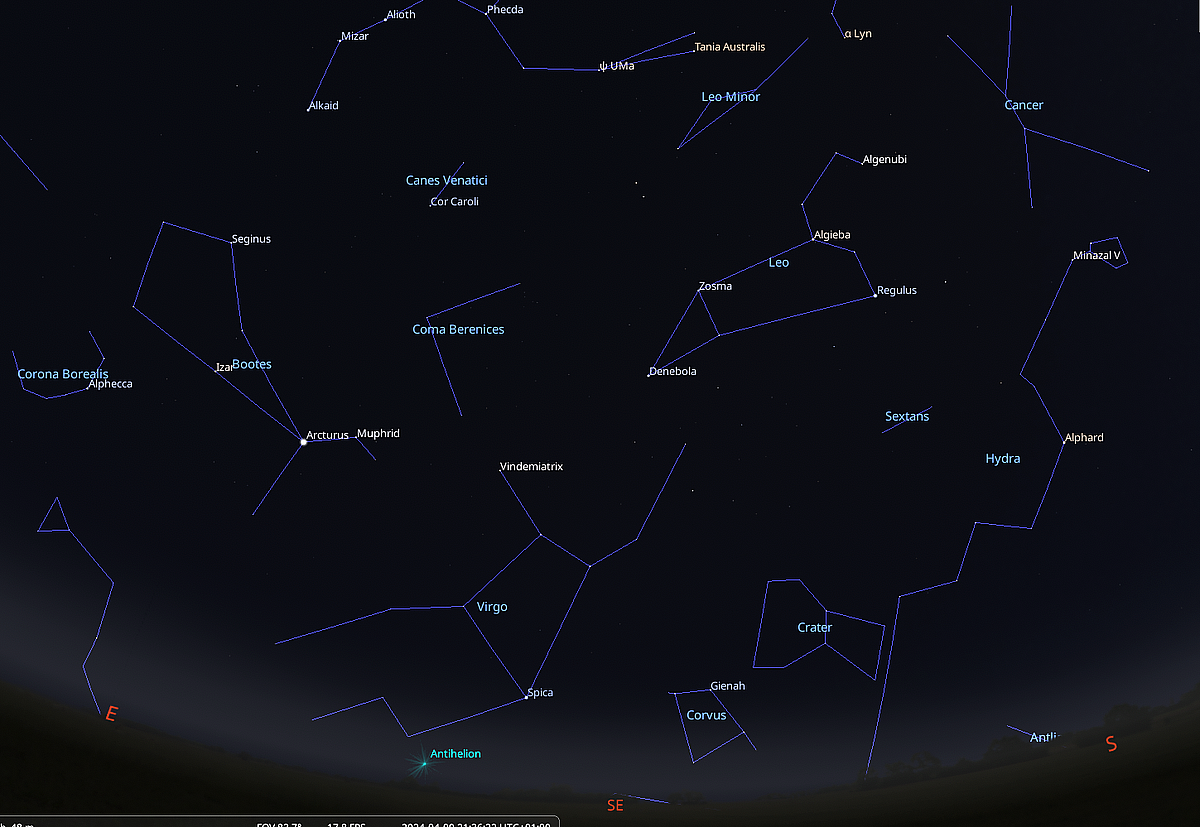
The main constellations associated with spring. (Click for full image)
Regarded as the chief signature group of the spring sky, Leo, is ideally located mid-April midway up to the south and standing on the ecliptic, is considered one of the most important constellations in the sky. Leo is best identified by the 'sickle' asterism denoting the lion's head and mane. This stellar pattern resembles the farming implement and also looks like a backwards question mark.
At the base of this formation shines the 1st magnitude star Regulus chief luminary of Leo but least brilliant of those stars ranked in the visual top league. Positioned almost on the ecliptic, Regulus is often involved in conjunctions with the Moon and planets. Historically, from 4000 to 2000 BC, Regulus was considered one of the four Royal stars, bright stars closest to the positions of the equinoxes and solstices. During this era, Regulus was nearest to the summer solstice position, but over millennia the effects of precession have altered this, so that as of 2021 it stands on the Taurus-Gemini border .
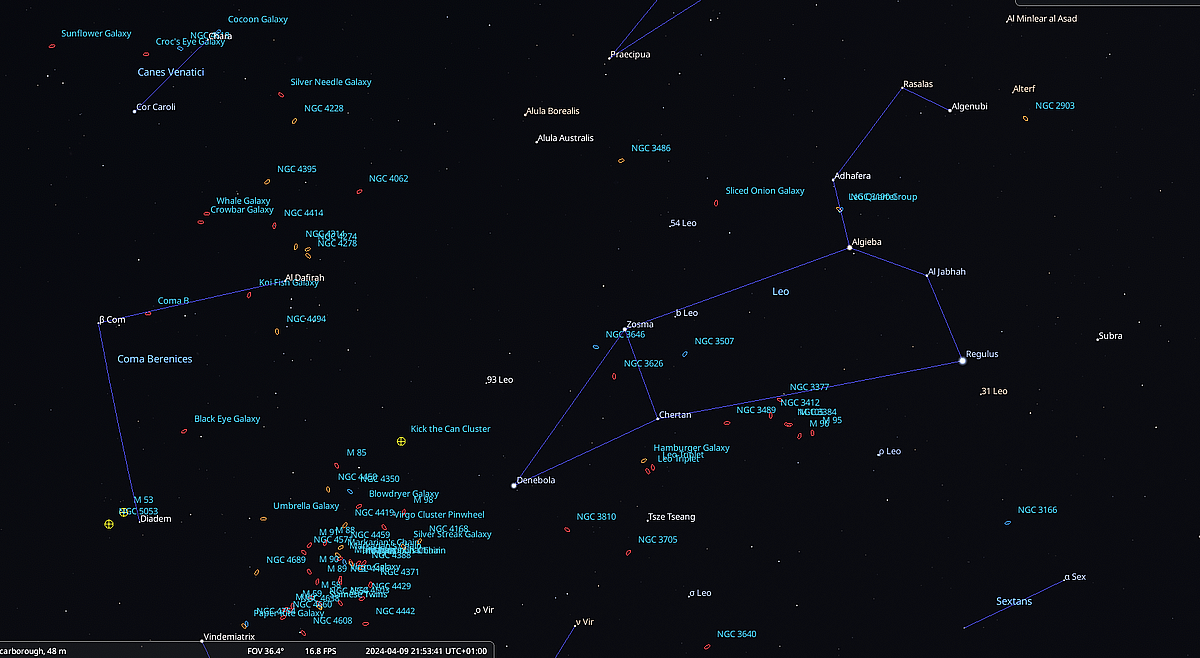
Leo - with deep sky objects visible to mag +11.5. (Click for full image)
The hindquarters of Leo are characterized by a triangular arrangement of stars, with Denebola marking the rear point. Several small galaxy groups lie directly below and to the right of this, with some of the brighter members visible to modest telescopes. Following Leo, a smattering of stars mark Coma Berenices, a constellation rich in deep sky objects including eight Messier objects as well as the Coma Galaxy Cluster, approximately 300 million light years distant. The messier objects include M53 (a globular cluster), and the galaxies M64, M85, M88, M91, M98, M99, and M100.
The sky between Regulus and twins of Gemini is home to the faint stars of Cancer the Crab. This constellation delineates the forward boundary associated with the spring section of the zodiac. Cancer contains the notable open cluster M44, known as the Beehive or Praesepe. In antiquity, the term 'nebulous' specifically referred to the Praesepe cluster. The cluster is visible to the naked eye as a hazy patch of light on clear, moonless nights and is an impressive view in wide field eyepieces. The distant open cluster M67, situated near to the southern border of Cancer, well below the Beehive is also worth checking out.
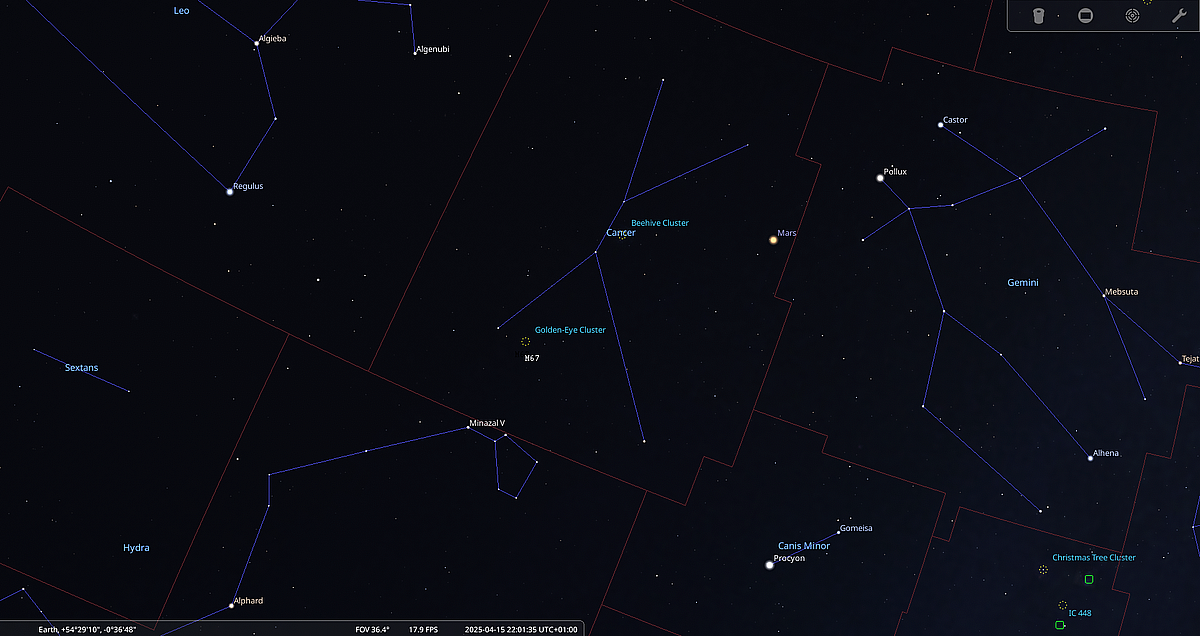
Cancer, Beehive and Procyon. (Click for full image)
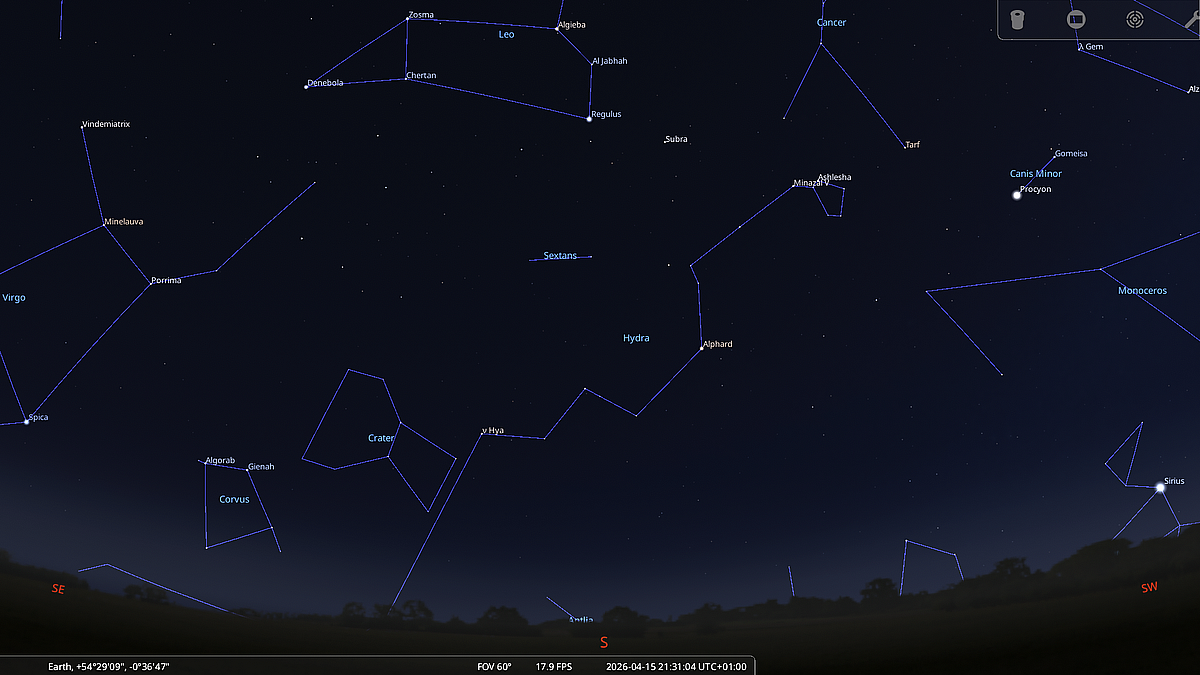
Below the Crab and east of the bright star Procyon, look for a faint, irregular loop of stars that denote the head of Hydra, the Water Snake, the largest constellation by volume in the entire sky. From this faint, open knot of stars the snake's body extends southeast to its brightest star, Alphard, known as ‘the solitary one’, located to the south, before it continues all the way to the eastern-southeastern horizon. Due to Hydra's significant size, the stars marking its tail are not fully visible above the southeastern horizon until midnight. Upon the sinuous curves sit two small yet distinct constellations: Crater, the Cup, and Corvus, the Crow.
These constellations can be observed above the SSE horizon at approximately 22:00hrs. The faint outline of Crater does indeed resemble a cup or goblet, while the outline of Corvus forms a quadrilateral shape, sometimes referred to as Spica’s Spanker—a type of sail of a similar outline to Corvus.
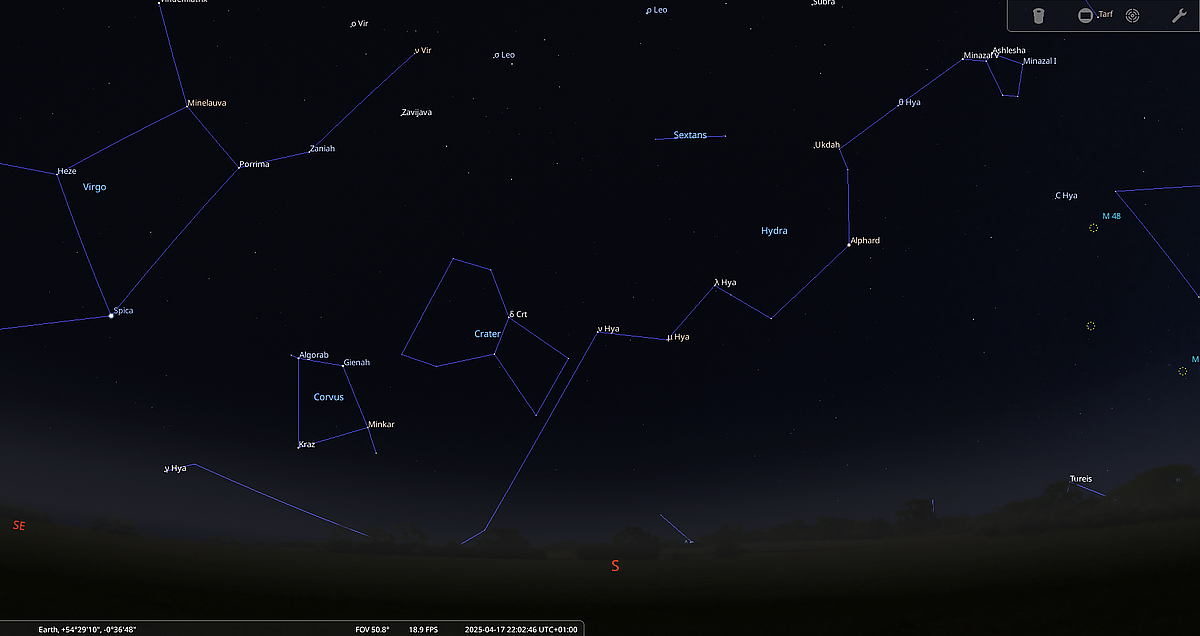
The skies largest constellation - Hydra, with Crater and Corvus perched on its coils.
(Click for larger image)
Spica is positioned to the upper left of Corvus and is the principal star in Virgo, visible low in the southeast by 22:00hrs. After being absent below the horizon for nearly six months, Virgo, known as the Sower of Crops, occupies much of the southeast sky above the horizon. Its outline is suggestive of a bowl or wide cocktail glass with a crooked stem, resembling a distorted 'Y' pattern. Although invisible to the naked eye, galaxies belonging to the Virgo Cluster 'fizz' just above and within this formation, many of which are observable with amateur telescopes.
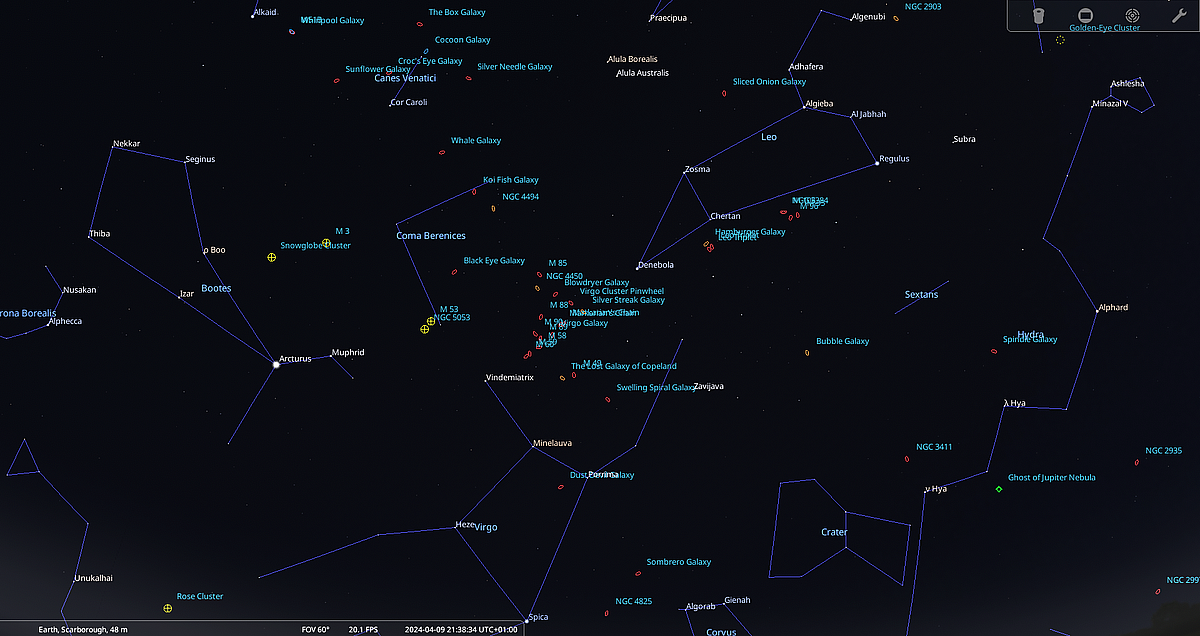
The realm of the galaxies above the bowl of Virgo (Click for full image)
This entire region of the sky, bounded by the 'bowl', Coma Berenices, and the hindquarter of Leo is frequently referred to as the 'Realm of the Galaxies', providing a window onto the wider universe, well away from intervening galactic gas and dust. Messier galaxies alone within this constellation number eleven: M49, M58, M59, M60, M61, M84, M86, M87, M89, M90, and M104 - the Sombrero Galaxy. It is not surprising that this region of the sky is considered crucial for achieving high counts in any Messier marathon endeavour.
Distribution of deep sky objects spread across the spring constellations. (Click for full image)
Looking to the east the bright orange hue of Arcturus in the constellation of Boötes is a welcome returnee to UK skies after its winter absence. Arcturus is the brightest star visible from the UK after Sirius - the Dog star. As part of a challenge (see In Focus - Stellar Bakers Dozen 2023), note how far into April you can spot both Sirius and Arcturus above the horizon simultaneously.
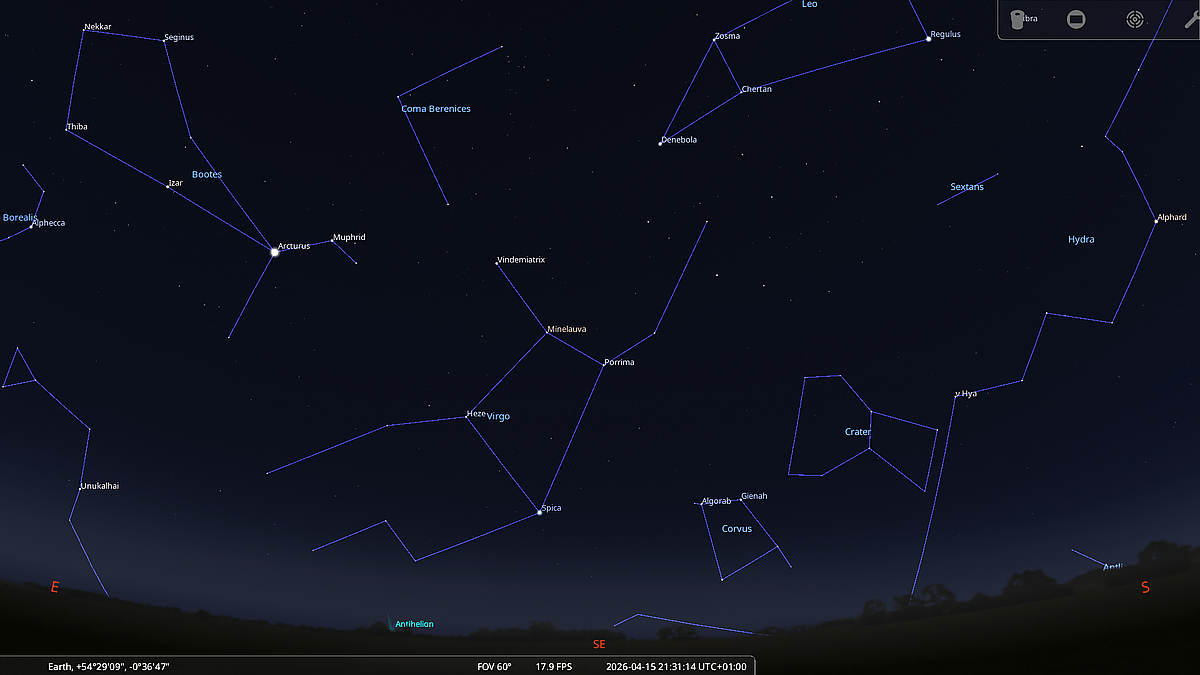
The view to the southeast mid-April, Arcturus and Spica. (Click for full image)
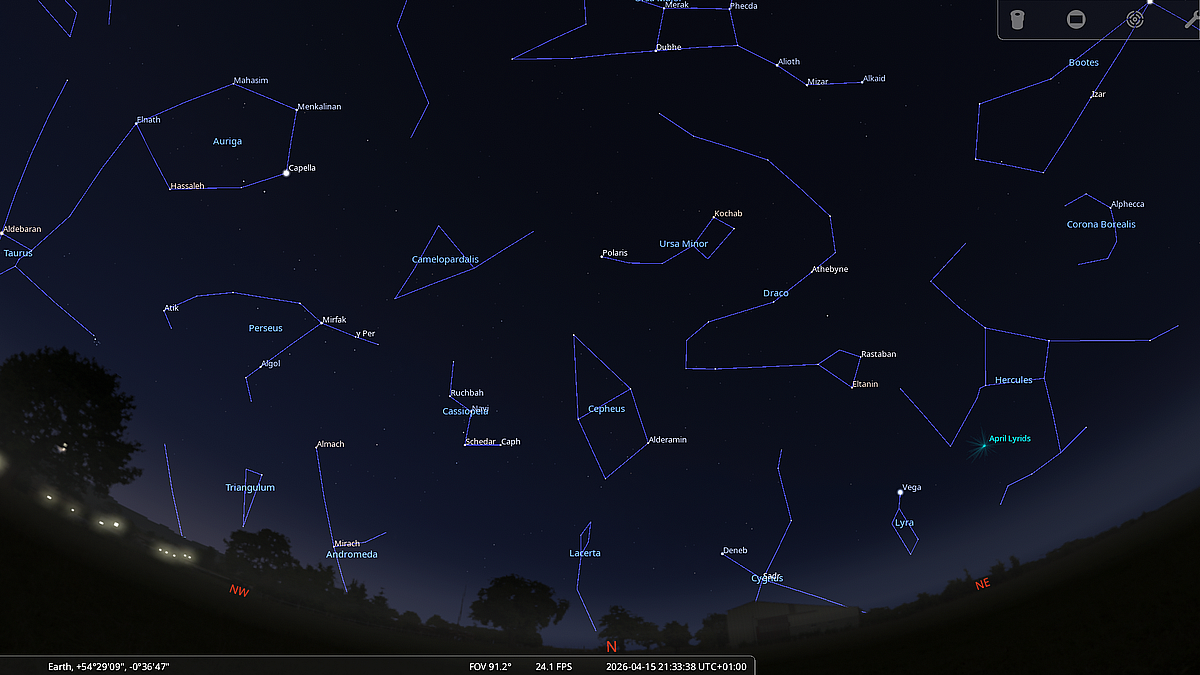
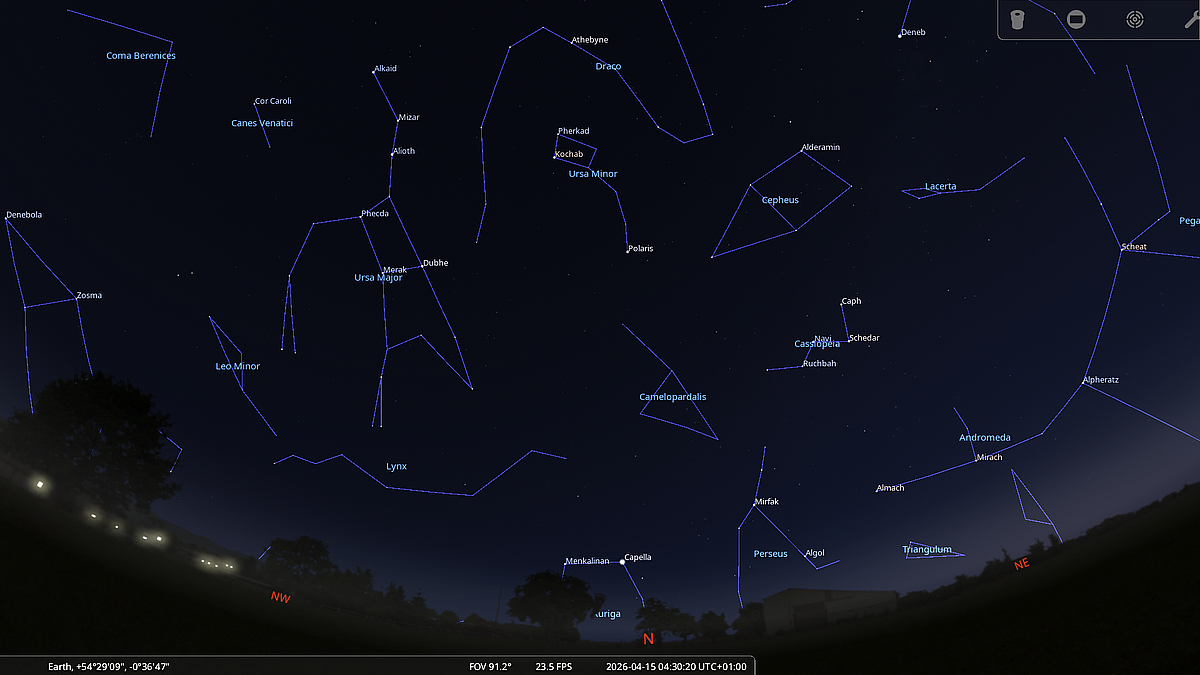
Located high in the northeast, the familiar outline of the Plough asterism, part of Ursa Major, may be utilised for locating both Arcturus and Spica by following the curve of the handle stars. To recall this process, use the phrase: ‘arc to Arcturus, then speed on to Spica’. Ursa Major spends part of the night occupying the zenith position - directly overhead, Perseus and the distinctive ‘W’ pattern of Cassiopeia having previously done so but are now arcing down in NW. The fainter stars of Cepheus (another zenith sitter) are now located lower down due north.
As the two celestial bears of Ursa Major and Minor chase their tails around the north celestial pole, only Polaris, the star nearest its location and about which the constellations in the northern hemisphere wheel, appears almost stationary. The summer Milky Way runs almost parallel to horizon during spring, the circumpolar summer constellations of Cygnus and Lyra visible above the horizon in the NE, highlighted by Deneb and Vega respectively. Both stars are members of the baker’s dozen challenge. Above Vega two different sized quadrilateral asterisms identify the location of Draco, (smaller quad) and Hercules (the keystone), both constellations now starting to move away from the horizon.
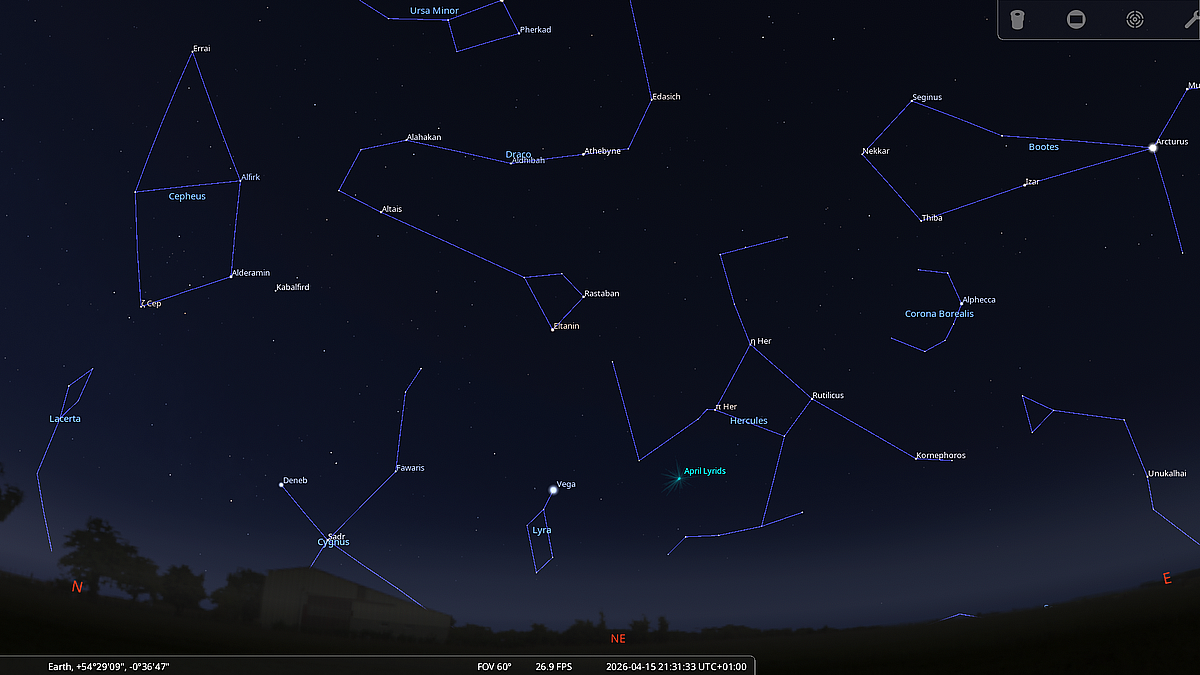
The northern aspect - circumpolar Autumn and Summer constellations descending...
and ascending. (Click for full image)
Finally, turning back to face the east, note the circlet of stars marking Corona Borealis - the Northern Crown resting between the keystone in Hercules and Boötes. Just below the circlet is where we hope the recurrent nova T Cor B will erupt to naked eye visibility this year. Normally invisible to the naked eye and smaller binoculars, the binary star erupts every 80 years becoming a naked eye object similar in brightness to the constellation lead star - Alphecca or Gemma, around mag+2. The eruption is slightly overdue and so we watch and wait in anticipation. Now would be a good time!
April Sky Charts
 |
 |
|
Looking North
April 15th - 21:30hrs BST |
Looking East |
 |
 |
|
Looking South
April 15th - 21:30hrs BST |
Looking West
April 15th - 21:30hrs BST |
 |
 |
|
Northern Aspect
April 15th - 21:30hrs BST |
Southern Aspect
April 15th - 21:30hrs BST |
 |
 |
| Northern Aspect (dawn) April 15th - 04:30hrs BST |
Southern Aspect (dawn) April 15th - 04:30hrs BST |
Additional Image Credits:
- Planets and Comets where not otherwise credited: NASA
- Sky Charts: Stellarium Software and Starry Night Pro Plus 8
- Log in to post comments

