
In this month's Sky Notes:
Planetary Skylights: A Brief Guide to November's Night Sky
Saturn is well placed for evening observation, while a close conjunction of Jupiter and Mars is the month’s highlight. Uranus lies below the Pleiades, and Neptune ahead of Saturn; both are best identified with a telescope. Mercury and Venus appear in the morning sky by mid-month.
 Mars and Jupiter gradually enter the late-evening sky, becoming visible shortly after 23:30hrs at the start of November and an hour earlier by month’s end. Moving eastwards along the ecliptic in prograde motion, Mars travels from the Cancer–Leo border to near Regulus in Leo by the end of the month. Its proximity to Jupiter around mid-month is November’s planetary highlight, making the Red Planet easy to identify just above Jupiter. Mars brightens from magnitude +0.8 to +0.5 during November but remains considerably fainter than Jupiter at magnitude −2.1.

Mars and Jupiter Nov 12th early morning hours. (Click for full image)
At the start of November, Mars is almost 6 degrees ahead of Jupiter but closes the gap as it moves five times faster. They remain within 2 degrees from November 12th to 20th, reaching their closest separation of 1.2 degrees on the night of November 15/16th. Regulus, Leo’s brightest star (magnitude +1.35), lies 4.5 degrees below them, with all three fitting within the field of 7 x 50 binoculars. For telescope observations, 02:00–04:00hrs offers more favourable views: Mars and Jupiter have climbed 30 degrees above the SE horizon, clear of poor ‘seeing’ by then.
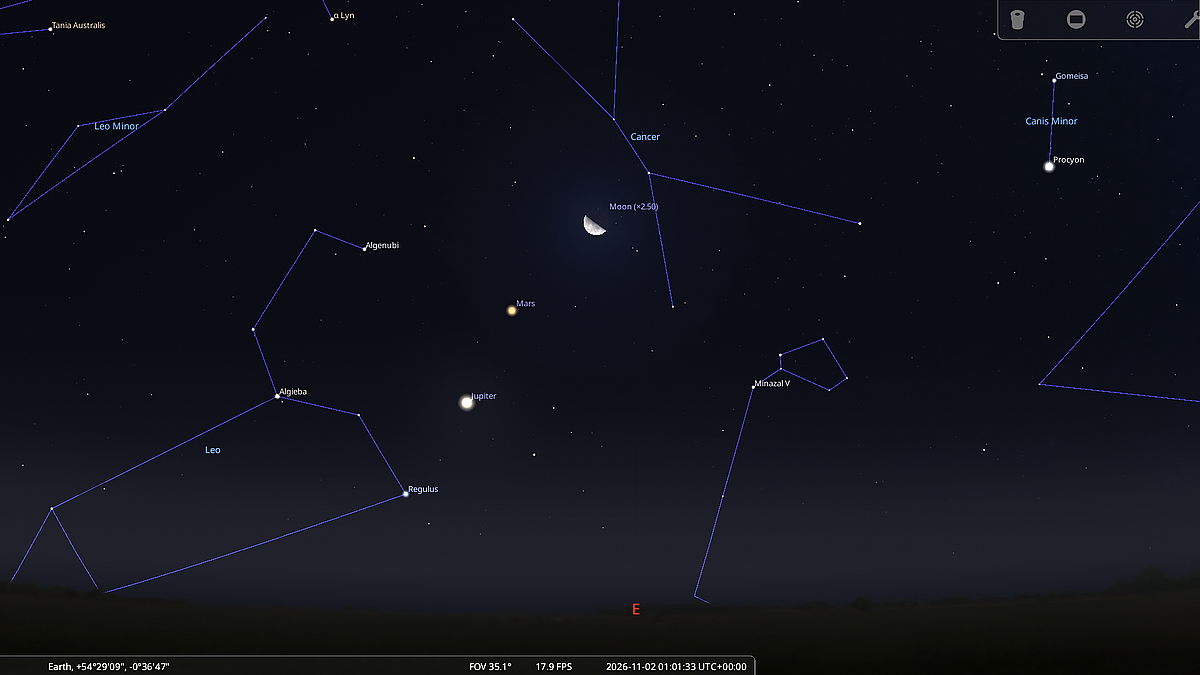
Moon, Mars, Jupiter and Regulus Nov 2nd - early morning hours. (Click for full image)
Mars and Jupiter look strikingly different through the eyepiece. Despite being much closer to Earth, Mars appears less than 8 arcseconds across, compared with Jupiter’s almost 40 arcseconds. Larger telescopes at medium to high magnification may reveal Mars’s dark, fin-shaped Syrtis Major feature in the last week of November, while Jupiter displays abundant detail. Look for the Moon alongside both planets at the beginning and end of the month.

Moon, Jupiter, Regulus & Mars, Nov 30th - early morning hours. (Click for full image)
 Jupiter becomes increasingly prominent alongside Mars in the late-evening sky during November. As noted above, their spectacular mid-month conjunction is best viewed in the early morning. Jupiter lies ahead of Leo’s ‘Sickle’ asterism, moving slowly towards it in prograde motion without reaching it. At magnitude −2.1, it is the brightest object in the ‘night’ sky, although opposition is not until February 2027.

Jupiter, Moon and Regulus - Nov 3rd - early morning hours. (Click to view full image)
A waning Moon lies nearby Jupiter in the sky on November 3rd and 30th.
Jupiter, Moon, Regulus and Mars - Nov 30th early morning hours. (Click to view full image)
Jupiter’s flattened globe spans 39 arcseconds through a telescope, making it a rewarding target even for relatively small instruments. Dark equatorial cloud bands and lighter polar regions are readily visible, while apertures over 200mm (8") may reveal the subtler northern and southern temperate belts.
Jupiter’s famous Great Red Spot, a major storm, should be visible through a 100mm (4”) telescope, though a 150mm (6”) instrument at medium magnification shows it more clearly. However, it is smaller and less vivid than it was three decades ago.

Jupiter & Mars Nov 18th @ 06:00hrs.

Jupiter & Mars Nov 24th @ 06:00hrs.
Jupiter’s four large Galilean moons are readily visible as points of light. Following their changing positions over successive nights is fascinating, with opportunities to observe moon transits, shadow transits or both together. Shadow transits are easier to spot through the eyepiece; timings for some of the more favourable events will be highlighted from next month.
 Saturn is well placed to the south for observation throughout the evening, having reached opposition early last month. It reaches its highest point before midnight, about 37 degrees above the southern horizon and clear of the turbulent seeing that has hampered observations for nearly a decade. Conditions should improve further over the coming years as Saturn climbs higher on the ecliptic.

Saturn and Moon - Nov 20th at 17:00hrs GMT. (Click to view full image)
Saturn stands out among the faint stars along the Cetus/Pisces border, below the Square of Pegasus, at magnitude +0.38, fading to +0.5 by month’s end. It remains an impressive telescopic sight despite a ring tilt of less than 8 degrees—enough to reveal the Cassini Division in steady seeing. The rings reach their maximum tilt in 2032.

Saturn and Titan - Nov 15th @ 21:00hrs GMT.
(Click for larger image)
Through the eyepiece, also look for Titan, by far Saturn’s largest moon. It usually appears as a nearby point of light and orbits Saturn every 16 days. Our Moon is nearest Saturn on November 20th.
 Neptune is favourably positioned for telescope viewing all evening and through the night. It lies in Pisces, about 8 degrees ahead of Saturn, at magnitude +7.8. Detecting it requires at least a 60 mm (2.5 inches) aperture; instruments larger than 130 mm (5 inches) give a clearer view of its tiny blue-grey disc, only 2.5 arcseconds across. The nearest named stars; 5 Cet and 4 Cet, lie 2 degrees below it.

General finder location chart for Neptune, mid-November. (Click for larger image)

Neptune finder chart - detailed, mid-November. (Click for larger image)
 Uranus reaches opposition on November 25th and is visible all night. The third-largest planet lies in Taurus, roughly halfway between the Hyades and Pleiades star clusters, near the named star pair A1 & A2 Tau. At magnitude +5.6, it is technically visible to keen-eyed observers under very dark skies, though difficult to spot with the naked eye from the UK. Binoculars show it as a faint point of light; resolving its small, green disc, 3.8 arcseconds across, requires an aperture of 80mm (3+ inches). Instruments of 150mm (6”) or larger show the disc more clearly—an impressive sight given its distance of over 18 AU, or 2.76 billion km.

General location chart for Uranus - mid-Nov. (Click for larger image)
Uranus stays above the critical altitude of 25 degrees from 17:30hrs to 04:30hrs, reaching its highest point over 55 degrees above the southern horizon around local midnight. This gives observers ample time to locate and observe it.

Detailed location chart for Uranus - mid-Nov. (Click for larger image)
 Venus returns to the dawn sky in early November, becoming more prominent in the month’s second half. Initially, the ‘morning star’ appears only 45 minutes before sunrise and stays low until twilight hides it, so observers need a clear, unobstructed south-east horizon. Even then, it shines at magnitude –4.2, seven times the apparent brightness of Jupiter.

Nov 7th @ 06:15hrs GMT - Venus and crescent Moon. (Click for full-sized image)
By mid-month, Venus reaches magnitude –4.6 and climbs steadily higher in the dawn sky, thanks to the ecliptic’s steep morning angle at this time of year. Before daylight obscures it, Venus stands 20 degrees above the south-east horizon, just 1.2 degrees above Spica, the brightest star in Virgo. A crescent Moon joins the pair on Nov 7th at around 06:15hrs.

Venus and Spica on Nov 20th, Mercury lower left. (Click for full-sized image)
Venus reaches peak brightness on Nov 29th, shining at a dazzling magnitude –4.7 and easy to spot with a clear view east. Through a telescope, its 27% illuminated disc resembles a miniature crescent, Moon. No features are visible: Venus’s permanent dense cloud cover reveals little, if anything, beyond its phase.

Venus and Spica on Nov 26th, Mercury lower left. (Click for full-sized image)
 Mercury joins Venus in the pre-dawn sky, briefly escaping the Sun’s glare for its best morning apparition of the year for UK observers. From Nov 12th, look a few degrees above the ESE horizon, 40 minutes before sunrise. At magnitude +1.1, it requires binoculars and appears dimmer through the dense atmosphere near the horizon. Mercury brightens to magnitude -0.5 towards the end of the apparition, when it should be visible with the naked eye low in the ESE sky.

Mercury on Nov 12th @ 06:20hrs. (Click for full image)
Mercury reaches greatest western elongation on Nov 21st, standing about 11 degrees above the ESE horizon at around 06:45 GMT. Through a telescope, its phase changes rapidly from a broad crescent, resembling a smaller version of Venus, to a gibbous disc by the end of the apparition.

Nov 30th - southeast - Mercury with Venus upper right @ 07:00hrs. (Click for full image)
November Meteors
November’s main meteor shower, the Leonids, is active from Nov 6–30th and usually peaks on the night of 17/18th. It is renowned for meteor storms at roughly 33-year intervals.
Outside storm years, Leonid activity is modest, reaching at best 10–20 meteors per hour, as expected this year. Moonlight should cause little interference: the first-quarter Moon sets by 23:00hrs, leaving the more productive early morning hours dark. By then, Leo, which contains the shower’s radiant, is high above the southern horizon.
The Leonids originate from comet 55/P Temple-Tuttle, which returns to the inner solar system every 33 years and can produce storms of hundreds, thousands or even hundreds of thousands of meteors per hour. The next storm-level event is predicted for November 2031 or 2032. Among the fastest meteors, Leonids enter the upper atmosphere at 45 miles per second (72 km/second), often leaving bright, persistent trains. If the night of 17/18th is clear this year, watch for them, but don’t expect prolific numbers.
Also watch for the South Taurids, peaking on the night of Nov 4/5th, and the North Taurids on Nov 11/12th. Both showers produce only around 5 meteors per hour, but these can be bright, with occasional fireballs. Moonlight should not interfere.
The Taurids are a long-established shower associated with periodic Comet Enke. Over time, its dust has dwindled and spread across a broad region of the inner solar system, producing Taurid showers on Earth, Mars and Venus.
As 2026 draws to a close, we still await an eruption of the recurrent nova T Corona Borealis. An outburst in the next month or so would be harder for UK observers to see, as Corona Borealis sinks towards the north-west horizon by late November. Fortunately, it dips only a little below the horizon and reappears by 05:00hrs—an inconvenient observing time. Darker mornings and an earlier rise in December and the New Year will extend the observing window should T Cor B erupt.

Artist's impression of T Cor B system.
The star erupts roughly every 80 years, with its last outburst recorded in 1946. Normally at magnitude +10, near the limit of typical binoculars, it reached +2.0 in 1866 and +3.0 in 1946 during its two well-documented outbursts.
T Cr B is a binary system comprising a large, cool M3-class red giant, perhaps 190 million km (120 million miles) across, and a smaller, hotter, more massive white dwarf about 6400 km (4000 miles) across. An accretion disc of material drawn from the red giant surrounds the system. The stars orbit each other every 227.5 days and lie almost 3000 light years away. T Cr B is by far the brightest known recurrent nova.

The constellation of Corona Borealis. (Click for full image)
T Coronae Borealis undergoes recurrent nova eruptions rather than a supernova because its white dwarf is not massive enough. Only the hydrogen accumulated on its surface detonates, leaving the star intact. By contrast, a Type 1a supernova requires the white dwarf to reach a critical mass of about 1.44 solar masses, destroying the entire star.

Location of T Cor B or the Blaze star. (Click for full image)
Predictions of an eruption in 2024 and 2025 proved incorrect, and none has occurred so far in 2026. Astronomers have speculated that an outburst could coincide with the end of the 228-day orbital period, next due on Feb. 8th, 2027. Whenever it happens, it will make headlines, and we should be alerted within 24 hours. T Cor B may remain visible to the naked eye for only a week, but that should give everyone a chance to witness what, for most, will be a once-in-a-lifetime event.
Aurora Sighting
There have been several sightings of the aurora over the past month, with a particularly impressive display on the evening of 10th October. Mark and Paul were at the DSS that evening but, unfortunately, were too late to witness the display after being alerted. Paul’s wife had managed to capture an image earlier in the evening, when the aurora was much more widespread and visible across large parts of the country.

Aurora image - Oct 10th, captured by Hanneke Wood. (Click for full image)
It is certainly worth keeping an eye on the skies over the coming winter months. Solar activity data suggests that strong auroral displays could continue for at least another year, potentially up to two years beyond the solar maximum.
November Night Sky
November, the Jekyll and Hyde month weatherwise, sometimes calm and fair, sometimes stormy and wet - but increasingly milder, with only occasional frost. Trees shed the last of their colourful autumn coats, abruptly or gradually, leaving winter poised at the threshold by month’s end. Darkness falls in late afternoon, and daylight returns later in the morning, offering observers many potential hours under suitable conditions.

2026 Mid-November night sky - 20:00hrs GMT. (Click for full-sized image)
The celestial tapestry overhead continually changes, yet even as winter approaches, parts of the sky still recall seasons past. The Summer Triangle stars—Vega, Deneb and Altair—and their constellations remain prominent at nightfall and accessible for observation.
Deneb crowns Cygnus, the Northern Cross, which looks increasingly like a crucifix as it descends towards the WNW horizon. High in the NW, brilliant, steely-blue Vega lights Lyra’s lozenge-shaped outline. Both stars are circumpolar at our latitude, remaining visible throughout winter as they dip close to the northern horizon. Only Altair, in Aquila the Eagle, migrates to warmer climes, leaving the late-evening sky after mid-month in search of quarry.

The southwest aspect of the late November night sky, mid-evening. (Click to enlarge image)
Looking north, the familiar Plough asterism in Ursa Major is at its lowest point in its continuous circuit around the celestial pole, almost marked by Polaris, the Pole Star. Follow the Plough’s pointer stars, Dubhe and Merak, in its ‘bowl’ to find Polaris at the tip of Ursa Minor’s tail. Draco’s faint stars wind between these two celestial bears; an irregular quadrilateral of fainter stars to the right of Vega in the WNW marks the dragon’s head.
Follow the curve of the Plough’s handle to find brilliant Arcturus, setting in the NW in the spring constellation Boötes. It stays below the horizon only briefly, rising again in the ENE by 03:00hrs GMT from mid-UK latitudes.

The northwest aspect of the late November night sky, mid-evening. (Click to enlarge image)
Corona Borealis (see T Cor B) and the upper part of Hercules depart with Boötes—though this is technically Hercules’s lower body, as stellar charts depict him upside down. Their absence is brief: they reappear in the NE by dawn. Due south, Pisces and Aquarius lie below the Great Square of Pegasus; neither has conspicuous stars. Saturn currently lies on their border. Below Pisces is the large constellation Cetus, the Whale. Use the Square’s two front stars to locate Diphda, Cetus’s brightest star.
Cetus’s most famous object is the variable star Omicron Ceti, known as Mira the Wonderful—an extraordinary pulsating red supergiant, perhaps 300 million miles across. At maximum brightness, which lasts about 10 days, Mira is easily visible to the naked eye and can rival Menkar. It then fades over seven months to magnitude +10.2, becoming difficult to detect even with binoculars. Its full cycle lasts 332 days, with the next maximum in February/March 2027. Mira lies roughly halfway between Menkar and Diphda.
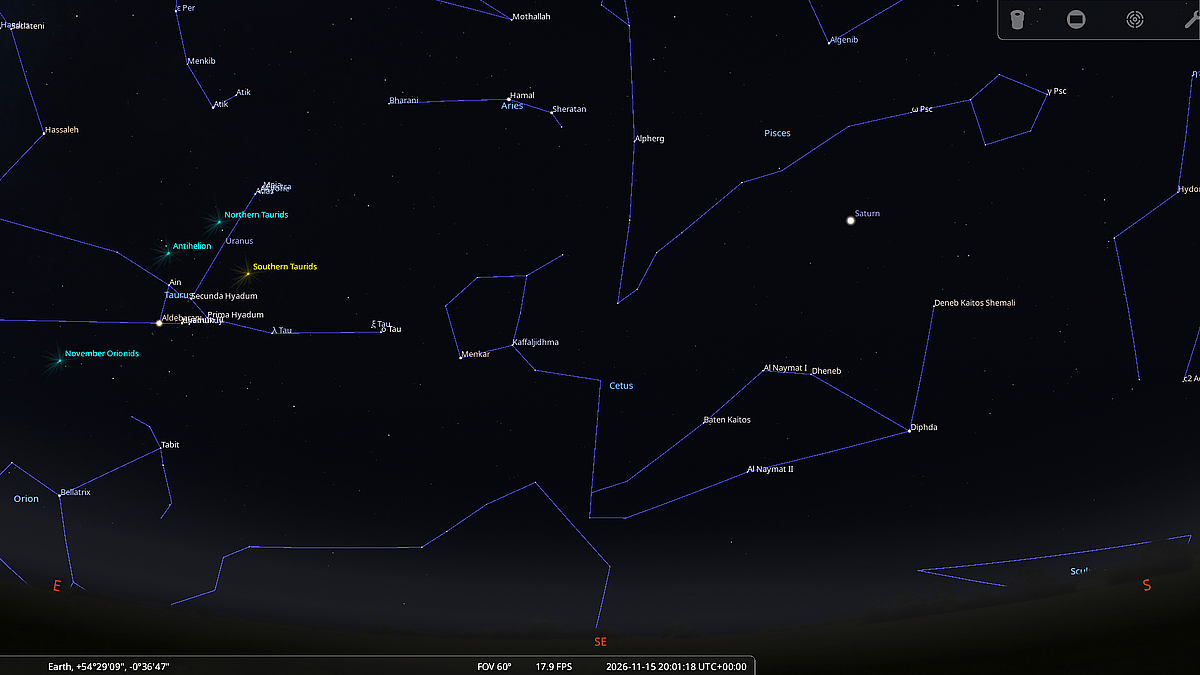
The southeast aspect of the late November night sky, mid-evening. (Click to enlarge image)
Capricornus lies along the SSW horizon, setting by mid-evening at month’s end. Look for conspicuous Fomalhaut in Piscis Austrinus, briefly visible just above the SW horizon throughout November and setting around 19:45hrs by early December. It is the southernmost first-magnitude star visible from the UK mainland. Scheat and Markab in the ‘square’ of Pegasus point down towards it.
High in the south, Andromeda’s stars extend eastwards from Pegasus towards the heroic figure of Perseus, rising high in the ENE. Perseus lies partly within the rich Milky Way and rewards exploration with binoculars or a telescope.
Alpha Persei, or Mirphak (also written Mirfak), is the constellation’s brightest star, but Beta Persei, or Algol, is far more intriguing. Algol means ‘Demon’s head’, from the Arabic ‘Ras al Ghul’; a ‘Ghul’ was a nightmare that haunted and ultimately destroyed its victims. Ancient star maps show Perseus holding Medusa’s severed head, marked by Algol, though it is doubtful that the Arabs knew the Perseus–Medusa legend. In antiquity, observers noted with alarm that Algol seemed to ‘wink’ every third night, fading before regaining its brightness. They regarded it as the most dangerous and ill-fated of stars.

Algol - the demon star. (Click for full-sized image)
Science has explained Algol’s behaviour: it is an eclipsing binary, consisting of two stars orbiting each other, one brighter than the other. Every 2 days and 21 hours, the fainter companion passes in front of the brighter primary, reducing their combined light. The eclipse lasts almost 10 hours before the ‘demon star’ returns to its normal brightness.
In this part of the sky, also seek out the superb ‘Double Cluster’: two exquisite galactic star clusters midway between Perseus and Cassiopeia, marking Perseus’s sword hand. H and Chi Persei (NGC 869 & NGC 884) appear as misty knots in binoculars and offer one of the finest celestial sights at low magnification through small or medium telescopes.
In one of the best-known myths, Perseus rescues Princess Andromeda, offered as a sacrifice to the sea monster Cetus sent to devour her and ravage ancient Ethiopia’s coastal towns and cities. This was the kingdom of boastful Queen Cassiopeia and her husband, King Cepheus. The winged horse Pegasus was a later addition to the legend. This mythological tableau is now ideally displayed across the autumn sky to the south and east.
Cepheus’s faint outline resembles a crooked house overhead on November evenings. Cassiopeia’s distinctive ‘W’ lies along the Milky Way and rewards exploration with binoculars or a telescope. Following Perseus up from the NE horizon, Auriga the Charioteer forms an imposing pentagon, lit by brilliant Capella, as it climbs towards the zenith—the point overhead.

The constellations of Autumn. (Click for full-sized image)
By mid-evening, winter constellations begin to dominate the eastern sky, led by Taurus, which meets Auriga at Al Nath. Taurus contains two familiar star clusters: the Pleiades and the V-shaped, or arrowhead-shaped, Hyades. The conspicuous reddish star Aldebaran, ‘the eye of the bull’, appears within the Hyades but is not a true member: it lies halfway to the cluster, whose stars are 120 light years away.
The Pleiades, or ‘Seven Sisters’, mark the bull’s swishing tail above and to the right of the Hyades. Often considered the loveliest open star cluster in the heavens, they reveal more than seven stars to keen-eyed observers, though most people see five or six with the naked eye. Binoculars or very low telescope magnification reveal dozens; the cluster contains over 380 members about 410 light years away. As it moves through a small cloud of gas and dust, its stars illuminate the nebulosity visible in images.
In Greek mythology the Pleiades were the seven daughters of Atlas and the Oceanid Pleione, after whom they are named. Orion is said to have pursued the sisters for seven years after trying to ravish them and their mother. Zeus immortalized the chase by placing the Pleiades in the heavens. This is of course just a tale, but ancient Aztec and Mayan traditions tell of real and gruesome rituals associated with the Pleiades. Then, the midnight culmination of the star cluster was an event of ominous significance, especially so every 52 years when timelines of separately used calendars converged. Believing the world would end at such times, virgins would be sacrificed to postpone the approaching apocalypse. Travel to Mexico today and many of the sacred ‘step’ pyramids have their west face orientated to the setting position of the Pleiades.
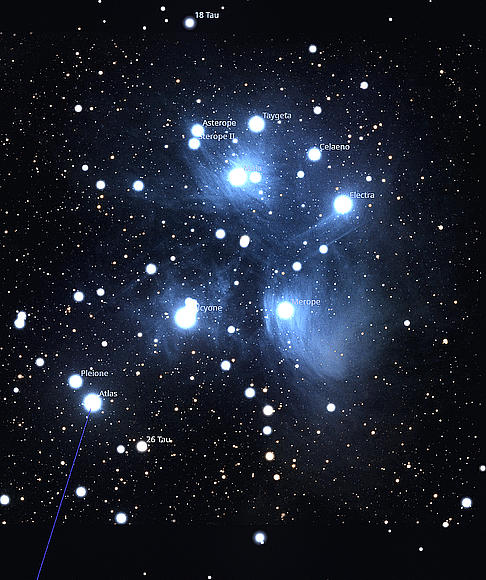
The Pleiades star cluster.
Towards month’s end, Gemini—the Twins—rises over the NE horizon by mid-evening, its heads marked by the first-magnitude stars Castor and Pollux. As November gives way to December, majestic Orion strides above the SE horizon by mid-evening. Orion and his stellar companions will guide our celestial rambles through winter; until then, explore the autumn sky—it will not disappoint.

The Northeast aspect of the late November night sky, mid-evening. (Click to enlarge image)
November Sky Charts
 |
 |
|
Looking North
Nov 15th - 20:00hrs GMT |
Looking East |
 |
 |
|
Looking South
Nov 15th - 20:00hrs GMT |
Looking West
Nov 15th - 20:00hrs GMT |
 |
 |
|
Northern Aspect
Nov 15th - 20:00hrs GMT |
Southern Aspect
Nov 15th - 20:00hrs GMT |
 |
 |
| Northern Aspect (Pre-dawn) Nov 15th - 06:00hrs GMT |
Southern Aspect (Pre-dawn) Nov 15th - 06:00hrs GMT |
Additional Image Credits:
- Planets and Comets where not otherwise mentioned: NASA
- Sky Charts: Stellarium Software and Starry Night Pro Plus 8
- Log in to post comments
