
In this month's Sky Notes:
- Planetary Skylights
- Meteors, T Cor Bor, Conjunction and Noctilucent Cloud reports
- July Night Sky
- July 2026 Sky Charts
Planetary Skylights: A Brief Guide to July's Night Sky
With Jupiter and Mercury now gone from the evening sky, Venus is the only remaining evening planet, though it too is gradually sinking toward the western horizon. Saturn and Mars can be seen with the unaided eye low in the eastern sky during the very early morning. Uranus and Neptune are also visible overnight, but optical aid is needed to identify them.
 Venus is now the only planet visible in the evening sky, shining low in the west. At magnitude -4.0 it remains prominent and will brighten slightly during the month, though it continues to sink toward the horizon and will be very low by month’s end. Through a telescope, Venus shows little surface detail because it is permanently veiled in cloud, but its phase should be visible, shrinking from 68% at the start of July to 56% by the end. Unlike observing most planets, viewing Venus in brighter twilight is probably preferable as it reduces glare, Venus appearing so bright. On July 17th, a slender crescent Moon will lie below and to the left of Venus; view from 21:35hrs.
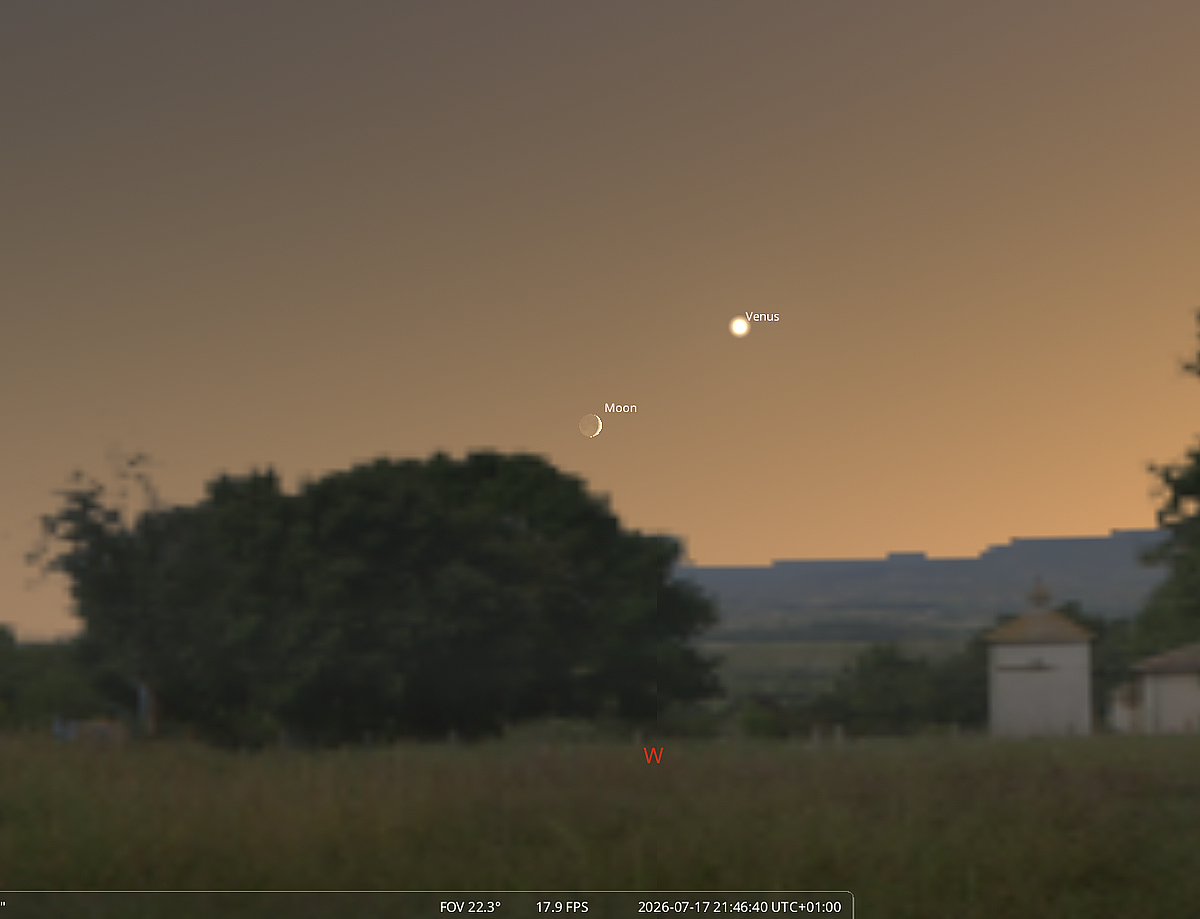
Venus and crescent Moon on July 17th @ 21:45hrs. (Click for full image)
 Saturn rises earlier each night, and by month’s end should be visible just above the eastern horizon by 23:30hrs. Seeing conditions for Saturn will improve through July as the planet climbs higher, reaching a respectable 37 degrees above the southern horizon by dawn later in the month. Located just within Pisces, Saturn shines at magnitude 0.68 and stands out clearly among the constellation’s faint stars. Through a telescope, its ring tilt has increased to 6 degrees, enough to show the Cassini Division in good 'seeing'. Titan, Saturn’s largest moon, should appear as a small point of light near the planet’s disk, while larger instruments under darker, steadier skies late in the month may reveal several additional moons. On the early morning of July 8th, the waning quarter Moon will lie above and to the left of Saturn.
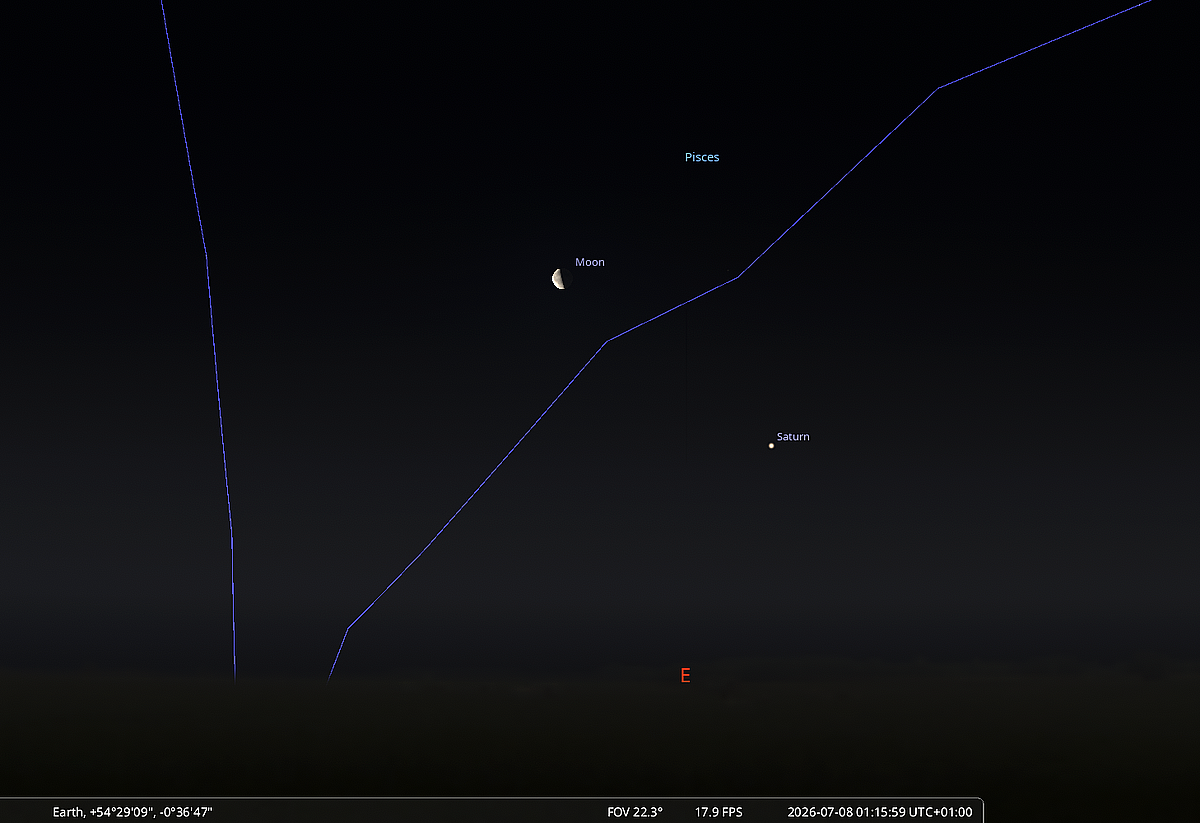
July 8th @ 01:15hrs BST - Saturn below right of waning Qtr Moon. (Click for larger image)
 Mars is also visible in the early morning sky and becomes easier to identify and observe as the month progresses. Even so, initially it remains a challenging target low in the east-northeast, shining modestly at magnitude +1.4. A short observing window, bright twilight, and its low altitude all make detection less than straight forward, so binoculars will be helpful.
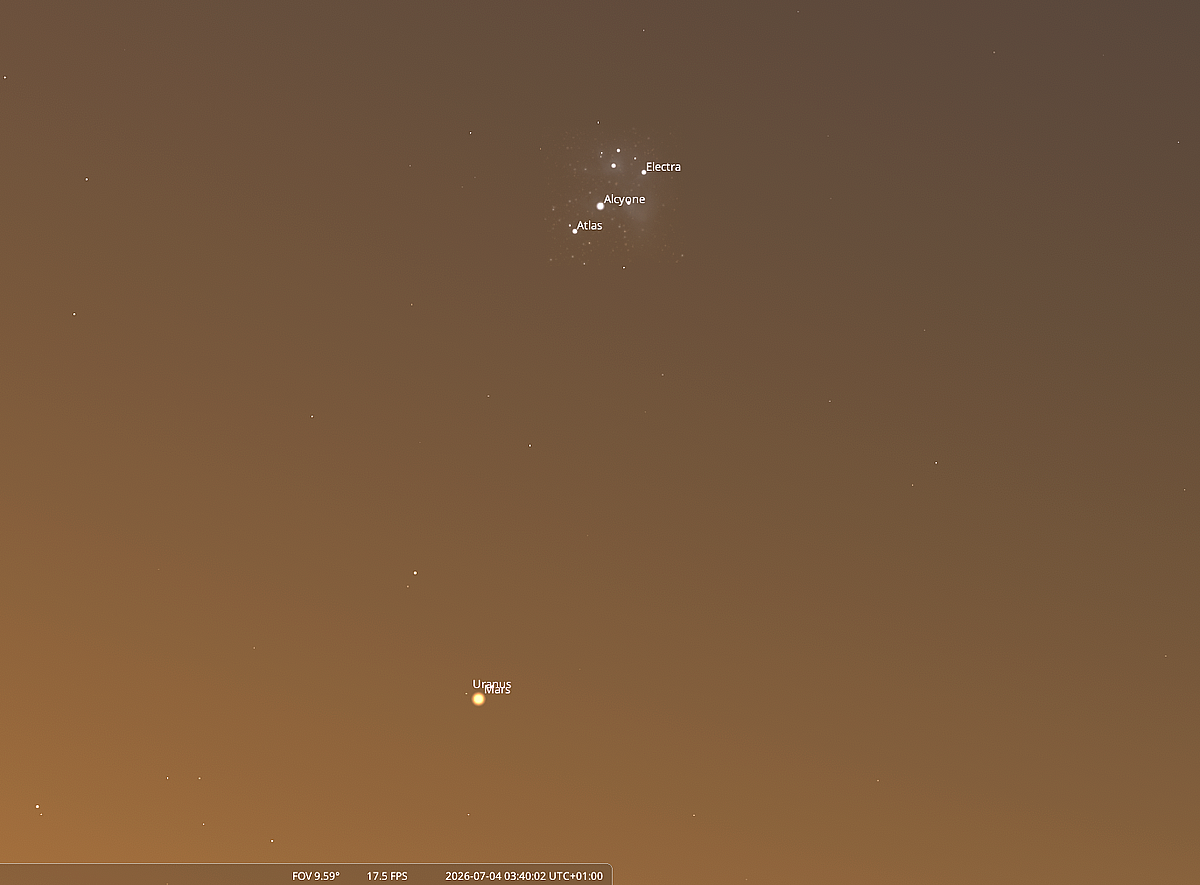
Mars and Uranus on July 4th at 03:30hrs. (Click for larger image)
Early risers at the start of the month can look for an interesting conjunction between Mars and distant Uranus. Over three mornings, Mars passes just below Uranus, with the two closest on July 4th, separated by only 8 arc minutes. Begin viewing from 03:00hrs for the best chance of spotting Uranus in the twilight sky; utilising optical aid, which will be required.
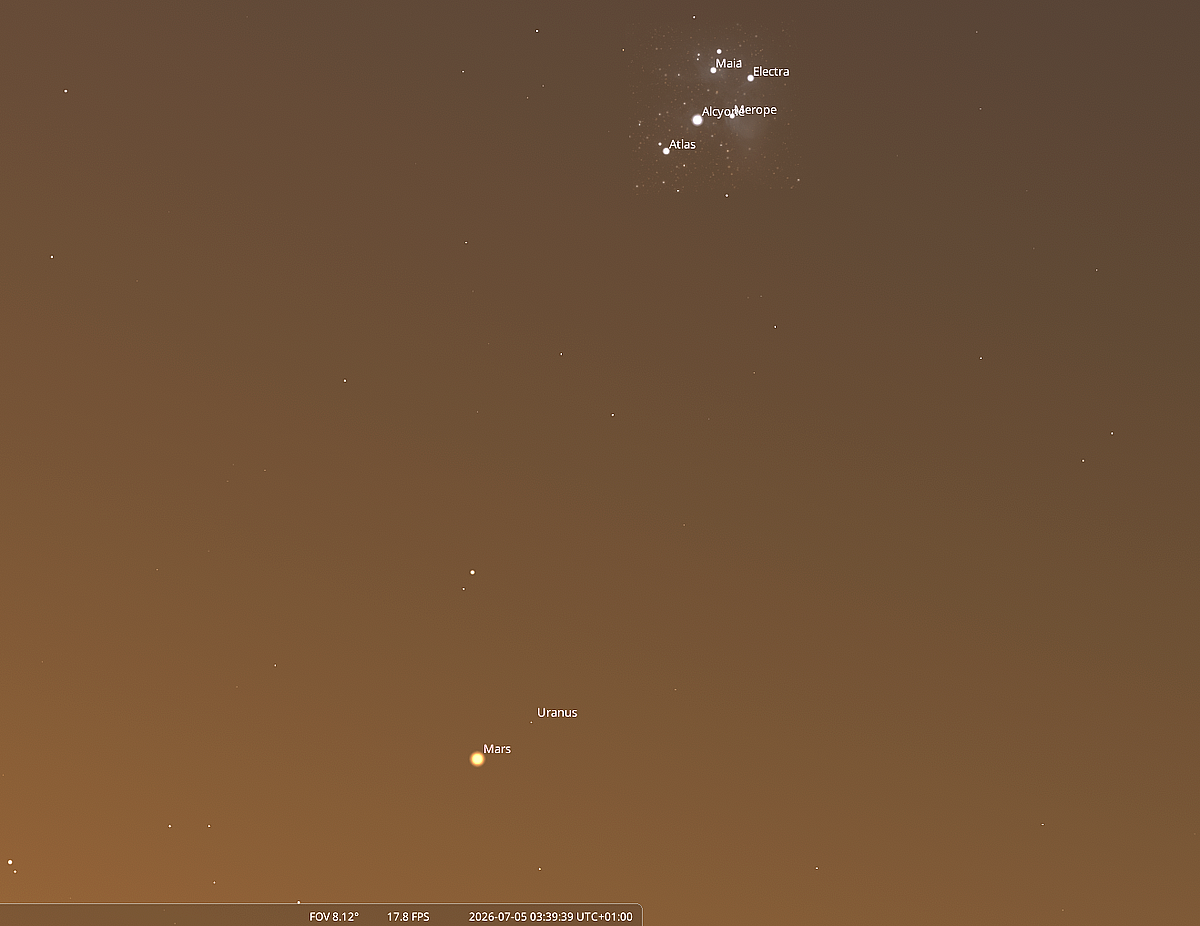
Mars and Uranus on July 5th at 03:30hrs. (Click for larger image)
On July 11th, Mars lies below a waning crescent Moon, which itself sits a few degrees beneath the Pleiades star cluster in Taurus. Aldebaran, the chief star of Taurus, appears below Mars with a similar amber hue, though it will be brighter. Look for the grouping above the NNE horizon between 03:30 and 04:00hrs.
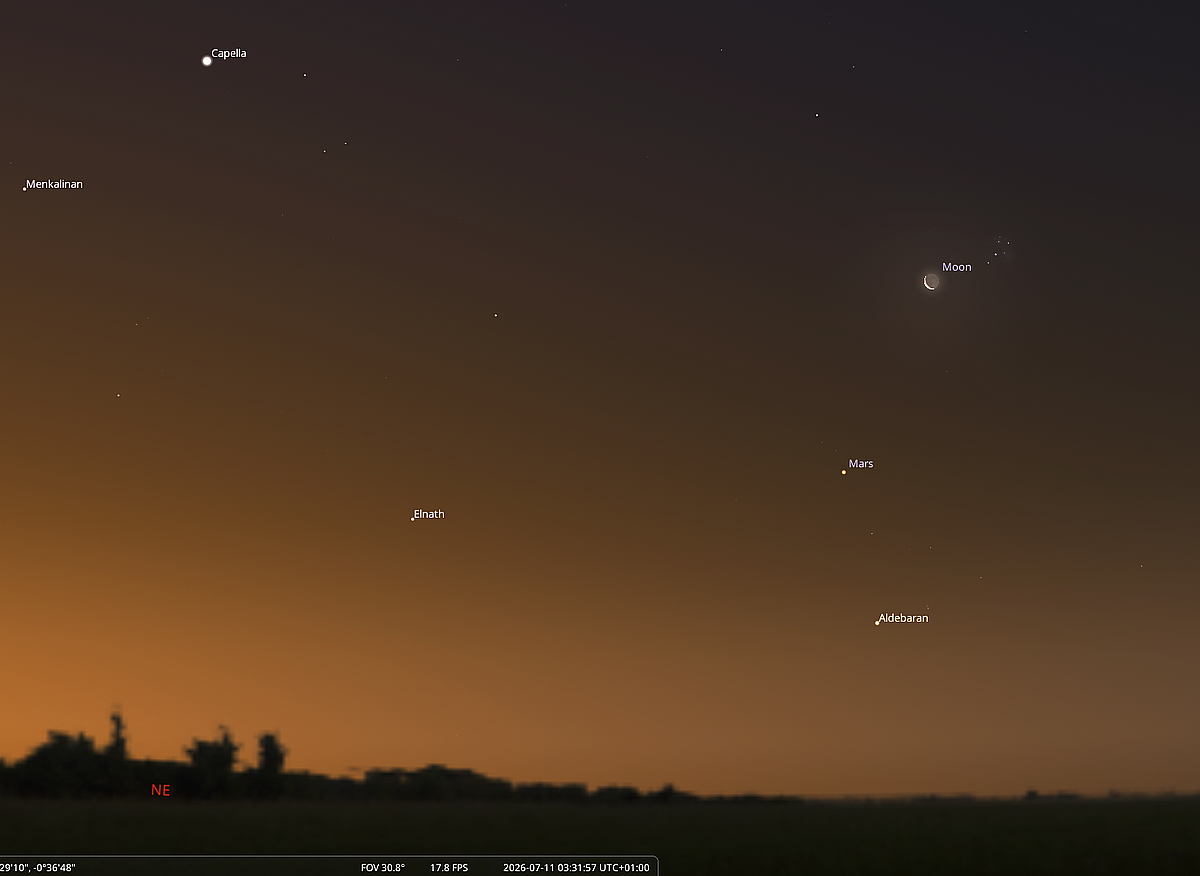
Mars, Moon and the Pleiades, with Aldebaran further down. July 11th @ 03:30hrs.
(Click for larger image)
On July 12th, the Moon will lie to the left of Mars.
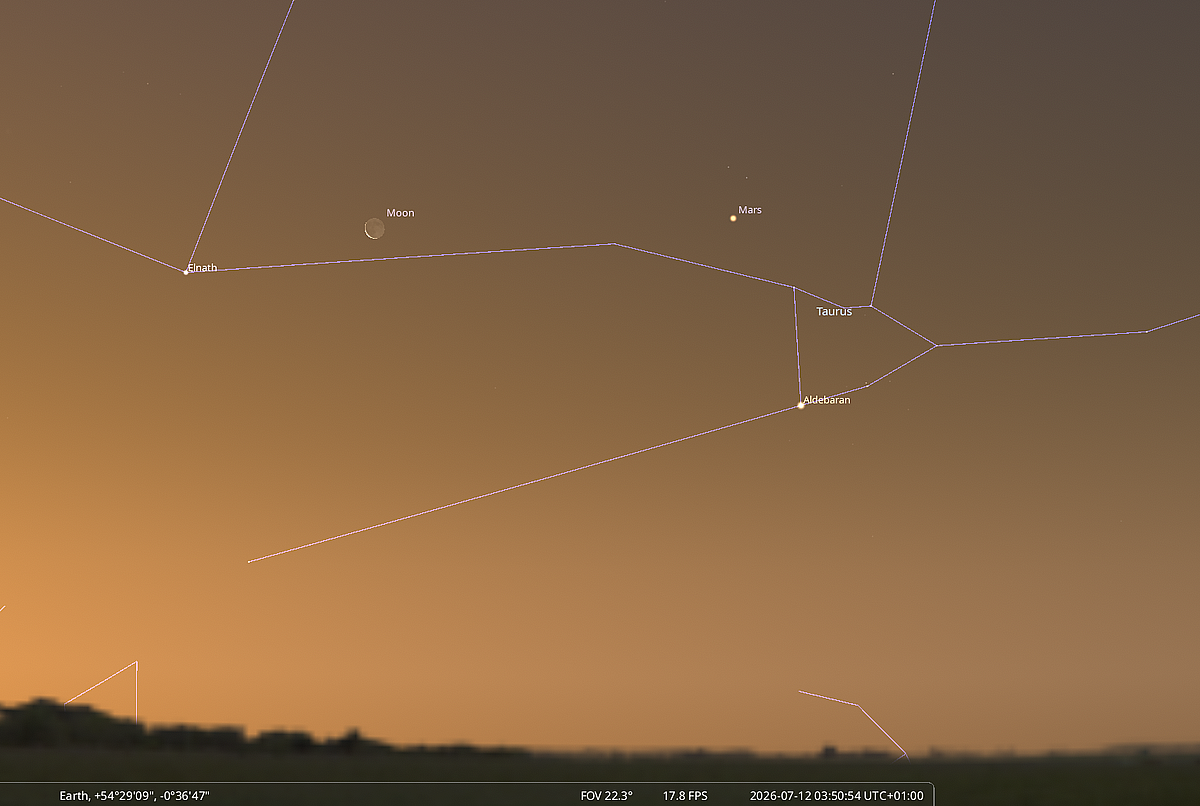
Mars and Moon July 12th @ 03:30hrs. (Click for larger image)
 Neptune is an early-morning target requiring optical assistance to track down. A GOTO telescope will make matters much simpler, otherwise the use of a sky app or planetarium program, and patience will be required. Its general location is 10 degrees to the right of Saturn and at magnitude +7.8, Neptune can be detected with binoculars - as a speck. A telescope of 100mm (4") to 150mm (6”) employing medium to high power is needed to show its tiny blue-grey disk, just 2.8 arcseconds across. The nearest named stars are 10 Cet and 44 Psc, both located 2.5 degrees eastwards of Neptune.
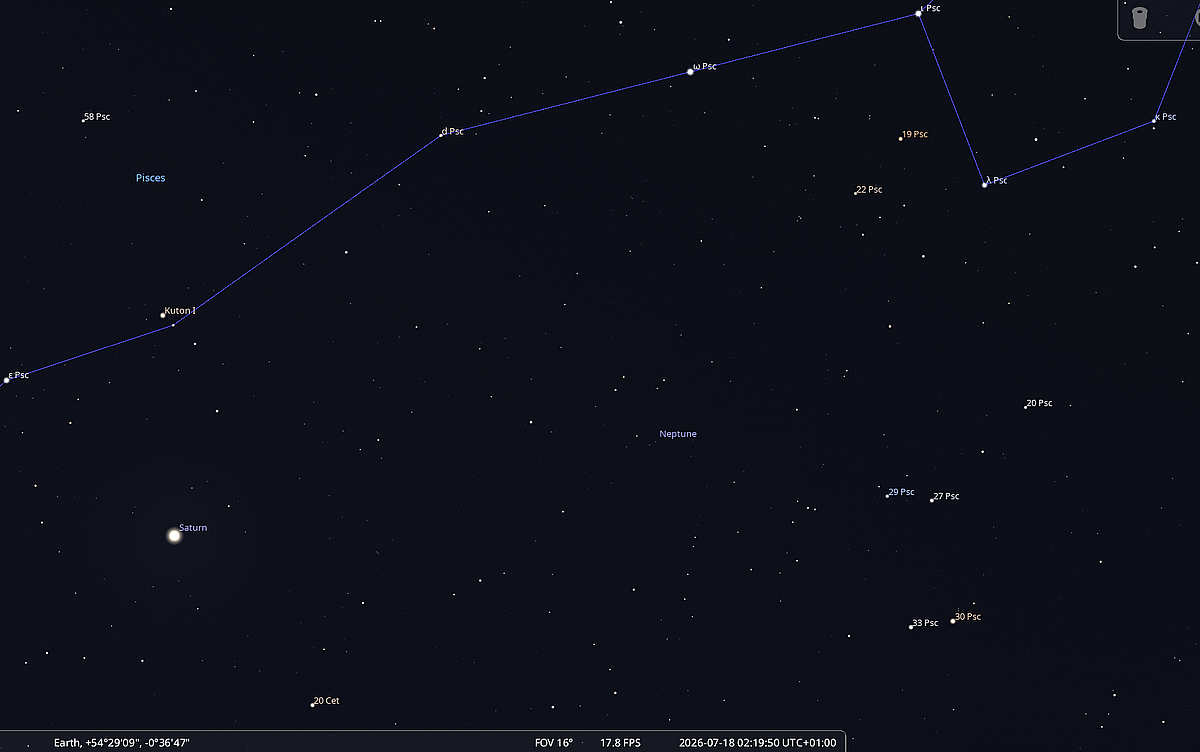
General location of Neptune for mid-July. Early morning hours.
(Click for full image)
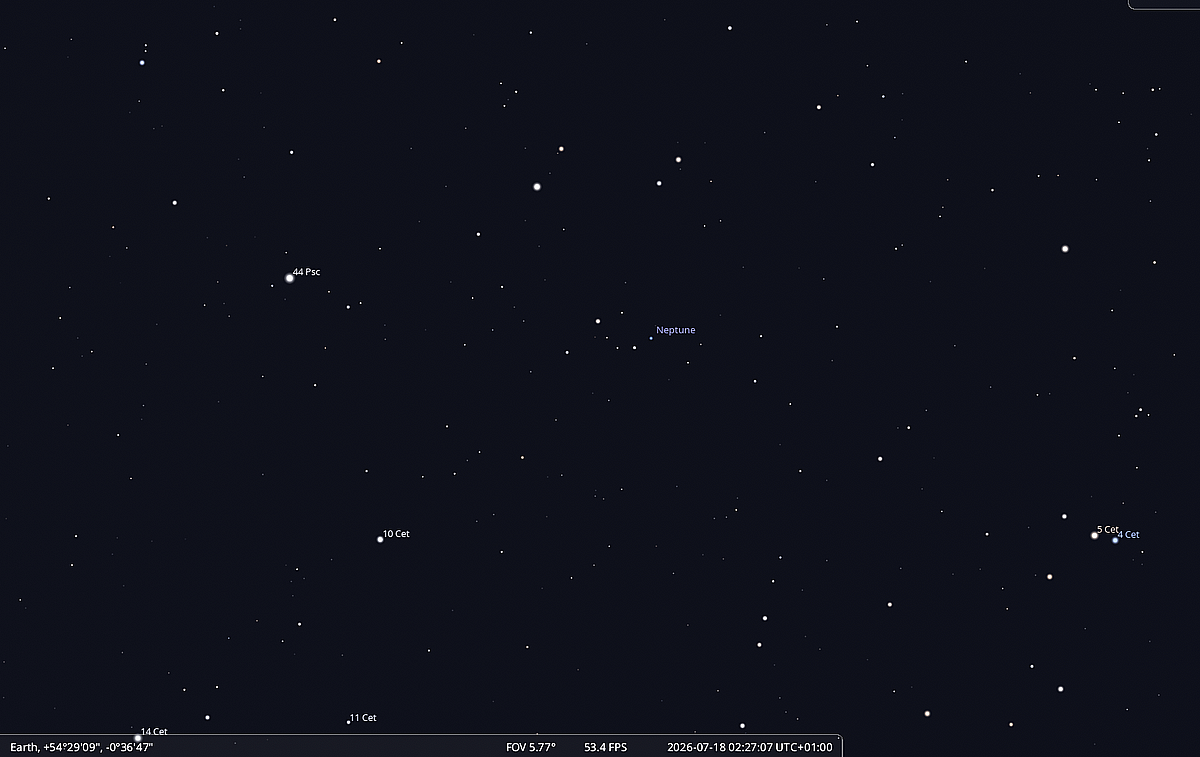
More detailed location chart of Neptune for mid-July. Early morning hours.
(Click for full image)
 At magnitude +5.7, Uranus would normally be a difficult object to spot with optical aid in the early morning twilight. The task becomes briefly easier on July 4th, when Mars passes very close to Uranus and the pair are separated by just 8 arc minutes! Observe around 03:15hrs, Uranus should be visible in binoculars or in a telescope at low magnification next to Mars.
Uranus next to Mars on July 4th at 03:15hrs. (Click for larger image)
By month’s end, it will be easier to locate through a telescope as it rises in slightly darker skies. An aperture of at least 80mm (3") is needed to show its tiny 3.7 arc-second grey-green disk, while instruments above 125mm (5") will define it more clearly.
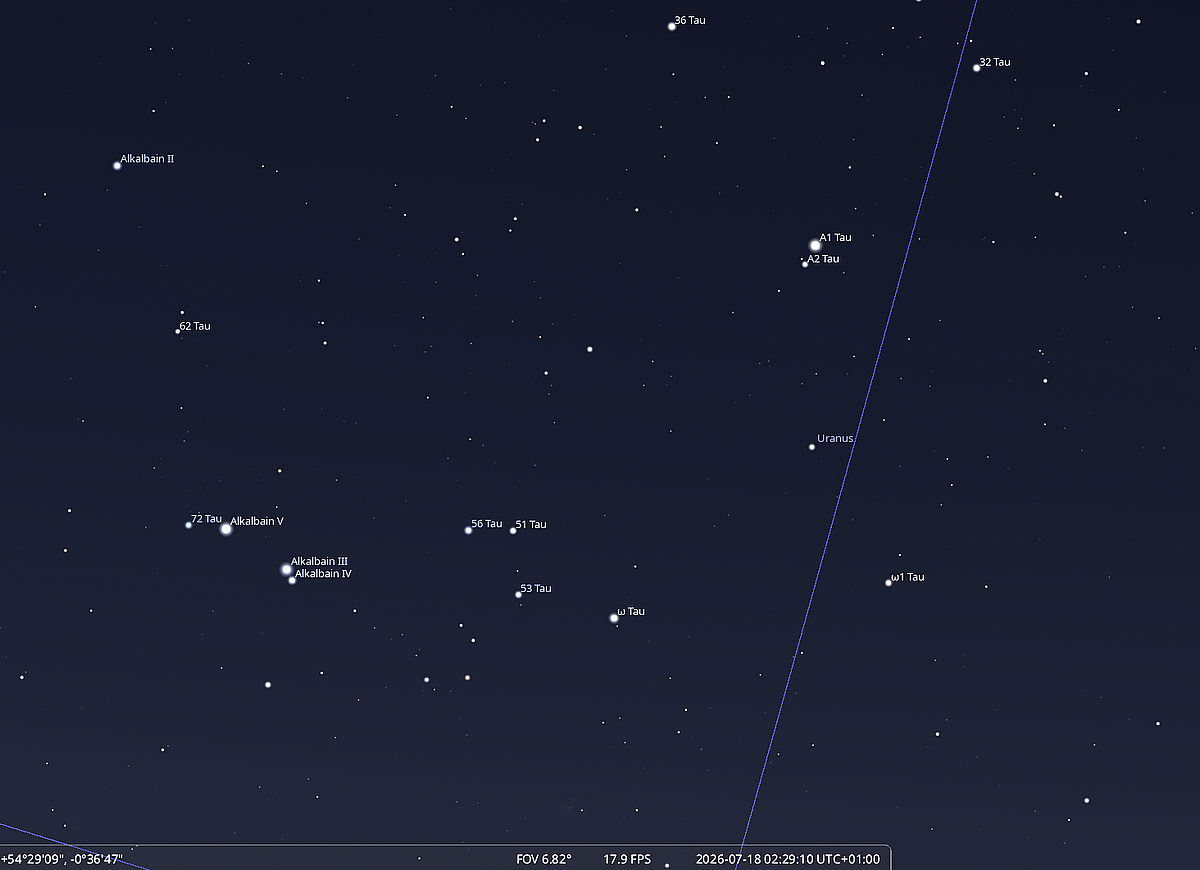
Location chart for Uranus, mid-July, 02:30hrs. (Click for full image)
July Meteors, Noctilucent Cloud & Conjunction Report, T Cor Bor.
Several minor meteor showers occur during July. The Capri-Cornids have three peaks on July 8, 15, and 26, with zenith hourly rates (ZHR) just above sporadic levels. View in the early morning hours around 02:45hrs. Only the 8th will be slightly affected by moonlight.
The Alpha Cygnids peak on July 21st, again with rates only slightly higher than sporadic levels. Cygnus will be positioned high in the SSE by midnight, although post-midnight hours will be the optimum period. Moonlight will not be an issue.
The Delta-Aquarids are somewhat more active, peaking on July 30th with a Zenith Hourly Rate in the low teens. Moonlight will interfere somewhat, the Moon residing in the vicinity of Aquarius during the early morning hours.
Noctilucent Cloud Watch
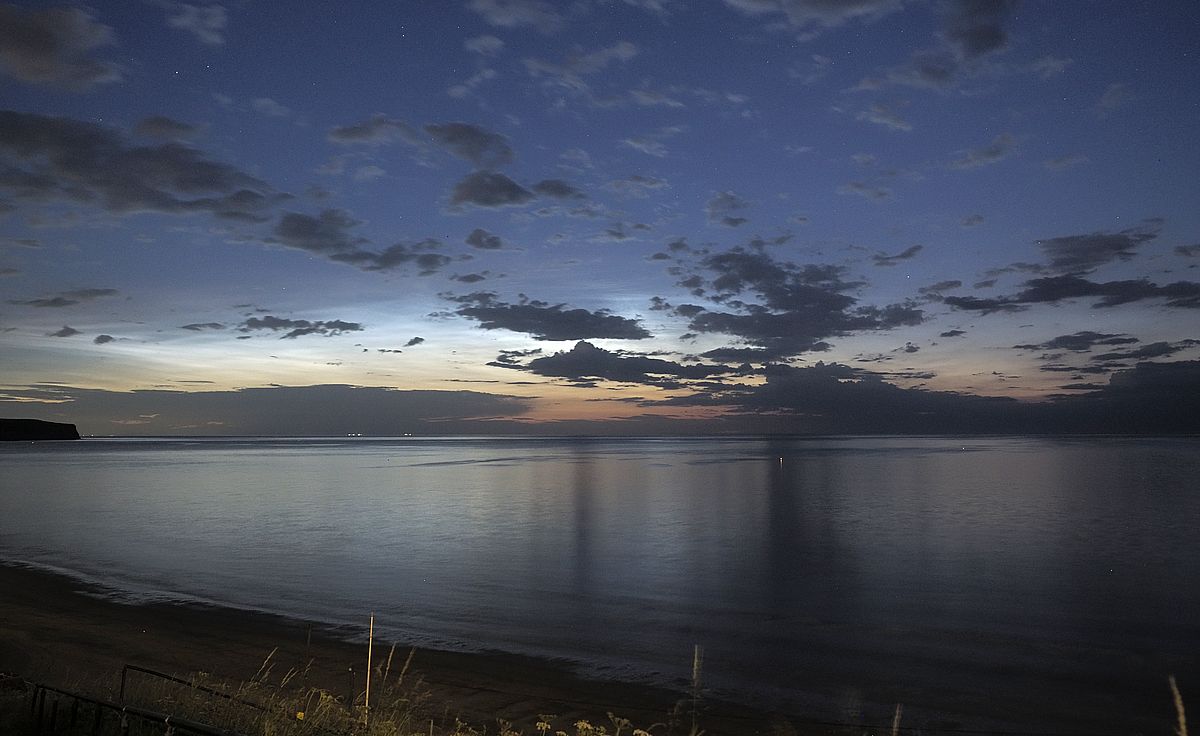
Underwhelming Noctilucent cloud display, June 28ht, @ 00:40hrs
Image, Mark Dawson - taken from West Cliff - Whitby. (Click image for full view)
Noctilucent cloud displays proved very elusive from our latitude in June, despite mostly settled weather and frequent clear skies. None were noted by WDAS members before the summer solstice, but activity increased slightly in the final week with several displays observed. These were mostly very low, although a more extensive display was observed in the early morning hours of June 29th.
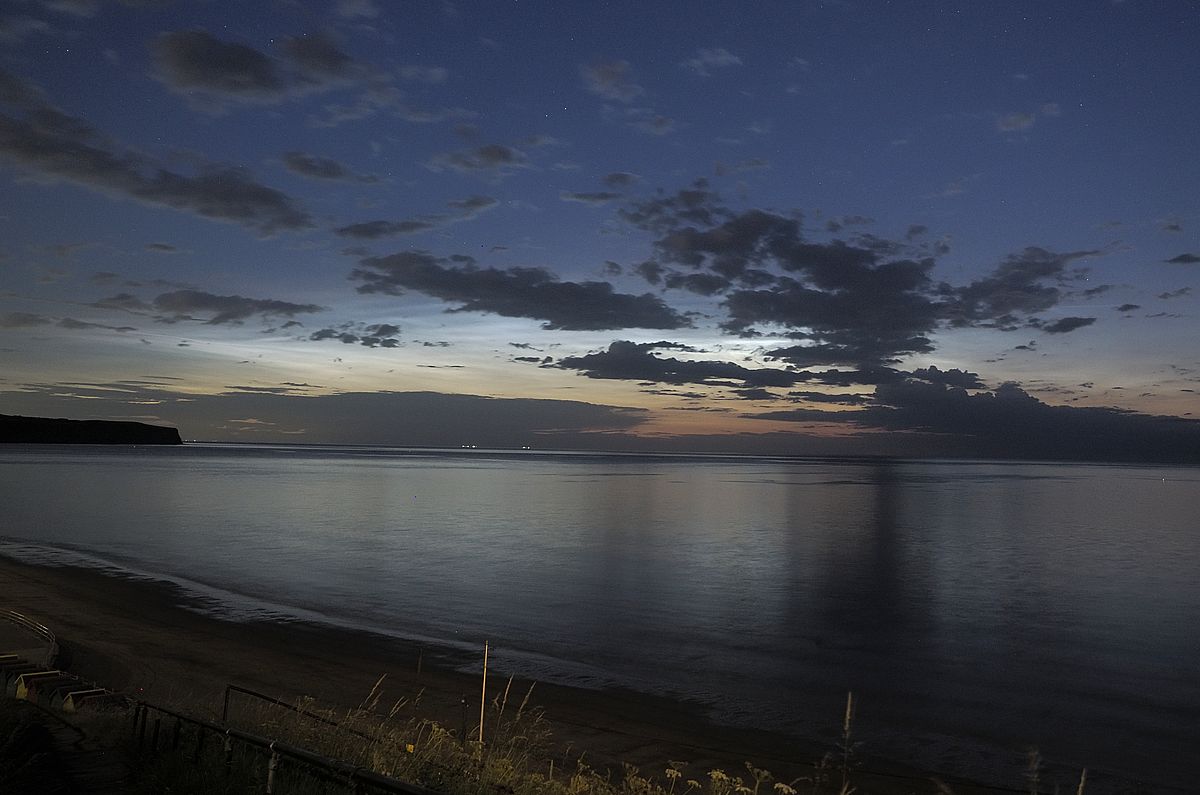
Noctilucent cloud display - midnight June 22/23 2025.
Image - Mark D 0M-1 with 12-40mm f2.6 - 8 sec exp
(Click image for complete view)
Noctilucent cloud formations are seen only above the northern horizon over the summer months - up to early August and appear long after sunset often around midnight and beyond. Noctilucent cloud is quite distinct, exhibiting a characteristic silvery-blue hue, filamentary in structure and shining quite brightly. These clouds form exclusively between latitudes 50 and 60 degrees north, at an altitude of over 50 miles, five times higher than normal clouds. The cloud forms when water vapour condenses at the low temperatures that prevail at such altitudes onto particles suspended in the air.
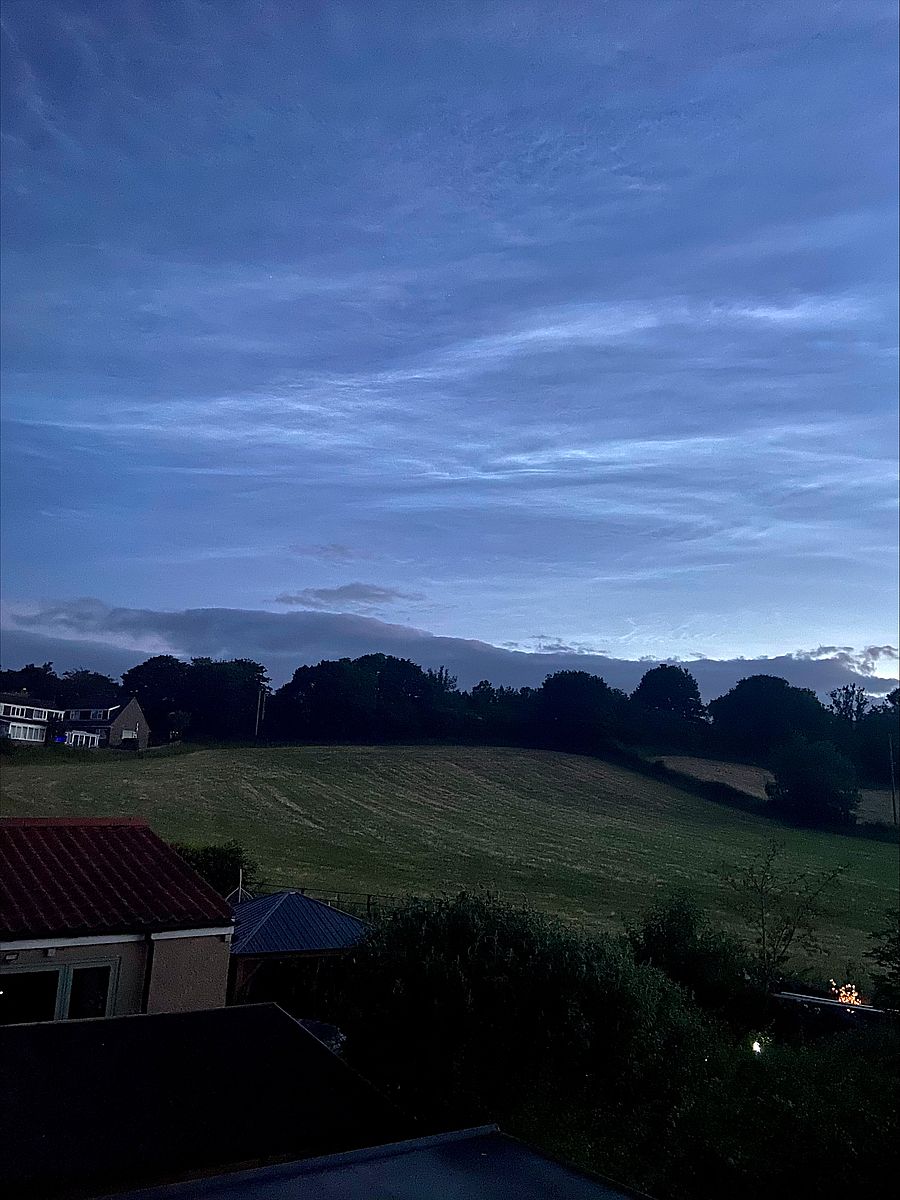
Noctilucent cloud display captured by Richard Randle, early morning hours June 29th.
(Click for full image)
Venus-Jupiter Conjunction Review
June’s lingering evening twilight provided the setting for a fine conjunction of the sky’s two brightest planets, Venus and Jupiter. Elusive Mercury was also present, though much harder to spot with the naked eye.
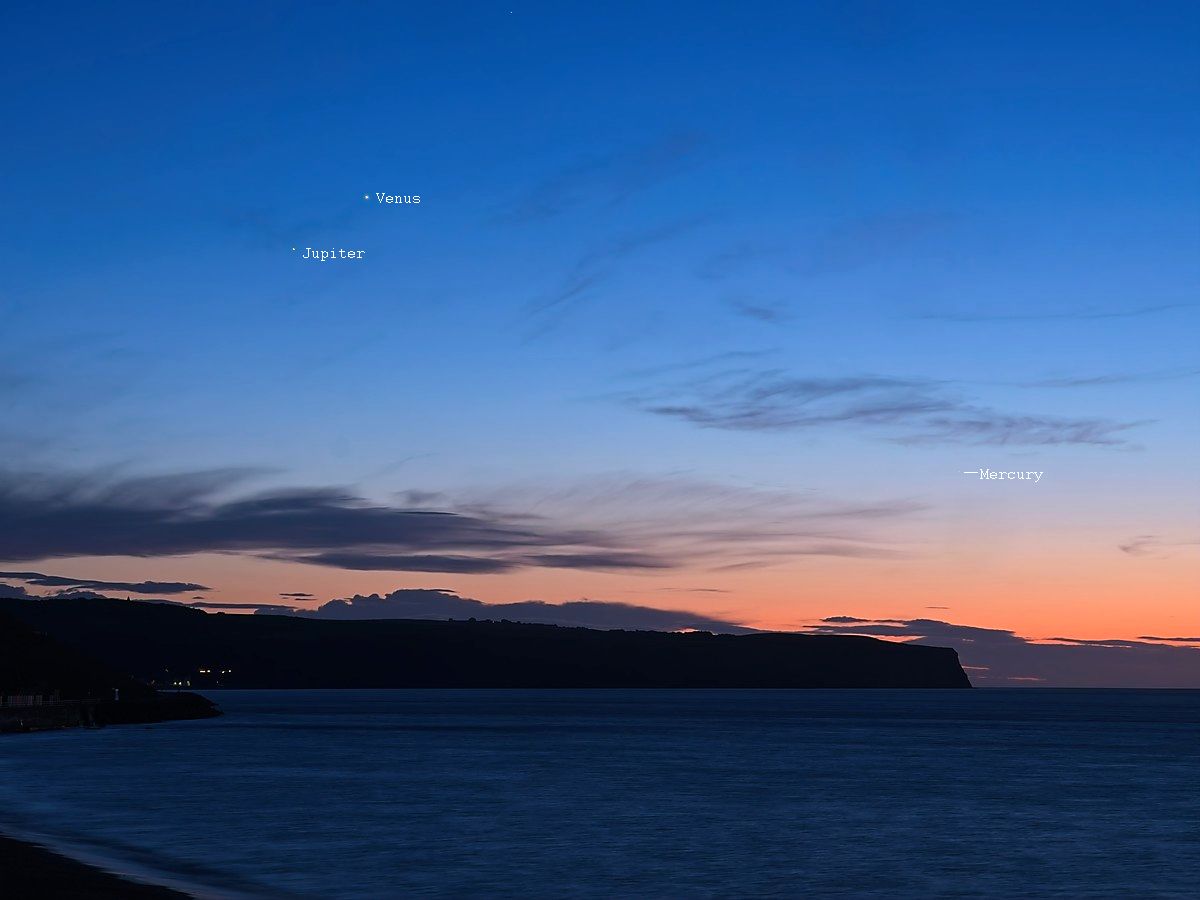
Venus and Jupiter with a difficult Mercury lower right.
Image - Mark D, Whitby beach, June 7th @ 23:25hrs. (Click for full image)
All the planetary action took place between June 6th and 10th, Venus climbing slightly higher into the western twilight sky, Jupiter dropping down toward the horizon allowing the pair to close together.
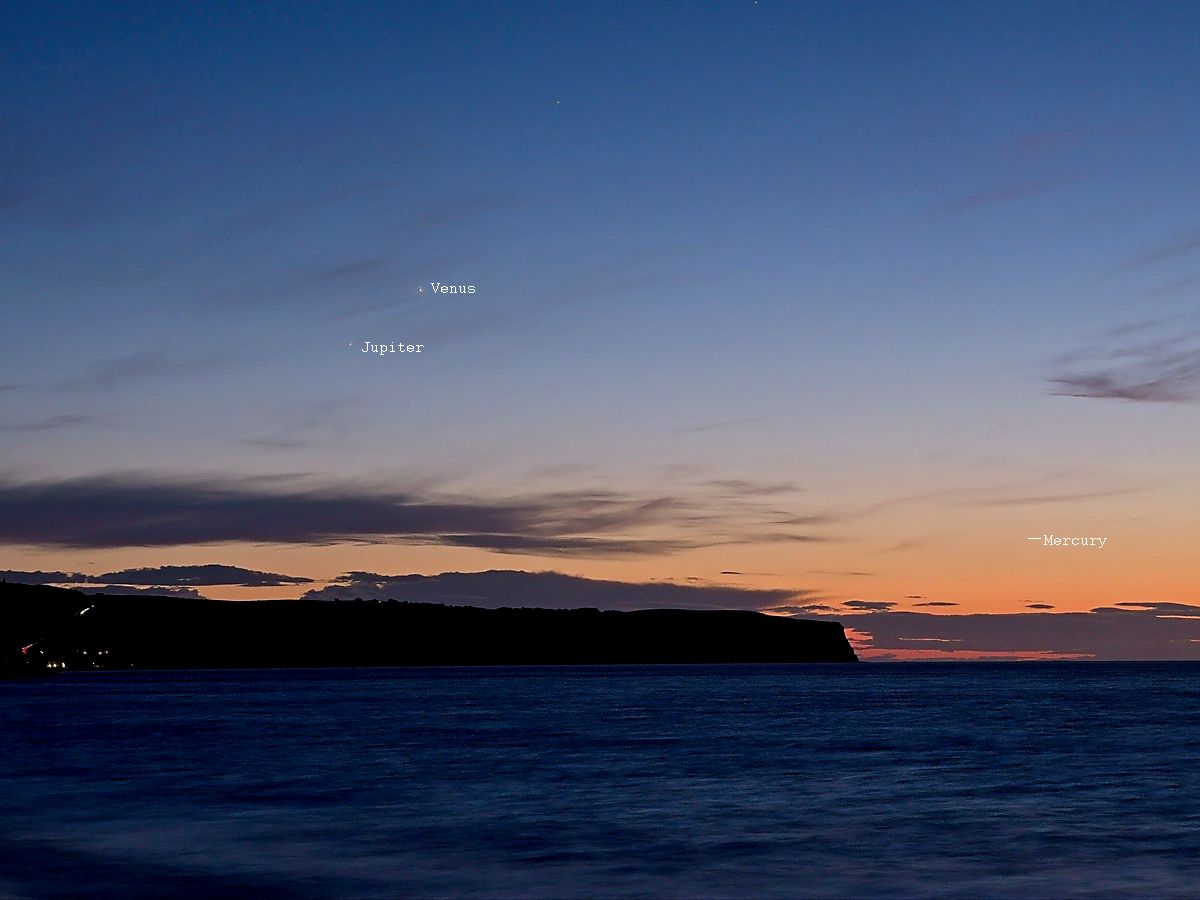
Same view 20 mins later. Mercury still just about visible. (Click for full image)
The separation appeared closest on June 9th, just 1.5 degrees. Much fainter Mercury sat 13 degrees to the lower right. Mark managed to capture a few images of the conjunction over several evenings but unfortunately not the 9th due to a cloud bank.
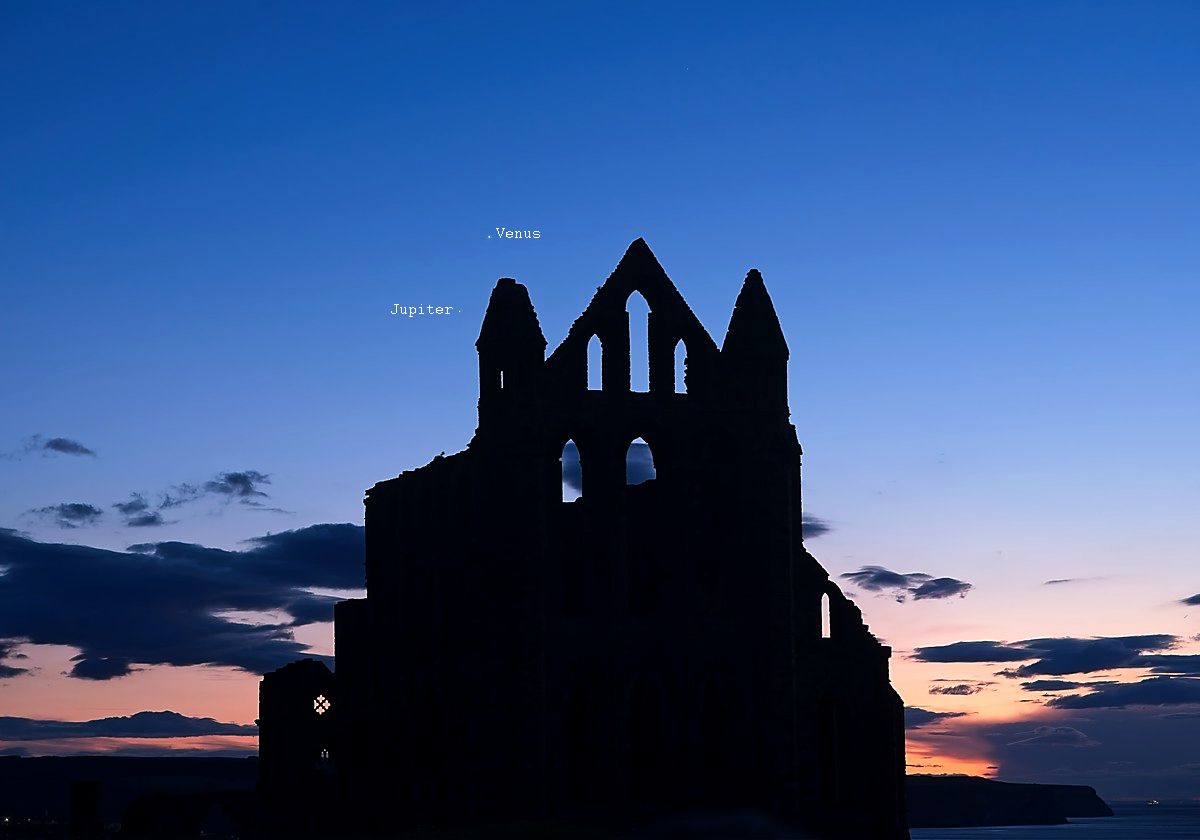
Venus and Jupiter over Whitby Abbey, June 8th @ 23:15hrs.
Image - Mark D. (Click for full image)
T Corona Borealis
The recurrent nova T Coronae Borealis continues to keep observers waiting, with astronomers across the northern hemisphere maintaining a close watch. Speculation had suggested a possible outburst around June 25th, coinciding with the next 228-day perihelion passage, but this proved to be another false alarm. Corona Borealis is currently well placed for UK observers, high in the southwest as twilight deepens, though skies will not be dark enough to spot T Cor Bor should it erupt before 23:30hrs. Keep checking regularly and watch for reliable updates in the media. See January Sky Notes.
July Night Sky
July nights are short and remain very light, leaving few opportunities for astronomical observing until darker skies gradually return toward the end of the month.
For those unfamiliar with the summer night sky, persistent twilight and the lack of easily recognised constellations before midnight can make celestial landmarks difficult to identify. In these conditions, the brightest stars are the most useful guides once you know where to look.
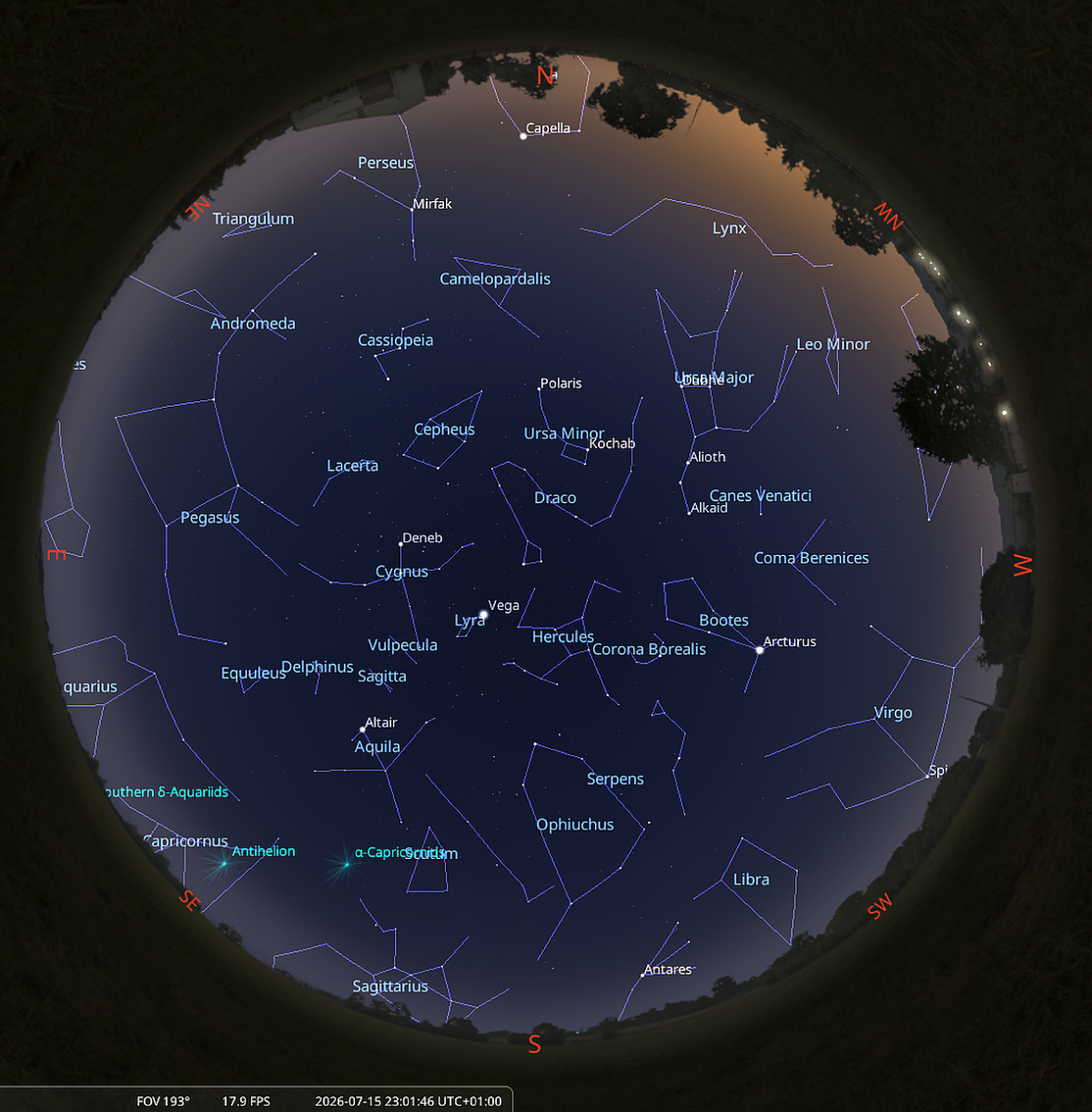
Mid-July night sky - around 23:30hrs BST. (Click for full sky image)
The first bright stars to emerge from the twilight are Arcturus, high in the west, and Vega, high in the north-east. Arcturus was probably once much like our Sun, but it has now entered an advanced stage of stellar evolution, burning helium in its core—a phase expected to continue for another 150–200 million years. It has expanded to more than 30 million miles (46 million kilometres) in diameter and, at 37 light-years away, is the nearest orange giant star to the Sun. Its distinctive orange colour makes it a striking sight through a telescope.
By contrast, Vega shines brilliantly high in the eastern sky with a steely blue-white glow often associated with youth. Yet appearances can mislead at about 500 million years old, Vega is already halfway through its life because it is at least twice as massive as the Sun. It will eventually swell into an orange giant before ending its life as a planetary nebula.
Vega is the brightest star in the Summer Triangle, an asterism formed with Altair and Deneb. Altair, in Aquila the Eagle, marks the triangle’s southern point and is the nearest of the bright summer stars visible from the UK, lying just 16 light-years away.
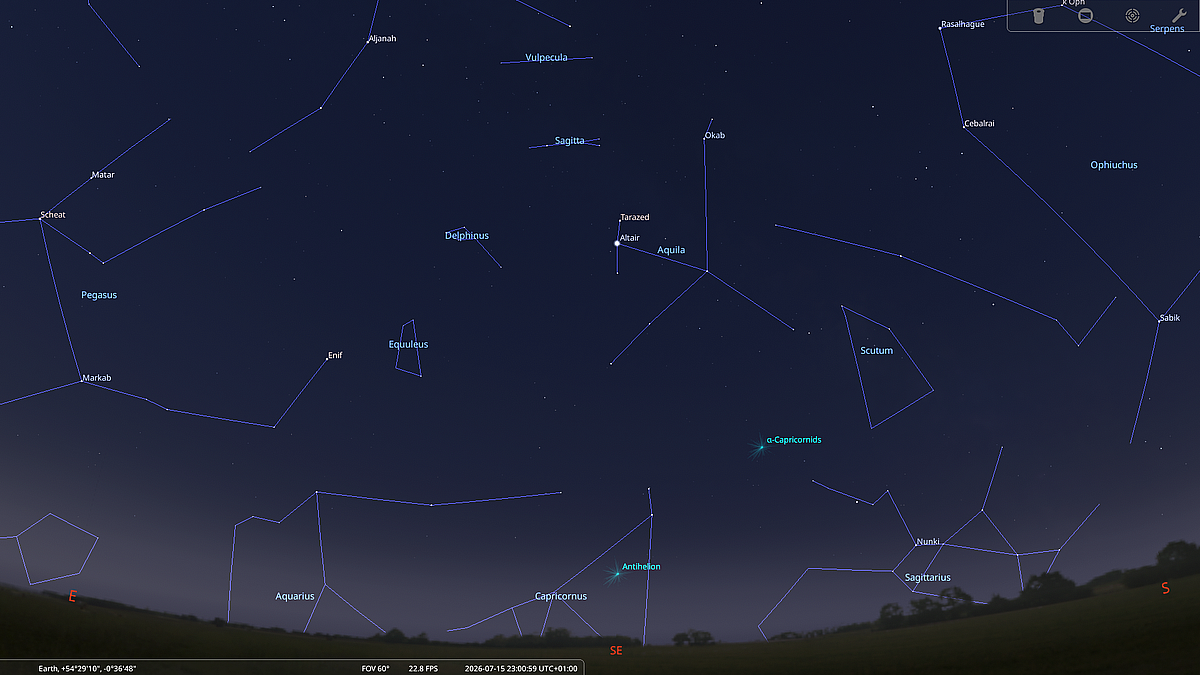 The view to the SE. (Click to enlarge)
Deneb, in Cygnus, is the most distant member of the Summer Triangle, lying about 1,500–1,800 light-years away. Although it appears less bright than Vega or Altair at magnitude +1.25, it is still among the 20 brightest stars in the night sky. With a diameter around 203 times that of the Sun, a luminosity more than 180,000 times solar, and at least 20 solar masses, Deneb is one of the largest known A-type stars. Its great mass means it will have a short stellar life, ending in a spectacular supernova in roughly 20–25 million years.
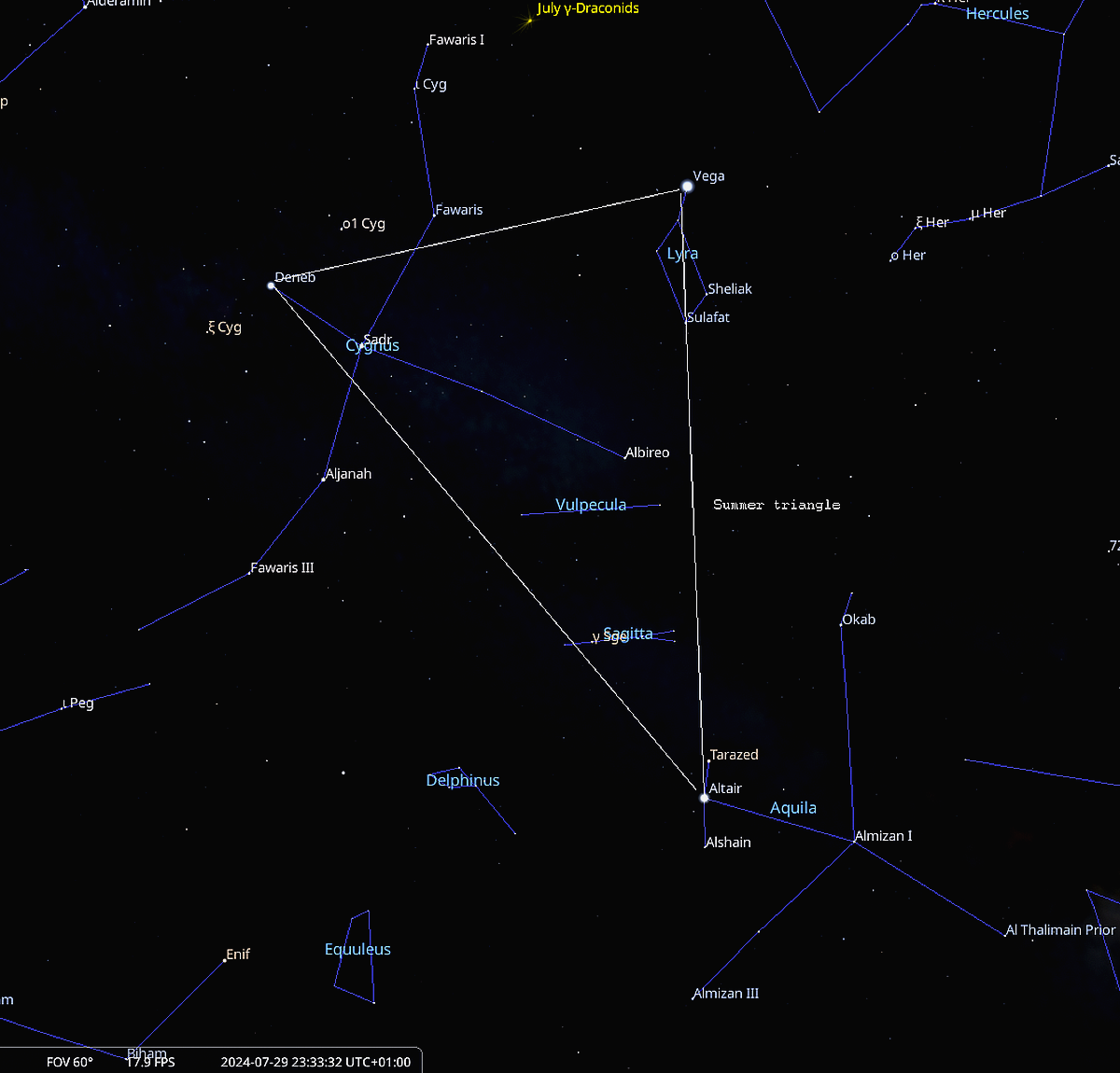
The 'summer triangle' - mid-month 23:30hrs. (Click to enlarge)
One of the few popular Chinese tales associated with the night sky absorbed into western culture involves Vega and Altair, the imperial weaver girl and the lowly goat herder. After falling in love, they neglected their duties and to prevent further interruption to their work the celestial emperor harshly separated them, placing them on opposite sides of the Milky Way. Thereafter, the couple were allowed only to meet one night each summer, the seventh night after the seventh full Moon, when magpies bridged the Milky Way with their wings.
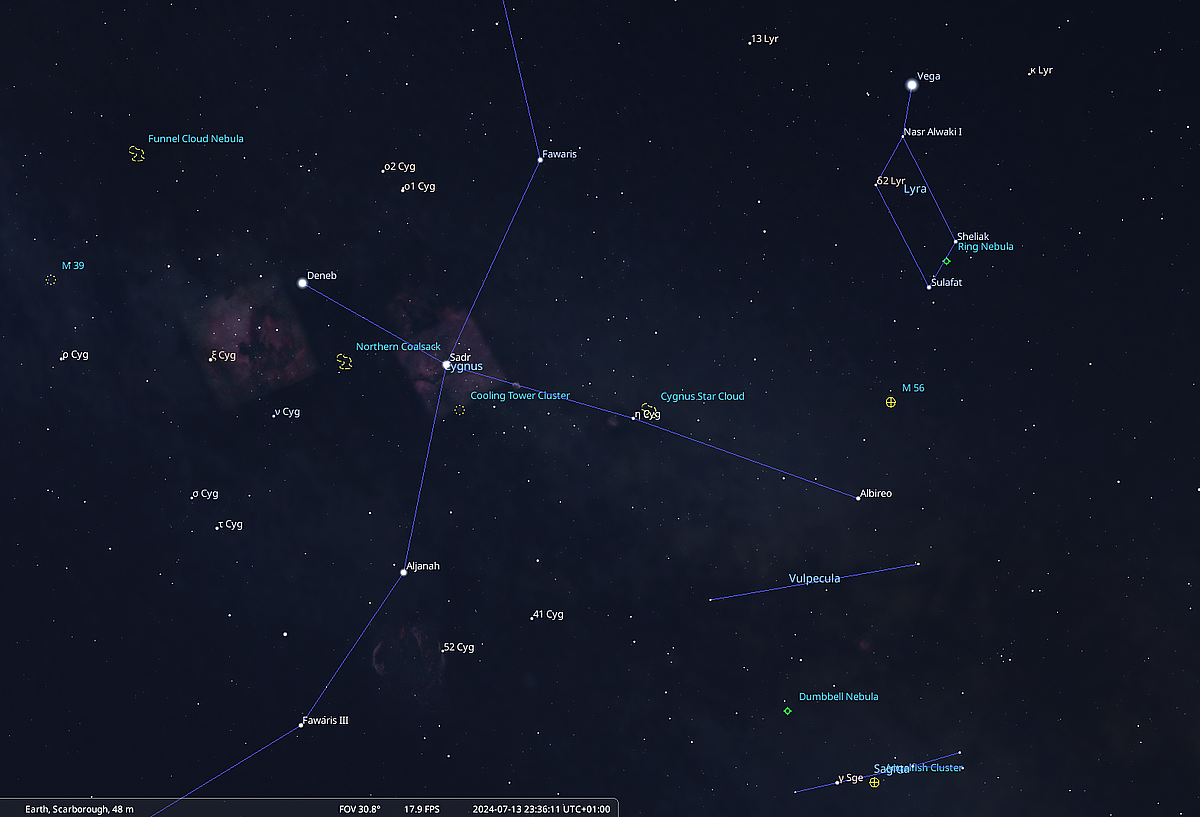
Lyra, Cygnus and Co. showing positions of Messier deep sky objects. (Click to enlarge)
Returning to Arcturus, look for the delicate arc of Corona Borealis, the Northern Crown, just upper left of Boötes. Its brightest star, Alphecca, also known as Gemma, sits near the middle of the circlet and is easy to pick out. Astronomers are still awaiting the eruption of the recurrent nova T Coronae Borealis, located slightly lower left of the circlet. This event occurs roughly every 80 years; the star is normally around 10th magnitude but can briefly brighten to 2nd magnitude during an outburst.
Despite many predictions over the past year, T Coronae Borealis has yet to erupt, but it could do so at any time. When it does, it should appear as bright as Alphecca, Corona Borealis’s magnitude +2.0 leading star.
To the left of Corona and high to the South, stands the great hero of mythology, Hercules, a large but ill-defined group. The central asterism of Hercules, known as the 'keystone', resembles the shape of the central stone of an arch. On the right-hand side confine of the Keystone resides the wonderful deep sky object M13 - the great globular star cluster, visible in binoculars as a blurred star, but revealed through modest scopes as a glowing gossamer ball containing upwards of half a million stars 26,000 light years distant.

The overhead, or 'Zenith' position in July night sky. (Click to enlarge)
Above Hercules, Draco’s head lies almost overhead, while the dragon’s body winds between the two celestial bears. Alpha Draconis, or Thuban, lies roughly midway between Mizar in the Plough’s handle and Pherkad Major and Kochab in Ursa Minor. Although only the eighth-brightest star in Draco, it is labelled “alpha” because of its historical importance: around 5,000 years ago, Thuban was the star closest to the north celestial pole. Earth’s axial precession has since shifted that point to its present position near Polaris. From mid-UK latitudes, Polaris lies due north, a little more than halfway up the sky, though its height varies with the observer’s latitude.
To find Polaris, follow the “pointer stars” Dubhe and Merak in the bowl of the familiar Plough, or “saucepan,” in Ursa Major, the Great Bear, which emerges through the twilight around 23:15hrs. At this time of year, beginners sometimes mistake the bright star low on the northern horizon for the North Star, but this is Capella in Auriga, the Charioteer, a star more commonly associated with winter. From the UK, Capella is the third-brightest star visible during the summer months, after Arcturus and Vega.
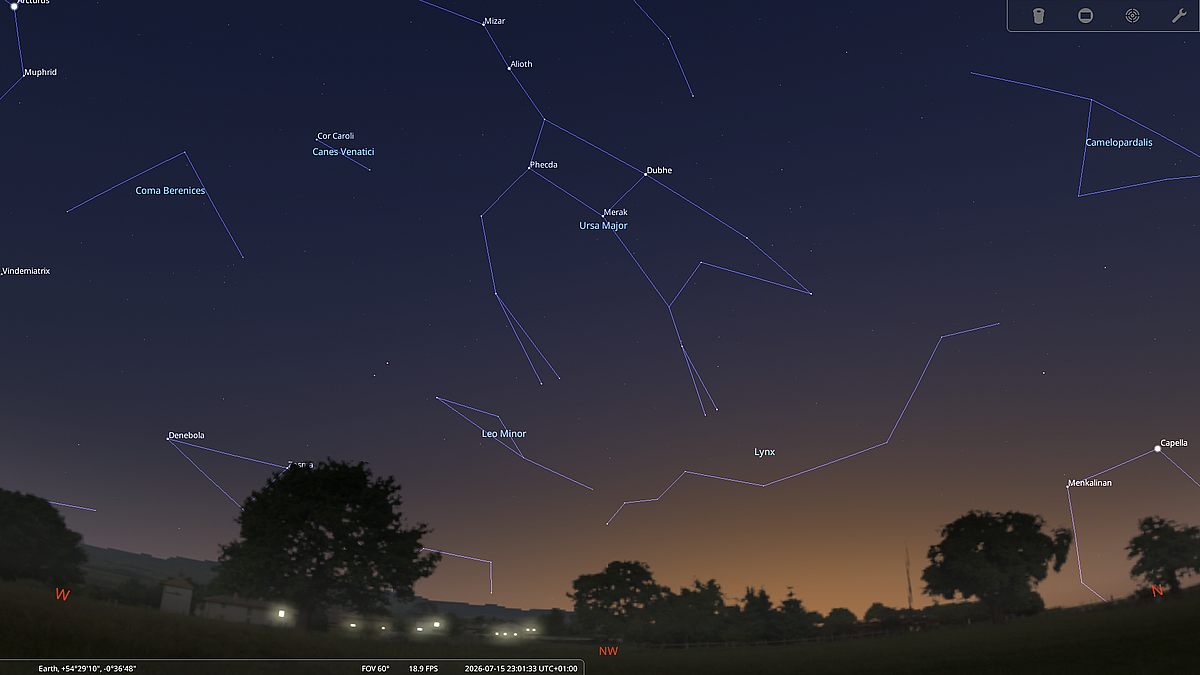
The view to the northwest. (Click to enlarge)
A short distance east of Polaris, about halfway up from the NNE horizon, lies the faint “crooked house” outline of Cepheus the King. Nearby, the more distinct constellation of Cassiopeia the Queen is easily recognised by its familiar “W” shape. When darker skies return in August, Cassiopeia is worth exploring with optical aid, as it contains numerous star fields and clusters. Below Cassiopeia, Perseus rises from the NNE horizon, its pattern resembling a distorted pi symbol. Andromeda and Pegasus also accompany Perseus into the north-eastern sky.
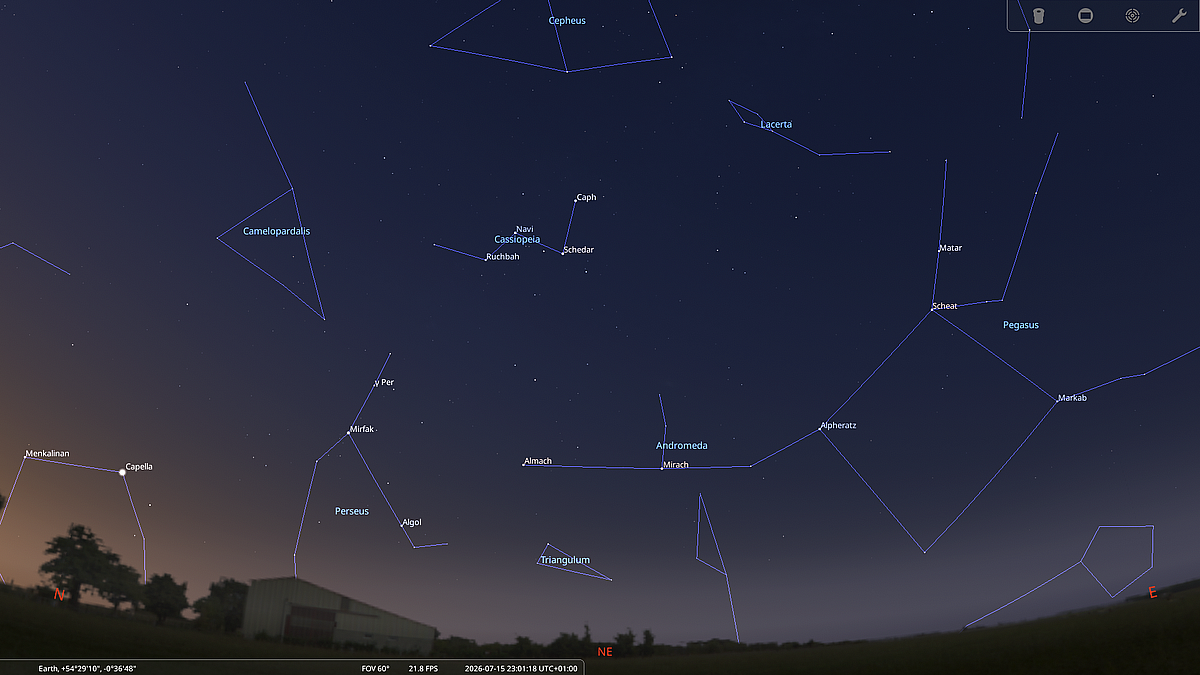
The view to the Northeast, where autumn is already gathering. (Click to enlarge)
Although it is still midsummer, the autumn constellations are already rising in the east and will eventually dominate the night sky. Meanwhile, in the west, the last signs of the spring sky are only just fading, with Spica, Virgo’s brightest star, setting in the WSW shortly after 23:00hrs BST.
Much of the south-western sky is occupied by the large constellations Hercules, Ophiuchus, and Boötes, already discussed above. Just above the SSW horizon, however, lies Antares, the bright first-magnitude, M-class star at the heart of Scorpius and one of the most orange stars visible from the UK. From our latitude, only part of Scorpius rises, with its tail and “sting” remaining below the horizon. The constellation and Antares are visible from the UK for only about eight weeks, and even then, for no more than four hours each night, so casual observers can easily miss them.
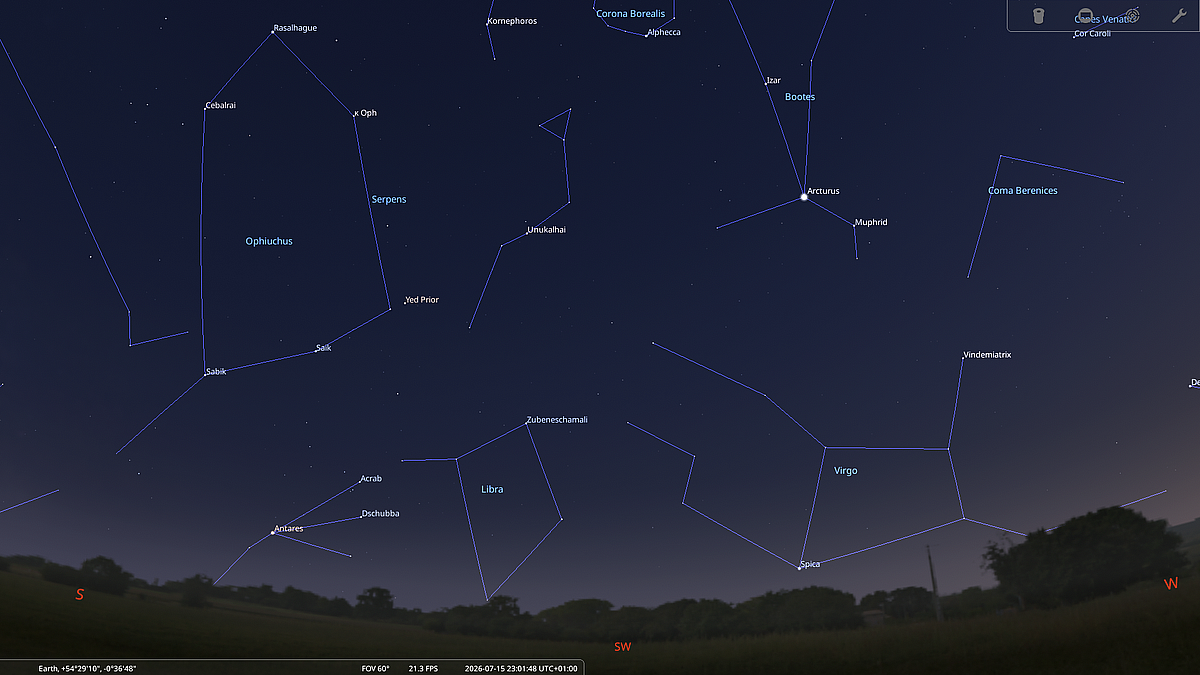
The SW aspect - mid-July 23:30hrs. (Click for full image)
Following Scorpius along the southern horizon is Sagittarius, the Archer, another zodiac constellation whose southern reaches never rise above the UK horizon. It contains 17 named stars, seven brighter than magnitude 3.0, though none are first magnitude. Sagittarius is best recognised by the “Teapot” asterism, which sits almost on the horizon and resembles a tilted teapot ready to pour. Many of its deep sky objects are seen from the UK under poor low-altitude conditions, but the constellation is still well worth exploring when the sky is clear and ‘seeing’ good. Use binoculars or a low-power telescope to enjoy its rich star clouds and numerous nebulae.
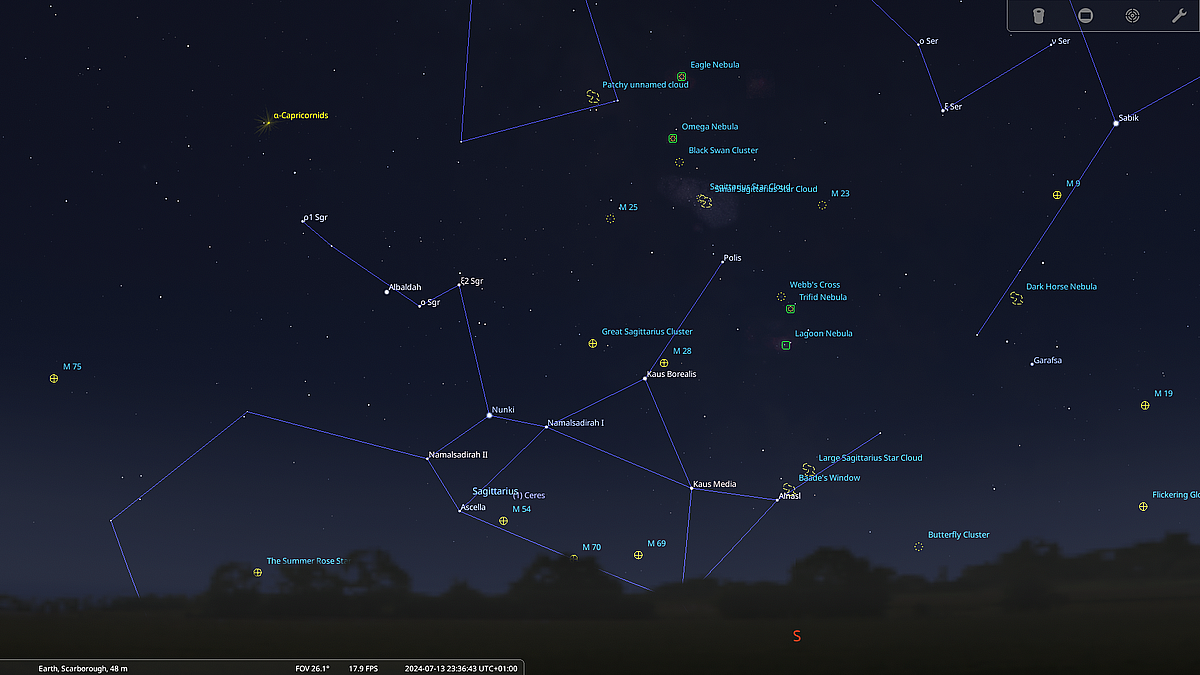
Sagittarius and some of the DSOs visible to observers. (Click to enlarge)
Sagittarius contains a wealth of Messier objects—15 in all. M18, M21, M23, and M25 are open star clusters, while M22, M28, M54, M55, M69, M70, and M75 are globular clusters. M8, M17, and M20 are nebulae, and M24 is a star cloud. The constellation also includes the Large Sagittarius Star Cloud, the brightest visible region of the Milky Way. In this direction, amid the Milky Way’s rich star clouds and near the border with Scorpius, lies the centre of our galaxy, about 27,000 light-years away!
July 2026 Sky Charts.
 |
 |
|
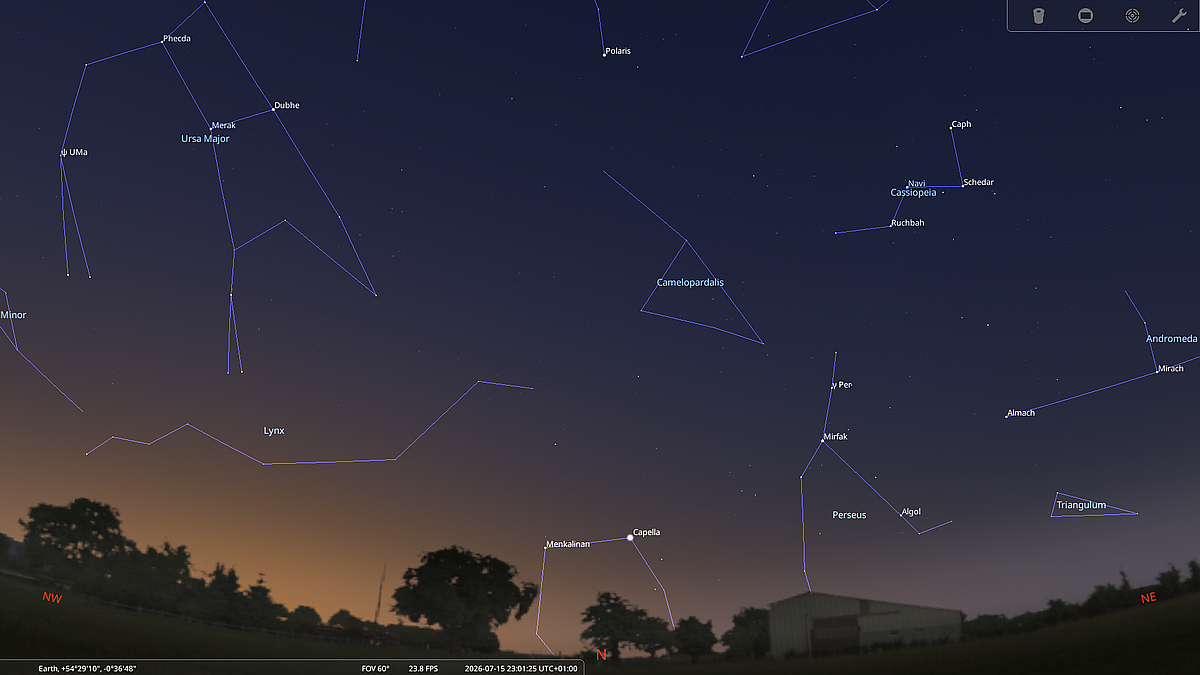
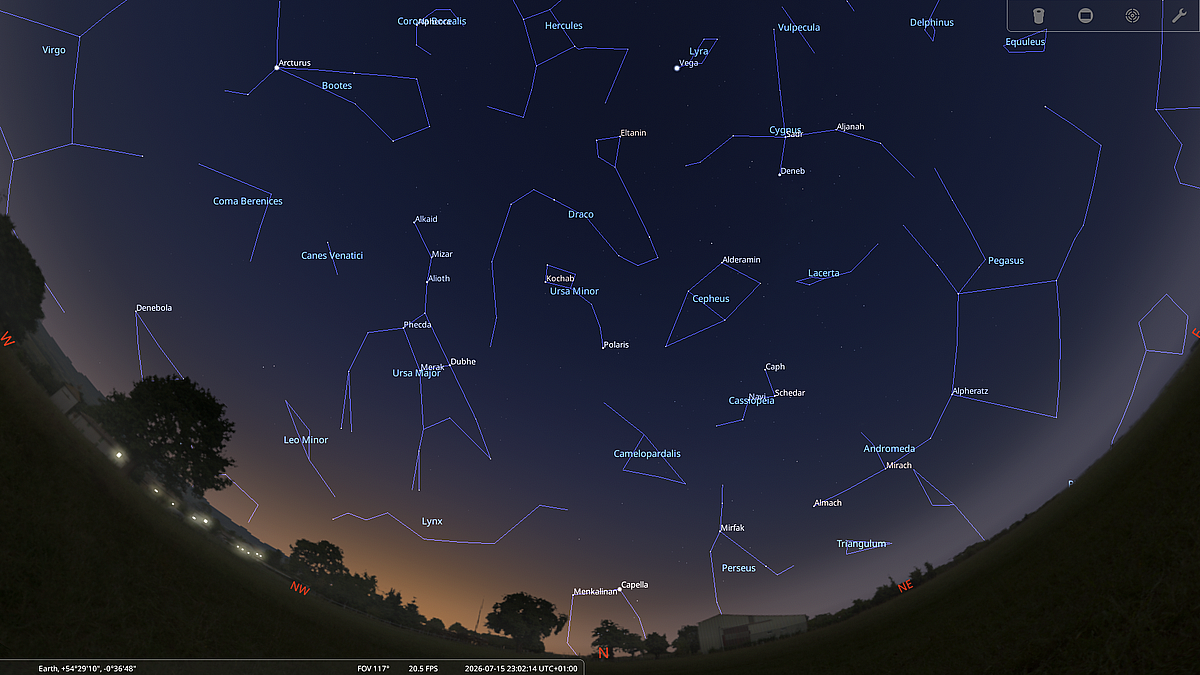
Looking North
July 15th - 23:00hrs BST |
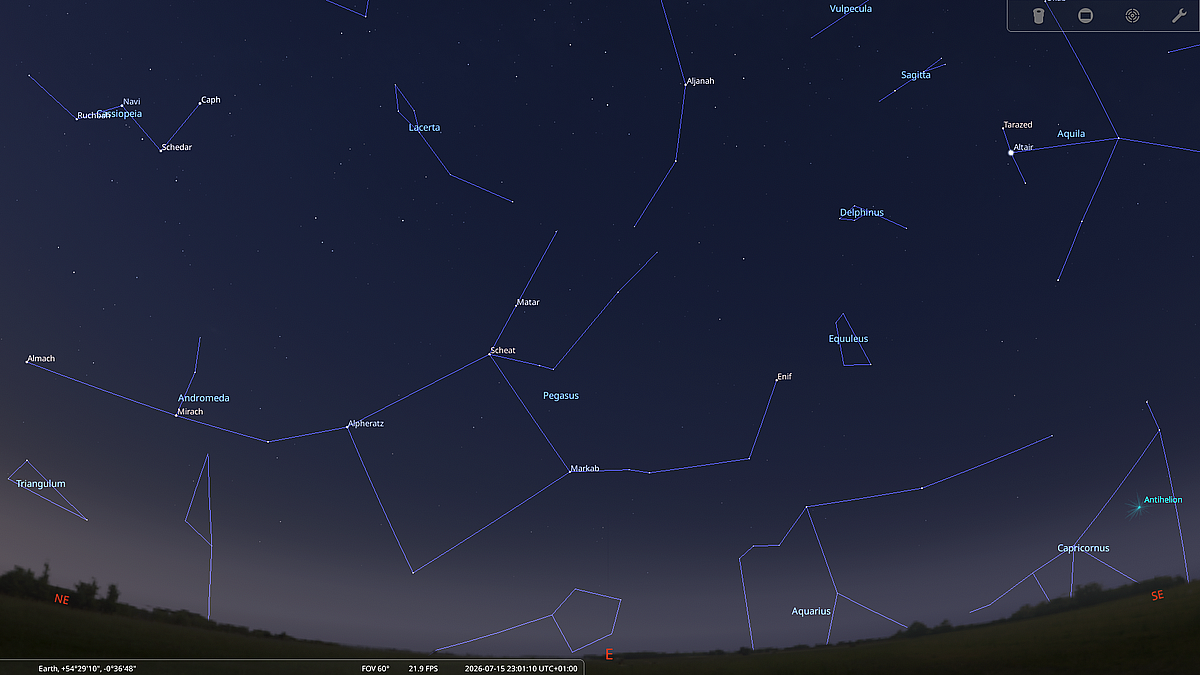
Looking East |
 |
 |
|
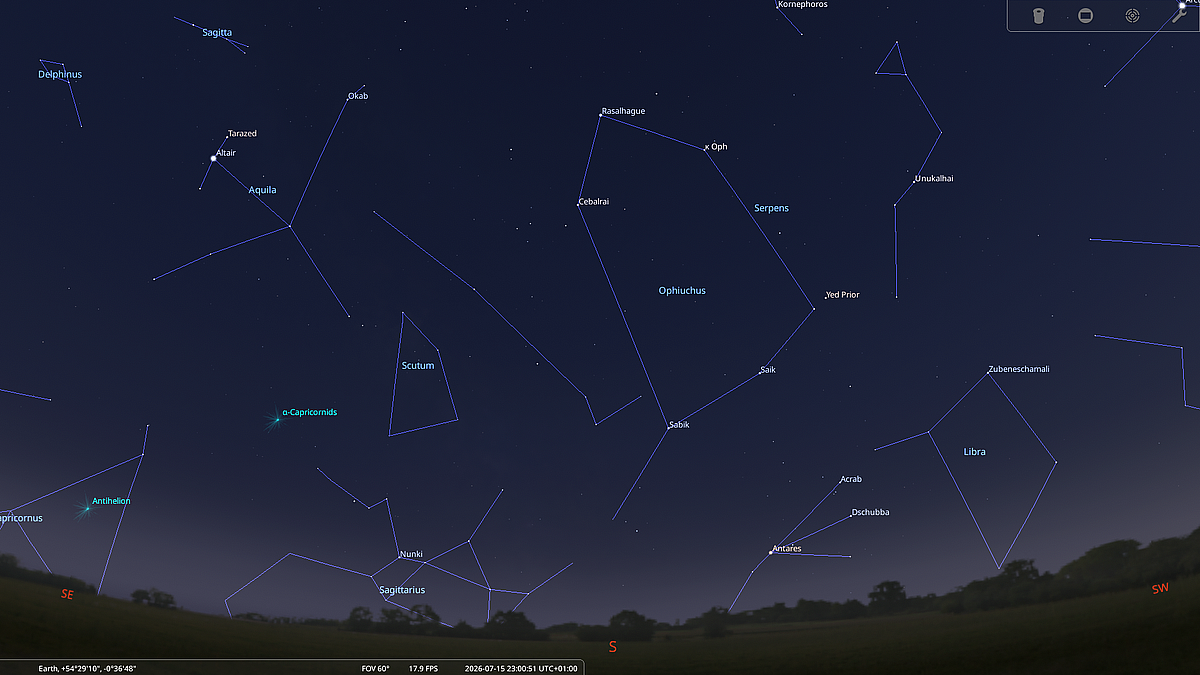
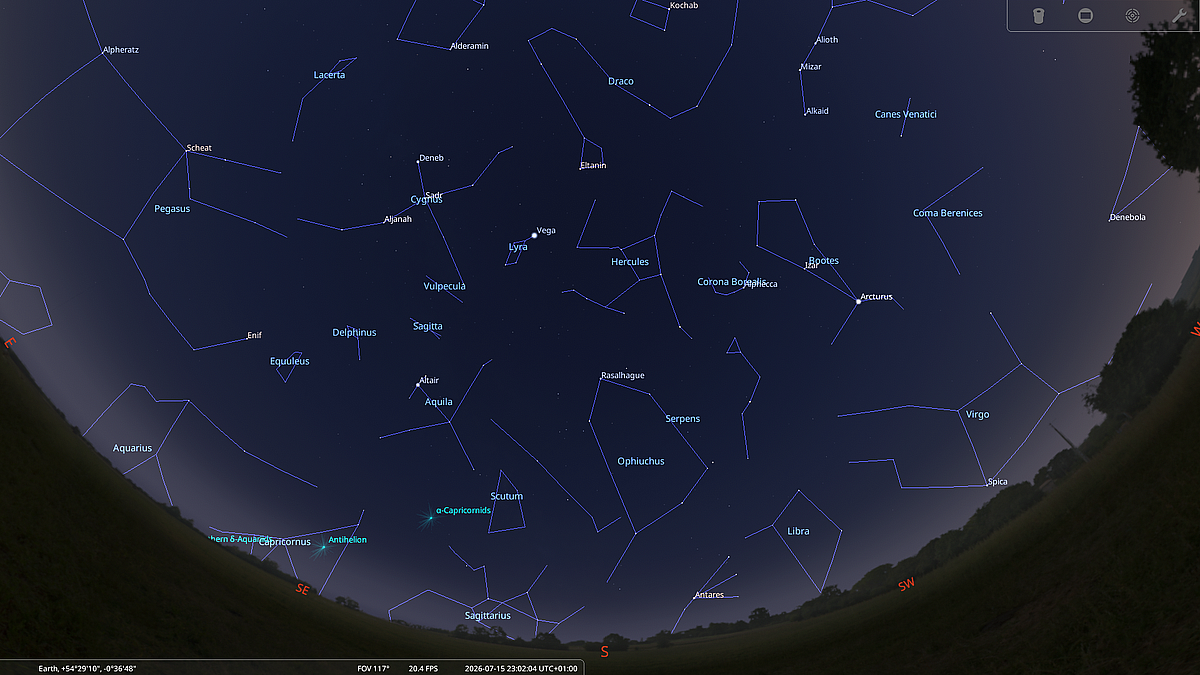
Looking South
July 15th - 23:00hrs BST |
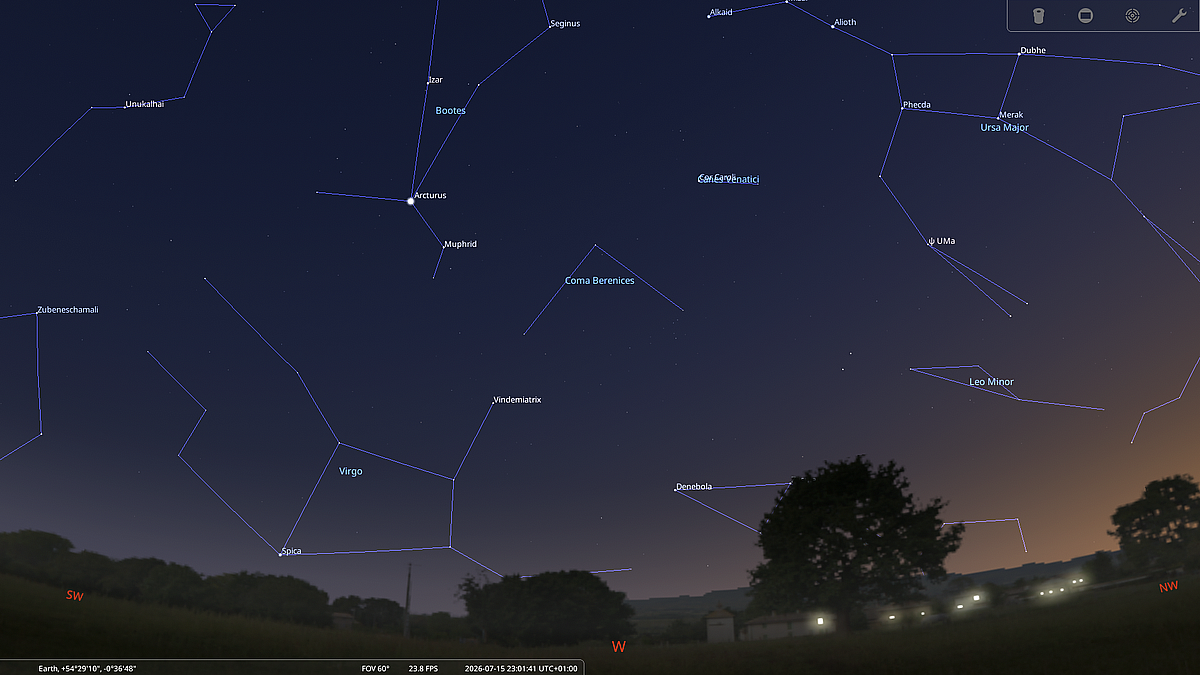
Looking West
July 15th - 23:00hrs BST |
 |
 |
|
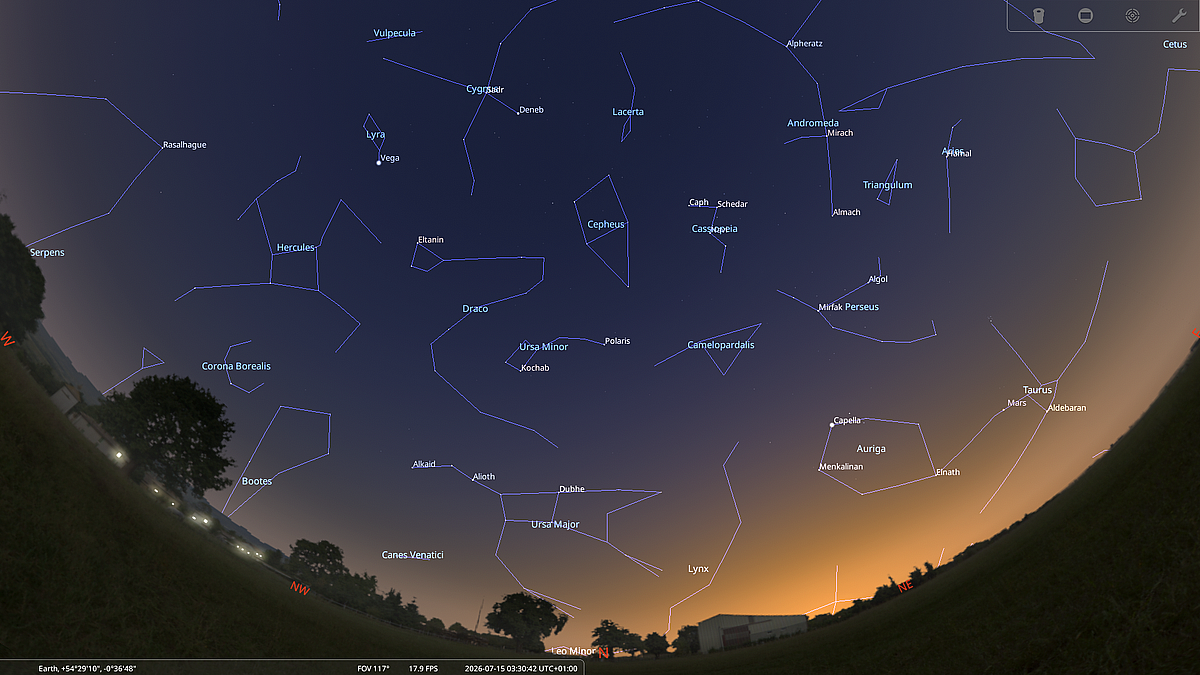
Northern Aspect
July 15th - 23:00hrs BST |
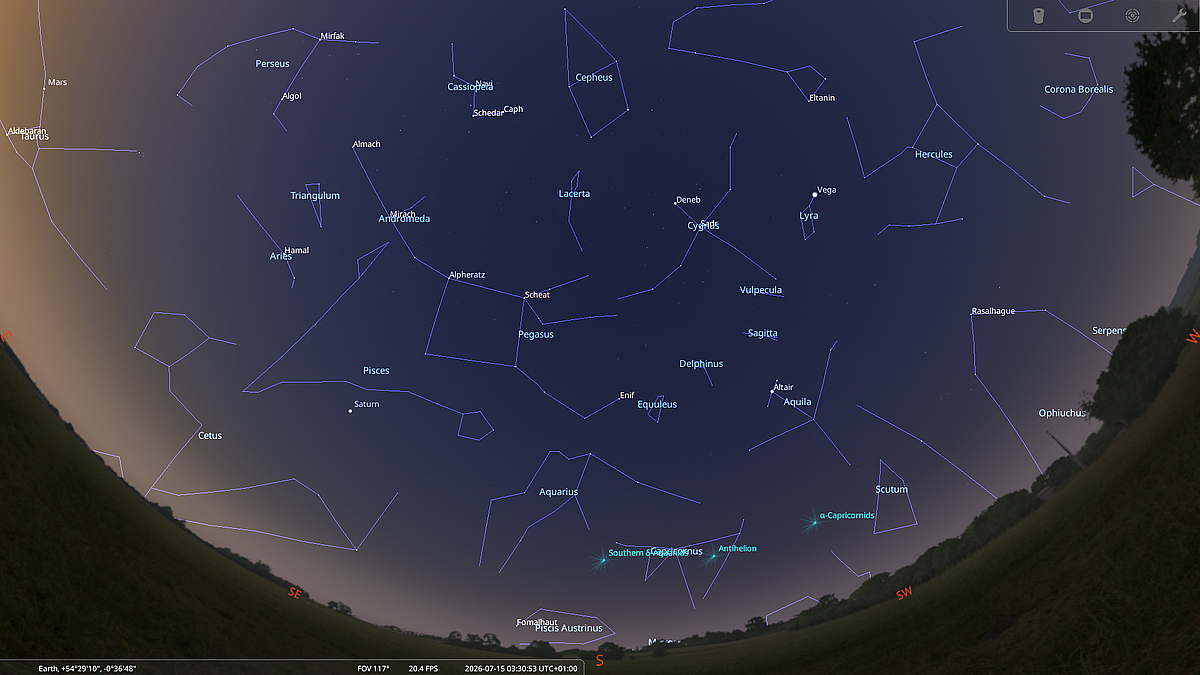
Southern Aspect
July 15th - 23:00hrs BST |
 |
 |
| Northern Aspect (dawn) July 15th - 03:30hrs BST |
Southern Aspect (dawn) July 15th - 03:30hrs BST |
Additional Image Credits:
- Planets and Comets where not otherwise mentioned: NASA
- Sky Charts: Stellarium Software and Starry Night Pro Plus 8
- Log in to post comments
